

If gold is an inflation hedge, why has the yellow metal been struggling as inflation expectations rise due to the Iran conflict?
I’m asked this question a lot, and it’s a reasonable query.
The simple answer is that there are multiple factors driving the gold market at any given time. So, while gold does ultimately shield you from currency depreciation, it’s not a one-to-one correlation. You often need to step back and look at a longer timeline to see your inflation fire insurance in action.
As Money Metals Exchange CEO Stefan Gleason pointed out, “It is certainly true that gold has historically performed well during inflationary eras. However, there have also been periods when inflation rose sharply, and gold prices moved sideways. Sometimes, gold prices have even declined.”
While inflation drives gold prices higher (more money circulating in the economy drives up all prices – including gold), other factors play a role. Interest rates, Federal Reserve policy, real yields, and U.S. dollar strength can all significantly affect gold prices.
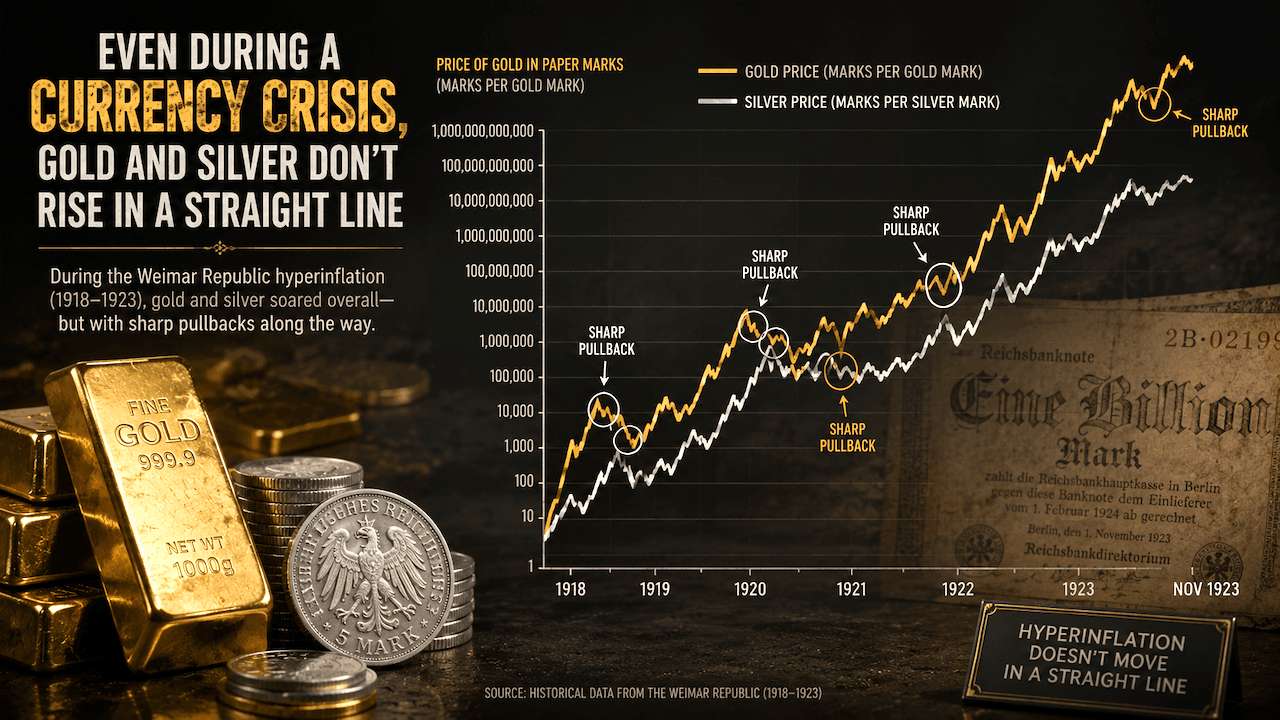
As a result, gold and silver tend to move up in fits and starts, even when inflation is elevated. We’ve seen this kind of volatility during the Iran conflict. Gold and silver have been charting big headline-driven swings, both up and down, seemingly daily.
This phenomenon even plays out in the midst of a full-blown currency crisis. In fact, the price of gold can become extremely volatile as an inflationary event unfolds.
We can also see this phenomenon clearly if we chart the price of gold in Reichsmarks during the hyperinflationary era of the German Weimar Republic.
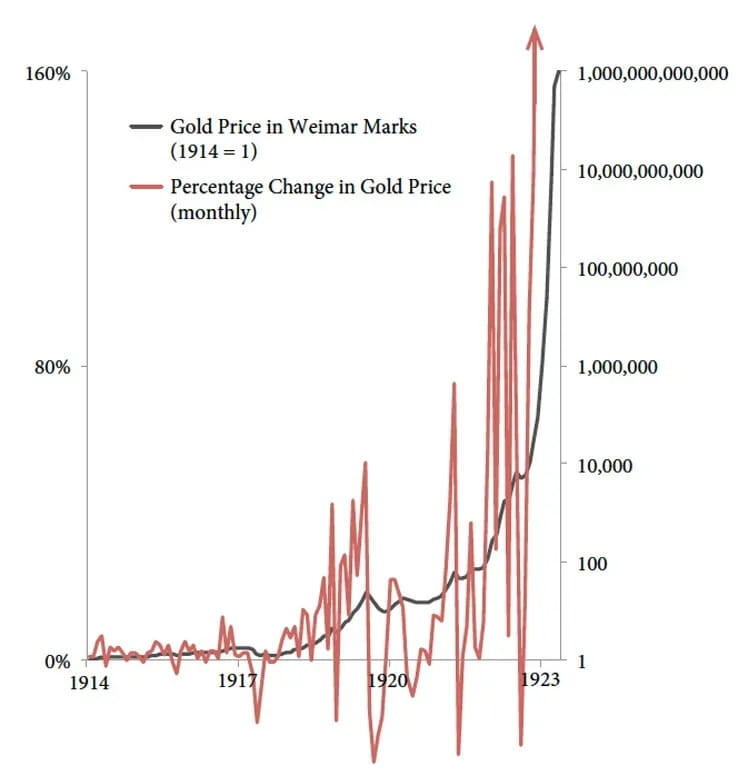
As you can see, the price moved up in fits and starts. This becomes even more apparent when you chart the percentage change in the price.
Economist Mark Thornton insisted this kind of volatility is normal.
“Even after it became known that the government was going to be entirely dependent on printing money for its budget and its financing of government debt, the price of gold, as measured in German Reichsmarks, was highly volatile. So, if you look at the relative change on a short-term basis, you see very wide swings. And I think most seasoned and informed investors in the precious metals market realize that it’s not a straight line up. There is a lot of volatility, and these are structured long-term savings actions on the part of stackers.”
The key is looking past the short-term volatility and understanding the broader trend. Daily price swings can muddy the water. This is why it’s imperative to understand the mechanism behind inflation and currency devaluation.
Simply put, inflation drives up the gold price over time. However, that upward trajectory can be confused or even obscured by daily, weekly, and even monthly corrections and price movements.
You will also note that the hyperinflation in Germany started slowly and then seemed to happen all at once. This is the anatomy of a currency crisis. An analyst for the Scottsdale Mint argues that currencies have a tipping point. They work well until people stop believing in them. And they tend to stop believing all at once.
“Currency crises rarely unfold linearly. Markets initially price policy mistakes. Eventually, they begin pricing the reaction function of policymakers themselves. When investors begin anticipating how central banks will respond to instability rather than focusing on the instability itself, volatility increases dramatically. Gold often becomes the transmission mechanism for that shift.”
So, you might want to think twice before you unload your gold just because prices seem to be trading sideways, or even tanking. If inflation is in the picture (and it always is), you need to have gold and silver – money the government can’t print and devalue.
Comments
Log in or sign up to join the conversation.