


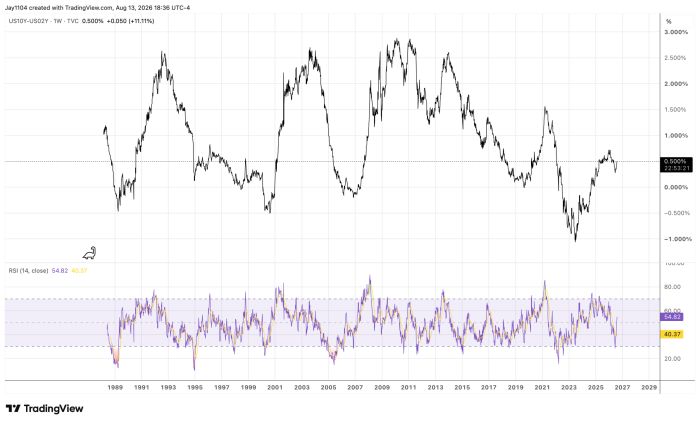
Despite an in-line CPI reading and a slightly weaker PPI reading, 10-year rates are flat for the week, while 30-year rates are actually up 2 bps. I don’t think many would have expected that, given all the worries around inflation we read about. To me, the recent rise in rates is about more than just inflation. It is perhaps about the normalization of the yield curve, given that it seems pretty clear at this point that the rate-cutting cycle is over.
If that is the case, then it would seem that 10- and 30-year rates are too low relative to the 2-year Treasury and should be much higher. A spread of just 50 bps doesn’t seem wide enough at this point, especially when you look at that spread on a historical basis. It tells us one of two things: 2-year rates should be much lower, or 10-year rates should be much higher. One issue is that the yield curve never steepened enough during the 2022 and 2023 rate-hiking cycle because markets were convinced the Fed would break the economy and trigger a recession. That never happened. The spread being this low at this point seems silly.
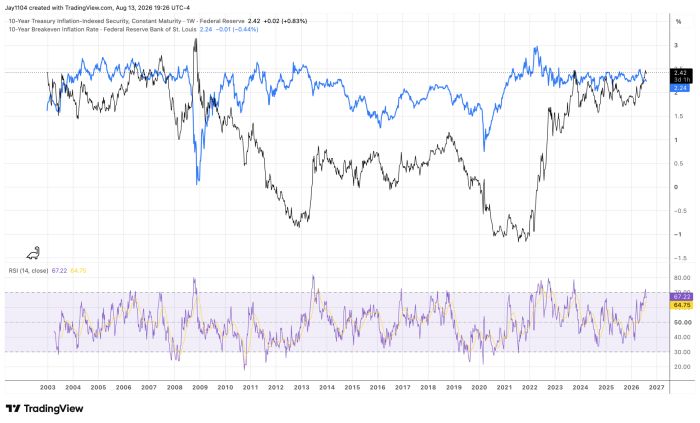
The more interesting development is that the 10-year real yield is now higher than the 10-year breakeven inflation rate. In effect, higher real rates are doing some of the heavy lifting for the Fed by tightening financial conditions and putting downward pressure on inflation. The question is how high real yields ultimately need to rise, and how long they need to remain elevated, to sufficiently suppress inflation in the real economy.
Judging by the strength in gold and most risk assets, it would seem that real rates are still not restrictive enough. If that is the case, and breakeven inflation remains relatively stable, any further increase in real yields would likely have to come through a higher nominal 10-year Treasury rate.


Comments
Log in or sign up to join the conversation.