

Our latest ING Consumer Research survey shows that in most European countries, fewer households report having savings than a year ago. Yet, in every economy surveyed, a higher share of respondents chose not to answer the question at all

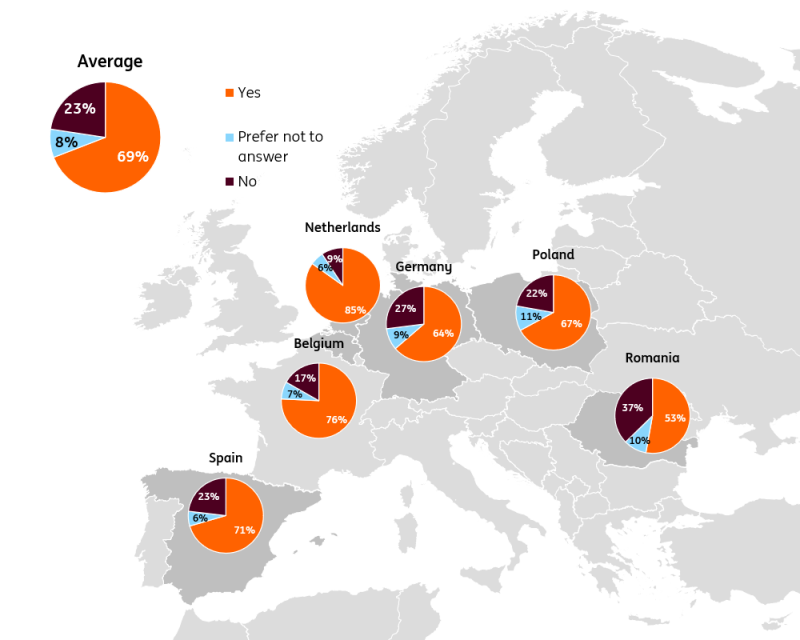
ING's survey asked consumers in six European countries whether their household had any savings. Half of those countries recorded more “no” responses than last year, while five out of six saw fewer “yes” answers.
8% prefer not to answer
Amid this mixed picture, the percentage that didn’t want to answer the question at all increased everywhere by between one and four percentage points. While exercising your right not to answer may not be held against you in a criminal court (at least that’s what countless crime TV shows have taught us), it’s likely that a considerable share of these respondents wouldn’t have answered “yes” if pressed.
Out of the six countries surveyed – Belgium, Germany, the Netherlands, Poland, Romania and Spain – the Dutch retained the top spot, with 85% answering “yes”. This marked a 1 percentage-point decline from the previous year. Belgium strengthened its No. 2 position; it was the only country to register a higher percentage than a year ago.
Percentage of households with savings varies greatly
“Does your household have any savings?”
Source: ING Consumer Research
Germany, a 'country of savings' rather than 'country of savers'
It may surprise some that Germany doesn’t rank higher here. The self-perceived “country of savers” might in fact be more a “country of savings”, since they have the largest amount of money sitting in savings accounts by a considerable margin. Since we first asked this question in 2013, Germany has regularly recorded one of the highest shares of households without any savings.
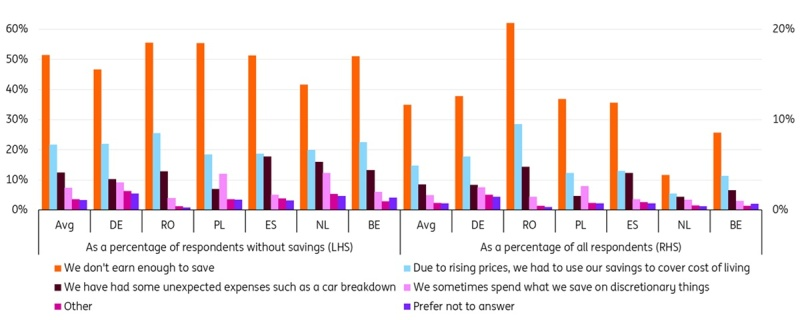
Romania has similarly remained at or near the bottom of the ranking. With the lowest per‑capita GDP in our group of six, Romania has the highest share of respondents without savings. And, among them, the largest share of respondents cited insufficient earnings as the reason.
21% of all Romanians don’t earn enough to save
Across all countries, insufficient earnings are the leading reason for not saving. This was cited by roughly half of non‑savers, though the share varies by country. As a percentage of all respondents, this really highlights the difference we’re talking about: While less than 4% of all Dutch participants in our survey say they don’t earn enough to save, that number is 21% in Romania.
In total, between 4% and 21% say they don’t earn enough to save
“What is the main reason your household doesn't have any savings?”
Source: ING Consumer Research
At least many Romanians don’t have to worry about the risk of eviction if they lose their source of income: the nation has the EU’s highest home-ownership ratio and a low number of mortgage payers. So, their savings might well be tied up in property rather than in bank accounts.
Discretionary spending doesn’t play much of a role
Using existing savings to cope with the rising cost of living ranks a distant second across all six countries. This was cited by around 20% of non‑savers. What about other reasons not to save? There is, of course, the occasional unplanned expense. And discretionary spending tops 10% among Dutch and Polish non-savers as a reason not to save. But it doesn’t even reach 3% of all respondents in any country. So, there might be a small share that is optimistic enough to forgo saving and spending instead. But this won’t be the basis for a broad-based resurgence in domestic consumption.


Comments
Log in or sign up to join the conversation.