

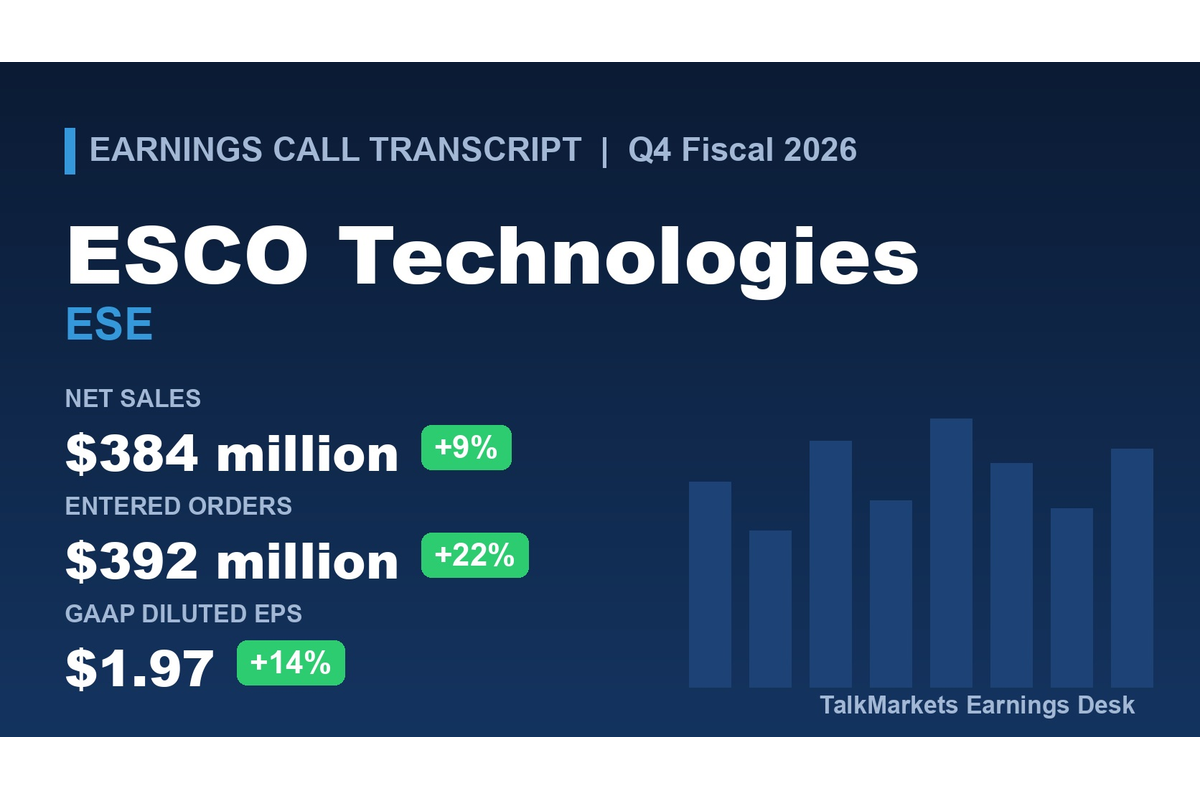
ESCO Technologies' fiscal Q4 2026 sales rose 9% to $384 million, all organic, while entered orders rose 22% to $392 million and GAAP EPS from continuing operations rose 14% to $1.97.
Ticker: ESE
ESCO Technologies Inc. (ESE) reported results on 19 November 2026 for its fourth quarter and fiscal year ended 30 September 2026. The industrial technology company, which reports Aerospace & Defense, Utility Solutions Group and RF Test & Measurement segments, grew sales in all three in the quarter. The Megger transaction closed on 1 October 2026, after the end of the fiscal year.
The key numbers (three months ended 30 September 2026)
Metric | This year | Last year | Change |
|---|---|---|---|
Net sales | $383,994 thousand | $352,674 thousand | +9% |
Entered orders | $392 million | +22% | |
Earnings from continuing operations | $51,219 thousand | $44,854 thousand | |
Net earnings | $51,090 thousand | $218,652 thousand | |
GAAP diluted EPS, continuing operations | $1.97 | $1.73 | +14% |
Adjusted diluted EPS, continuing operations | $2.67 | $2.32 | +15% |
Net earnings a year earlier included a $172,642 thousand gain on the sale of discontinued operations. The book-to-bill ratio for the quarter was 1.02x, and net cash provided by operating activities from continuing operations was $102 million.
Results by segment (fourth quarter)
Aerospace & Defense: sales rose 12% to $190.2 million from $170.4 million, driven by Navy and commercial aerospace. Adjusted EBIT was $56.4 million, a 29.7% margin, against $48.7 million. Entered orders rose 36% to $193.6 million.
Utility Solutions Group: sales rose 3% to $114.0 million from $110.2 million. Doble sales increased 8% and NRG sales decreased 20%. Adjusted EBIT was $31.4 million, against $32.0 million.
RF Test & Measurement: sales rose 11% to $79.8 million from $72.1 million. Adjusted EBIT was $13.9 million, against $12.6 million.
Dividend
The next quarterly cash dividend of $0.08 per share will be paid on 19 January 2027 to stockholders of record on 4 January 2027.
Chief Executive Officer and President Bryan Sayler said: "ESCO closed fiscal 2026 with strong performance."
Full year
For fiscal 2026, sales increased 21% to $1.3 billion from $1.1 billion. Organic sales rose 10% and the ESCO Maritime Solutions acquisition added $121 million. Entered orders increased 11% to $1.7 billion, giving a record year-end backlog of $1.5 billion. GAAP EPS from continuing operations increased 25% to $5.63 from $4.49, and adjusted EPS from continuing operations increased 40% to $8.42 from $6.03. Net cash provided by operating activities from continuing operations was $296 million.
Source: SEC Form 8-K Exhibit 99.1
Full call transcript
Operator:
Good day, and welcome to the Q4 ESCO Technologies earnings conference call. With us today are Bryan Sayler, president and CEO; Chris Tucker, senior vice president and CFO; and Kate Lowrey, vice president of investor relations. Currently, all participants are in a listen-only mode. After the speaker's presentation, there will be a question and answer session. To ask a question during the session, you will need to press 11 on your telephone. To remove yourself from the queue, you may press 11 again.
I would now like to hand the call over to Kate Lowrey, vice president of investor relations. Please go ahead.
Kate Lowrey (Vice President of Investor Relations):
Thank you. Statements made during this call, which are not strictly historical, are forward-looking statements within the meaning of the safe harbor provisions of the federal security clause. These statements are based on current expectations and assumptions, and actual results make it for materially from those projected in the forward-looking statements.
Due to risks and uncertainties that exist in the company's operations and business environment, including, but not limited to, risks and factors referenced in the company to press release issued today, which will be included as an exhibit to the company's Form AKB file. We had to take no duty to update or revise any forward-looking statements, except that may be required by applicable laws or regulations.
In addition, during this call, the company may discuss the non-GAAP financial measures in describing the company's operating results, a reconciliation of these measures, so the most comparable GAAP measures can be found in the press release issued today, and found on the company's website at www.esco-technologies.com under the link in gust relations. Now, I'll turn the call over to Brian.
Bryan Sayler (Chief Executive Officer and President):
Thanks, Kate, and thanks, everyone, for joining today's call. We are pleased to meet with you this afternoon to discuss ESCO's fourth quarter results. Momentum remains positive across all business segments in Q4, with broad-based order strength from all business platforms. Strong demand throughout the year drove a book-to-bill ratio above 1 in every quarter and 1.31 for the full year. We ended the fiscal year with record orders and backlogs, providing a solid foundation for growth going forward.
Fiscal 2026 was another milestone year for ESCO, with record revenue and adjusted earnings per share reflecting strong demand, disciplined execution, and continued operational improvements. We entered fiscal 2027 with confidence, supported by our leading market positions and strong balance sheet. Our focus is on building on these achievements, translating demand into profitable growth, and continuing to improve how we operate. We are excited about the opportunities ahead and committed to creating lasting value for our shareholders.
During the year, we also took a transformational step in ESCO's growth with the addition of Megger Group Limited, the largest acquisition in our history. We announced the deal back in April and completed the transaction shortly after the fiscal year ended. Over the summer, our teams worked diligently on planning during the regulatory approval process, and we were well prepared for the deal to close and to begin implementing integration plans and cost reduction actions. The combined company will now be known as Doble Megger.
Bringing together Doble and Megger expands our utility solution groups, scale, international reach, and complementary capabilities in electrical testing, monitoring, diagnostics, data analytics, and engineering services. This broader platform strengthens our ability to help utilities modernize aging infrastructure and meet rising electricity demand while creating new opportunities for growth. We are thrilled to have the Megger team as part of ESCO, and we want to wish each of them a warm welcome to the ESCO family.
Chris will take us through all of the financial details in the quarter, but before we get to that, I want to give you a few comments on each of the segments. Starting with A&D, we remain confident in the long-term outlook for our aerospace and Navy markets, supported by strong underlying demand and growth opportunities related to higher production rates. Our Navy business continues to deliver strong momentum. In addition to the full-year contribution from Maritime, organic sales increased 18% in both the quarter and the year.
Our U.S. and U.K. customers remain committed to strengthening the industrial base and increasing submarine build rates. Strong order activity across both Navy businesses drove their combined backlog to more than $770 million, up over 40% from the prior year, providing solid visibility into future growth. Commercial aerospace sales were strong throughout the year and grew 20% year over year. OEM progress in ramping production is encouraging, and we continue to take a measured approach to the pace of expected further increases.
Customer demand for additional aircraft remains strong, supporting our positive long-term outlook for the aerospace market. Our teams in the aircraft business continue to manage a number of supply chain and capacity challenges, but they've done a great job, and we feel good about their plans going forward. Turning to the Utility Solutions Group, Doble's strong order activity throughout the year drove double-digit revenue growth. Rising power demand, electrification, and grid modernization continue to increase the need for reliable, well-maintained electrical infrastructure.
As utilities expand generation, transmission, and distribution capacity, they must also maintain aging assets, prevent failures, and reduce downtime while meeting reliability, safety, and compliance requirements. This investment creates demand for tools to assess existing equipment, commission new assets, and maintain a larger, more complex grid, providing durable growth drivers for utility test instrumentation providers, such as Doble and Megger.
Related to the Megger acquisition, the guidance that we have laid out for 2027 includes Megger and is in line with revenue and earnings expectations outlined at the time of the acquisition announcement, with Megger being accretive to revenue growth and modestly accretive to ESCO's FY 2027 adjusted earnings per share. Finally, turning to the test business, another strong order kept a second consecutive year of double-digit revenue growth.
Order strength during the year was driven by military, automotive, and industrial shielding projects along with filters for U.S. government data centers and secure facilities. Sustained demand has led us to raise our fiscal 2027 revenue growth expectations to 5% to 7%, a good follow-up after two strong years. Overall, tests delivered another strong year with improved execution and margin expansion driven by continued momentum across its end markets. With that, I'll turn it over to Chris to run you through the financial details of the quarter.
Chris Tucker (Chief Financial Officer):
Thanks, Brian. Everyone can follow along on the chart presentation, and we will start on page three, which shows the financial highlights for the fourth quarter. ESCO's fourth quarter performance was strong and represents a great finish to another record year of financial performance for the company. Starting with orders, you can see that orders increased 22% compared to last year's fourth quarter, and all three business segments delivered double-digit order growth. Sales increased by 9%, which was all organic growth, and demonstrated the continuing strength across our business platforms.
Adjusted EBIT margins were 24.1%, and adjusted earnings per share finished at $2.67, representing an increase of 15% compared to last year's fourth quarter. Now we will go through the segment highlights, starting with aerospace and defense on page four. Another great quarter here is the A&D business continues to deliver for ESCO. Starting with orders, A&D had a book-to-bill ratio of 102% and growth of 36%. Growth was paced by the Navy businesses, and we also saw a nice order performance on the aerospace side.
With backlog of $1.1 billion, the business continues to be situated well for future growth. Sales in the quarter were $190 million, which represents an increase of 12%, all of which was organic. The growth was led on the Navy side, where we achieved 18% revenue growth. On the profitability side, we had good improvement to 29.7% adjusted EBIT margins, an increase of 110 basis points. Margin increases were due to positive impacts from leveraging sales growth and increased prices, somewhat offset by unfavorable mix.
Next we will go to chart five in the utility solutions group. Orders here were up 10% in the fourth quarter, and that was driven by 11% order growth at Doble. Sales in the quarter were up 3.5%. Again, the growth was driven by Doble, where sales increased by 8%. NRG sales in the quarter declined by 20%.
The NRG business has seen sizable declines throughout 2026, but we did see modest sequential improvements from the second quarter through the fourth quarter, and we expect the business to stabilize going forward against the reduced comparisons to 2026. Adjusted EBIT margins in the quarter declined by 160 basis points. Margin declines in NRG were significant, driven by volume de-leverage. We also saw some modest margin declines at Doble, as unfavorable mix and production costs increases more than offset leverage from the volume growth.
Next we have the test business on page six. This business had another good quarter, starting with orders which increased by 13%. Order growth was driven by strong project activity from the automotive and defense markets. Sales in the quarter increased by 11%, with particular strength seen from the U.S. government data center power filter product line. Adjusted EBIT margins were flat at 17.5%. Margin performance was a result of volume leverage and price increases, which were offset by inflation and less favorability from EAC adjustments in the quarter.
Next is chart seven, where we have full year highlights. As mentioned earlier, it was another great year for ESCO, with record performance on all key financial measures. Order strength has been significant, with 20% organic growth in the year. All three businesses have delivered double digit organic growth, with aerospace and defense at 25%, test at 23%, and the utility solutions group at 13%. Sales have also been strong, with 21% growth to just over $1.3 billion.
Organic growth for the year was 10%, as aerospace and defense and tests both delivered double digit organic sales growth. Adjusted EBIT dollars increased by 31%, and margins improved 170 basis points to 22%. Adjusted EBIT dollar was over $326 million, and adjusted earnings per share was $8.42, an increase of nearly 40% compared to 2025. Going to chart eight, we have cash flow highlights for 2026. Operating cash flow was up significantly at over $295 million, compared to $200 million in the prior year.
A key driver here to the increase has been increased advance payments on large Navy contracts. Capital spending is down slightly compared to last year, and acquisition spending is down significantly this year, given the maritime deal in April of 2025. EBIT dollar leverage was zero at September 30th, as the company was in a net cash position, and thus was well positioned for the debt requirements that came with the October 1st Megger deal.
Next on chart nine, we put in a few bar charts to show our sales and adjusted earnings per share performance over the last five years. It's really been a great run, with a sales cager of 16.9%, as we've seen sustained demand from our core end markets, and we've also been able to execute on strategic acquisitions and divestitures to enhance the business portfolio and growth profile.
The adjusted earnings per share performance has been even better, with a five-year growth cager of 30%, as our operating teams have executed well and delivered enhanced profitability across the business platforms. Our last chart is number 10, where we have the initial 2027 guidance. We expect 2027 to be a continuation of our recent strong performance, with meaningful contributions from the base company and a significant impact from the Megger acquisition.
Starting with sales, you can see we expect organic growth in the range of 7 to 9% in 2027, and we expect Megger sales in the range of 640 to $660 million. This results in a consolidated sales expectation within a range of $2.05 billion to $2.09 billion. By business, we expect revenue growth for aerospace and defense in a range of 7 to 9%, USG to be up 7 to 9% on an organic basis, and TES to be up 5 to 7%.
We expect adjusted EBIT dollars to increase between 51 to 55%, with margins in a range of 21.2% to 21.8%. You can see listed here the additional assumptions around interest expense, tax rate, and share count that get us to an adjusted earnings per share range of 940 to 970, representing growth of 12 to 15% compared to 2026.
We also wanted to note that these expectations are for adjusted earnings, which will exclude some sizable costs related to the closing of the Megger transaction, as well as integration expenses and acquisition-related amortization. We are excited to present the outlook today as ESCO moves to its next phase of growth. This completes the financial summary, and now we'll turn it back over to Brian.
Bryan Sayler:
Thanks, Chris. As you've heard from our commentary, 2026 was another great year for ESCO, and we're excited about what the future looks like for our business. That concludes the opening remarks, and we can turn it over to Q&A.
Operator:
As a reminder to ask a question, you will need to press 11 on your telephone. To remove yourself from the queue, you may press 11 again. Please stand by while we compile the Q&A roster. Our first question comes from the line of Scott Deutschel of Deutsche Bank. Your line is open, Scott.
Analyst (Deutsche Bank):
Good evening, and thank you, Operator. Chris, can you share any type of guidance goalposts for margins by segment in 2027?
Company Executive:
Yeah, what I would say there, Scott, again, we kind of target those 30 percent incrementals. I would tell you that at aerospace and defense, we're a little ahead of the 30 percent target as we look at the year, but certainly below 35 percent test. We're kind of right at that 30 percent range on incrementals.
And then I would say for the utility business, it's a little bit complicated there with Megger coming in, and we've got some synergies there that kind of go on both sides of the base company and on the acquired company. But if you kind of peel out the acquisition impacts, we do expect pretty good incrementals on the core utility business.
Just given some of the margin challenges within NRG this year and also Doble in the back half of the year, we expect that to pop back a little bit and see those incrementals up a little bit more towards 35. That's kind of what's embedded in the outlook.
Analyst (Deutsche Bank):
Okay. Yeah, and just following up on where you left off there, Chris, you mentioned in your prepared remarks that there was unfavorable mix and production cost increases at Doble. I guess can you say anything more about what exactly drove those Mexican cost pressures and then the expectations for those factors in 2027?
Company Executive:
Yeah, definitely. I would say we did see material cost escalation a little bit, especially as we came into the back half of the year. And so that was definitely a margin challenge. That was some electronic components, but then also kind of on some of the parts of the business there, particularly our Phoenix business, there's a fair bit of steel and copper in some of those products, and so we saw a little pressure there as well. So that was kind of the key driver there.
I think the other thing I'd point out there, Scott, if you look for the fourth quarter in particular, as we came into the quarter, we probably would have expected another $3 to $4 million of revenue to come out off the Doble side, and that ended up all in past due backlog. So we kind of had some past due backlog there that's a little unusual. That's, again, some kind of supply chain challenges and some customer approvals, a few things like that.
So had we got that extra volume, I think that would have kind of helped the margins a fair bit in the quarter as well. So I think those are kind of the key things we point out there.
Analyst (Deutsche Bank):
Okay. And then, Brian, maybe you could talk about what the 2027 guide assumes for Megger cost synergies, and then any update on your confidence in heading that $60 million target by year three?
Company Executive:
Sure. Sure. Yeah. So the guidance includes $20 million in synergies for 2027, and frankly, we feel very, very confident in being able to achieve that number. We're off to a roaring start there. As I said in my remarks, we were able to do a lot of planning so that right on day one, we were able to get started on those synergies by announcing some restructuring right away.
We put a new combined management team in place, rolled out a new brand, combined brand, and made some adjustments in our distribution channels. So all of those things together put us in a position where we think we feel very, very confident about achieving that first tranche of $20 million in synergies.
Analyst (Deutsche Bank):
Thank you very much. I'll jump back in queue.
Operator:
Thank you. Our next question comes from the line of Tomo Sano of JP Morgan. Your line is open at Tomo.
Analyst (JPMorgan):
Thank you. Hello, everyone.
Company Executive:
Hello, Tomo.
Analyst (JPMorgan):
Thank you for taking my questions. Starting with Chris, the 27th guidance excludes the sizable Megger integration expenses and acquisition-related amortizations. How much visibility do you have today on the expected magnitude, and then time of those items, please?
Company Executive:
Yeah, so I would say we have reasonable visibility, but there's still kind of a lot of moving parts there. I think, obviously, on the deal costs, we have good insight there. We have some banker fees that kind of paid when the deal closed. That was for investment banking, and then also for financing. We have some transfer taxes, so that'll be around $20 million. We have some transfer taxes that we pay for some of the foreign acquisitions that you have to pay whenever you buy things.
That's around $10 million. We have integration costs. That's going to be restructuring and things like that that are kind of one-time costs as we work on the integration. That's where I think our numbers are still kind of coming together a little bit. I would say today we're looking for that number to be around $30 million as a P&L impact, but again, there could be movement either direction there. I would also say that $30 million wouldn't be all cash.
There'll be a little bit of non-cash in there as well. Those would be kind of the key things I would highlight. The amortization and such, we're still kind of working through that, so we'll give you granularity as we go through the quarters to kind of let you know what's in there, but that's kind of what we see right now.
Analyst (JPMorgan):
That's really helpful. Thank you, Chris. Brian, if you could talk about a really high level, how do you see delays or changes in data centers' projects as a potentially affecting utility, your customers and capital spending and the older timing? How is the new ESCO utility group, including the Megger projections, to navigate those potential changes? Thank you.
Company Executive:
Yeah, I would say that we have indirect exposure to the data center build. Our primary business is really through the utilities of sales that are providing the power. We do have some amount of sales that go direct to the large data center construction outfits, and then we course sell to a lot of the EPCs and service providers that go there.
Those numbers are, I would say, pretty modest, maybe 1% to 2% of the total revenue for Doble Megger, and frankly, we're not anticipating any substantial reduction in our 2027 outlook. I think that based on a lot of the stuff you hear in the news, there could be a slowdown longer term in terms of some of these, frankly, astonishing growth rates that they've been projecting, but we don't expect that that's going to mean a lot for our business.
The fundamentals of electrification remain in place, and our business is primarily around managing long-lived current assets, preventing outages and making sure people can get the most out of what they already have, and I think that's a business that's going to continue to be sustainable, regardless of what happens in the data center build.
Analyst (JPMorgan):
That's really clear. Thank you very much, and congrats on the quarter.
Company Executive:
All right. Thank you. Thank you.
Operator:
Once again, to ask a question, please press *11 on your telephone. Our next question comes from the line of John Tanwanteng of CJS Securities. Your line is open, John.
Analyst (CJS Securities):
Hi. Good afternoon. Thank you for taking my questions, and congrats on closing the Megger deal and a strong quarter in the outlook.
Company Executive:
Thanks, John. Thanks, John.
Analyst (CJS Securities):
My first one is, can you just give us a sense of how the recent election results may have changed any of your planning or guidance for the next year? Was there any impact at all, or was that pretty much as expected, or how should we think of the flow through there?
Company Executive:
Well, so first of all, I would say that the results were only surprising in magnitude, not in direction, and so, frankly, the good news about the way our business is structured is that a lot of the government defense type activity we have is in backlog, and so we feel very, very good about our position.
The programs that we're on are among the highest priorities, and so we anticipate that there's going to be a fair amount of noise out of Washington, but at the end of the day, we anticipate good bipartisan support for shipbuilding programs, and in particular, the submarine programs.
There was, you know, the big debate right now is what's going to happen in the lame duck around the defense authorization and the reconciliation bill that's there, and frankly, it's too early to tell exactly what will happen there, but the, you know, the markups that we've seen, you know, have affected, you know, surface ships, you know, but not really submarines, and so we feel like that that's directionally correct, and, you know, matches what our expectation would have been.
As for outside of the defense world, we don't think it's going to have a big impact generally, and so no, we did not take any changes based on the election into our 2027 guidance.
Analyst (CJS Securities):
Okay, great. Thank you, and I know it's early days, but within the guidance for the Megger piece for the revenue, did you assume any revenue synergies there? If so, kind of help me understand what the magnitude of that is, and, you know, more broadly, just how customers are reacting to the combination of the portfolios there.
Company Executive:
Sure. No, we did not include any revenue synergies in the guide, and frankly, I think it's a little bit too early for us to make an assumption about that.
I think that customers are responding quite well to our initial, you know, rebranding and restructuring of the business, and I think that, you know, we've got a fair amount of work to do in order to be able to create, you know, new solutions where we're combining, you know, Doble and Megger content together to create, you know, a better solution, but we've got some suggestions from customers about that, and we're excited about what that might mean, but it'll take some time to do that.
As for the sales team, I think they're pretty energized, and it's early, but we are excited about what we're seeing so far.
Analyst (CJS Securities):
Got it, and then last one from me. Can you break out what the assumption is for NRG in the next year - is in the next year, and kind of what it might take to get that one moving again?
Company Executive:
Yeah, I would say that we've kind of reached the end of the bad, you know, comparables. We've seen, I would say, a trend of good sequential growth, you know, Q2 and Q3 and Q4, and so we're expecting, call it mid-single-digit type growth in 2027. I think the election probably will relieve some of the pressure that's there, but we do not anticipate that that market is going to respond to anything like what it did during the One Big Beautiful bill or the inflation reduction act.
That kind of stuff is still far ahead, and we're not anticipating any of that in the near term.
Analyst (CJS Securities):
Okay, great. Thank you.
Company Executive:
Thank you.
Operator:
We have a follow-up question from the line of Scott Deutschel of Deutsche Bank. The line is open, Scott.
Analyst (Deutsche Bank):
Hey, Brian, are you currently shipping at rate 47 on the 737 program right now, and then what does the guide assume on 737 rate?
Company Executive:
Yeah, I would say that what we're seeing out of our customer there is consistent with our expectations. They are, you know, increasing the build rate, but not in a nonlinear fashion, I guess I'd say, and that's to be expected, I think. But we're a couple of notches down the supply chain from them, so it doesn't, you know, what you would see printed in one of your teardown reports, for example, we would not be as responsive to those quantities.
We're on a steady build, and it's growing, and we like what we're seeing.
Analyst (Deutsche Bank):
Okay, and then similar question on Virginia class. Can you give a sense of what kind of build rate you're shipping to there, and if you're more or less aligned to the shipyards or shipping ahead of them? If you have been kind of aligned with them, just want to check on that.
Company Executive:
Yeah, so part of the way that business is structured, we generally are building one or two vessels ahead of where the shipyard is, and so we would have almost an entire ship set built and then delivered to be rapidly put onto the hall in the shipyard. And they continue to turn the crank on increasing those volumes, and as you saw in our announcement today, overall Navy growth was really, really good this year, and that included the Globe business with the exterior hull coatings.
Analyst (Deutsche Bank):
Okay, and then last question, Chris. Can you share some expectations around free cash flow conversion in 2027? This year is obviously very strong, so is there a sense that that can continue if they're kind of normalized?
Company Executive:
Yeah, we expect it to normalize back a little bit. You know, again, we did see really big advance payments that we called out this year. So on the Navy, you know, for both Globe and ESCO Maritime, you know, I'd say our cash flow was kind of above trend and the conversion was quite high there, is they kind of had these really big orders that started to get some advance funding.
So I would say that as we go into next year, Scott, those businesses will have lower cash flow in 2027, but they're still, I would say, in a high part of the curve there, because those contracts are still kind of in the early part of execution. The funding is still good, just not quite to the level that we saw in 2026.
Analyst (Deutsche Bank):
Okay. And I also wanted to ask, the 10% sales growth you saw available this year, can you give a sense as to how much of that was price versus volume, and does the price fees accelerate next year, or does that kind of stay stable?
Company Executive:
Yeah, good question. I think, you know, we would have been right around 3% to 4% realized in those numbers. And I think that it is something, you know, we're very focused on, especially, you know, I mentioned some of the material cost increases that we've been seeing, so in those businesses in particular, we've got to be, you know, razor focused on, you know, pricing, you know, quickly to make sure we're getting coverage there.
So, you know, I wouldn't say on par that we expect that number to go up meaningfully next year, but it should at least be at that level. That's kind of how we're thinking of it right now.
Analyst (Deutsche Bank):
Okay. Thank you very much.
Company Executive:
Thank you. Thank you.
Operator:
I would now like to turn the conference back to Bryan Sayler for closing remarks, sir.
Bryan Sayler:
Well, thanks for taking some time to talk to us about a really great 2026 and an even better 2027. We'll look forward to talking to you again in January or February. That concludes today's conference call. Thank you for participating. You may now disconnect.
Comments
Log in or sign up to join the conversation.