

Investors have long said that it is futile to fight the Fed, the all-powerful world’s central bank. But is the opposite true, should investors ignore what the Fed is saying about the future? Jay Powell sent an unmistakable message to investors yesterday, dashing hopes for a quick economic turnaround in the latter half of the year. He made it abundantly clear that it is illusionary to anticipate the economy returning to the pre-coronavirus growth path.
During a virtual press conference, Powell cited “considerable risks to the economic outlook over the medium term”. Furthermore, he stated there are two fundamental conditions facing the economy. First, there is the risk of “damage to the productive capacity of the economy”, in his words this created a “very negative” global dimension to the recovery problem. Every major downturn in the past has resulted in lowering potential growth. Second, consumers have been shell-shocked by the sudden loss in jobs, incomes, and their savings. We should expect them to be very cautious as they start spending again. In his words ‘the chances are that it{economy} won’t go right back to where we were.”
These comments were made just after the release of the GDP numbers for the January-March quarter before the nation-wide lockdowns came into full force. Wall Street is expecting a much deeper decline in the second quarter, perhaps as much as a 25% drop in output.
(Click on image to enlarge)
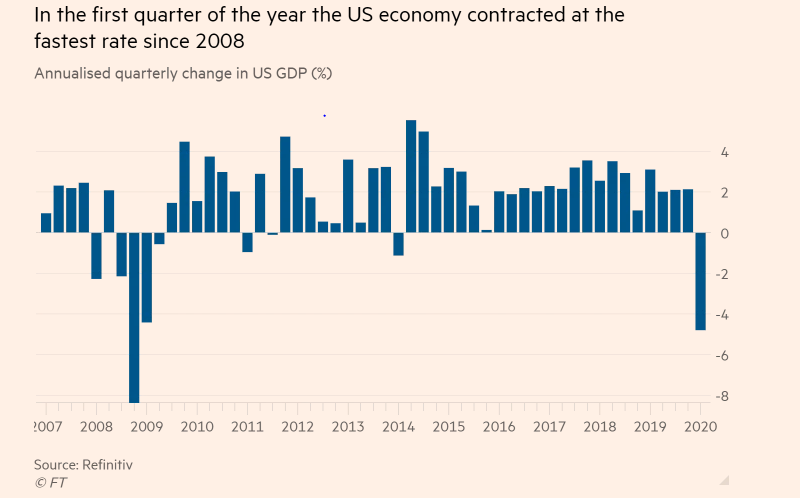
This rather pessimistic outlook comes on the heels of the Fed deploying a double-barrelled approach to fighting what will be the worse downturn since the Great Depression. It slashed the Fed funds’ rate back to a range of 0.0%-0.25%. It followed up with a most aggressive asset purchase program which includes not only Treasuries but corporate bonds (investment grade and high-yield) and municipal debt. The Fed is going to be the major participant in the US debt markets for a long time to come. The Chairman made it clear the FOMC will be in no hurry to withdraw from the credit markets-----in effect, an open-ended program to reflect their gloomy view of the future.
What lies behind the Fed’s worry? Initially, when China was the center of the virus, the rest of the world was concerned about the “supply shock” and the possible inflationary impact emanating from the near-collapse of the Chinese manufacturing base. That no longer is the case. Now, with 30 million Americans on unemployment insurance, the collapse in aggregate demand is forcing the Fed to up its game. The Fed realizes that there is going to be a prolonged and significant output gap that will alter inflation expectations. Without saying as much, the Fed is staring deflation in the face when it states that it expects rates to remain at these levels for an indeterminate time period. It no longer talks about reaching inflation targets.
So, what are the equity markets indicating against this macro-economic backdrop? With the S & P down only 15% from its recent high, investors do not seem as gloomy as the Fed. Perhaps, one explanation is that the Fed’s bond-buying program has mitigated a lot of the risk in the corporate debt market. The Fed will backstop this segment of a firm’s capital structure. But the expected large output gap and accompanying deflation should be a great concern to the equity markets. Worse yet, reporting companies have not been able to provide guidance for the remainder of the year, making it nearly impossible for analysts to set earnings and price targets. Despite the lack of clarity, the equity markets continue to support the position that within a year’s time, the markets could be testing previous highs. Investors should pay more heed to what Powell and company are saying. After all, the Fed tends to have a more objective view of what lies ahead.

Comments
Log in or sign up to join the conversation.