

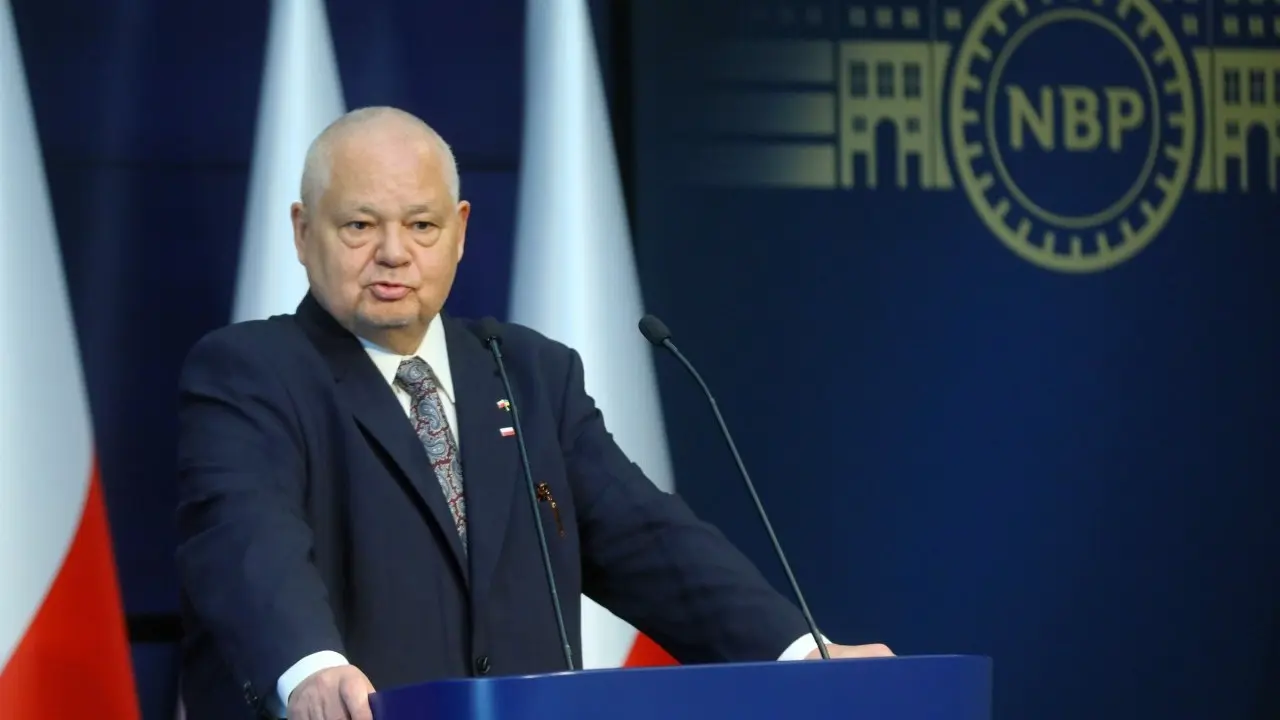
Poland's central bank is increasingly alert to inflation risks from the prolonged energy shock, despite limited evidence of second-round effects so far. Governor Adam Glapiński signalled that the Monetary Policy Council is ready to act if needed. We maintain our call for 50bp of rate hikes in 1Q27
Energy shock drives inflation up
At November's press conference, National Bank of Poland Governor Adam Glapiński noted that CPI inflation declined in October and returned to within the central bank's target range of 2.5% +/- 1ppt. Core inflation probably declined as well. At the same time, the war in the Middle East continues to keep energy commodity prices elevated, adding to global price pressures. European gas prices are currently 2.5 times higher than at the beginning of the year. A large part of the increase in inflation in Poland reflects more expensive commodities, although regulatory measures in the fuel market, including price caps and lower excise duties and VAT, are limiting the impact.
External supply shock dominates, with no second-round effects so far
Elevated inflation is primarily the result of an external supply shock that is beyond the reach of domestic monetary policy. Adam Glapiński said there were no clear signs that higher fuel prices were spilling over into prices elsewhere in the economy. Nor has there been a strong increase in core inflation, with CPI excluding food and energy only slightly higher than at the beginning of the year.
In the view of MPC Governor Glapiński, companies have limited scope to pass higher costs on to consumers due to weak demand and competitive pressures. Wage growth also remains moderate, while business surveys suggest that wage pressures are not building.
A range of inflation risks
Despite the still relatively favourable picture of the economy and limited evidence of secondary inflationary pressures so far, the NBP Governor highlighted a number of risks to the inflation outlook. In his view, a prolonged energy shock could prompt companies to pass higher energy, freight and insurance costs on to a broader range of goods and services.
Producer prices (PPI) are also rising rapidly. High gas prices feed through into fertiliser prices with about a one-year lag, which in turn pushes up food prices. Under current legislation, the fiscal programme reducing fuel prices is due to expire at the beginning of next year.
A balanced assessment of the risks, but readiness to act
In recent months, the NBP governor has presented a balanced assessment of inflation developments. On the one hand, he noted that the rise in prices largely reflects an external supply shock, core inflation remains relatively stable, wage pressures are moderate, economic growth is slowing, and companies have limited scope to raise prices. On the other hand, his comments on the outlook were less optimistic. He strongly emphasised that a prolonged energy shock increases the risk of higher food prices and the emergence of second-round effects. This is also one of our main arguments for expecting interest rate hikes in early 2027.
We maintain our call for rate hikes in 1Q27
Adam Glapiński stressed that the MPC is ready to act and that we are now approaching a point at which the outlook for inflation developments should become clearer. Other important remarks during the press conference suggest that the Council is moving closer to a rate hike. The governor said that "we are concerned that rates may have to be raised". He also said that the MPC was still considering "whether it would be a one-off hike, the beginning of a cycle, or whether it will happen at all". Moreover, he suggested that the threshold for a January hike was not far away.
Comments
Log in or sign up to join the conversation.