

Solid growth, decent jobs, and elevated inflation all point to the need for further policy tightening from the Federal Reserve. Nonetheless, the plunge in commodity prices and the weak wage growth environment suggest the Fed doesn't need to move aggressively
Given the Thanksgiving holiday is almost upon us, we have had three days’ worth of data released all at once. In general, it suggests that the upbeat story still holds despite the gloomy headlines on tech, tariffs and rate hikes, but there are hints of potentially softer figures for the fourth quarter and into early 2027.
Inflation too high for comfort
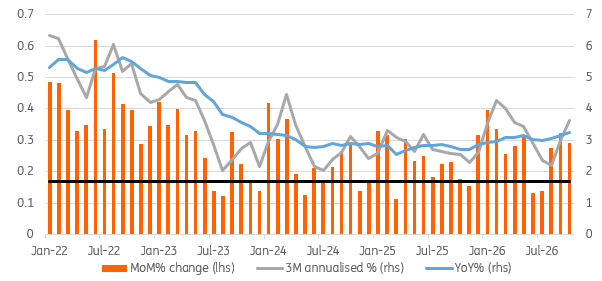
The number that was most in focus ahead of time was the core PCE price deflator, the Federal Reserve’s favoured inflation measure. Given the CPI and PPI inputs were already released, a 0.3% month-on-month outcome was expected and that is indeed what we got, 0.293% to three decimal places. The year-on-year rate was a touch higher than the 3.2% rate expected, at 3.3% due to some minor revisions to history. As the chart below shows, we are tracking well above the 0.17% MoM rate we need to average to bring the YoY rate down to the 2% target. After two good prints in June and July, we’ve had three consecutive figures of 0.3% MoM, pulling the 3M annualised rate up to 3.6%, which all but seals a 25bp rate hike on 9 December.
Core PCE inflation metrics (% change)
Nonetheless, there are clear signs that price pressures should ease in 2027. Gasoline prices are down nearly a dollar per gallon from their September high, to the lowest price since early March. Industrial and precious metals prices are in free fall while even agriculture and livestock prices are plunging. There is concern about the president’s renewed push on tariffs, but wages are the biggest cost input for corporate America, and, at 3.1% YoY, do not indicate a significant threat over the medium to longer term. The low-hire, low-fire economy is not going to change that story imminently.
GDP surged in 3Q, but a weaker 4Q number awaits
Meanwhile, third-quarter GDP growth was revised sharply higher to 4.3% annualised from the initially reported 3.4% rate. Consumer spending was revised up 0.4ppt, led by a 1.7ppt upward revision to goods purchases. Non-residential business capex was also revised sharply higher, with government spending revised up 0.4ppt. However, there is a sense that this is likely to mean a weaker fourth-quarter GDP growth figure lies ahead, with real consumer spending flatlining in October, the first month of the quarter. Even if we get two consecutive 0.2% MoM prints for November and December, which looks a little optimistic, real consumer spending growth would slow to 1.8% from 4.2%.
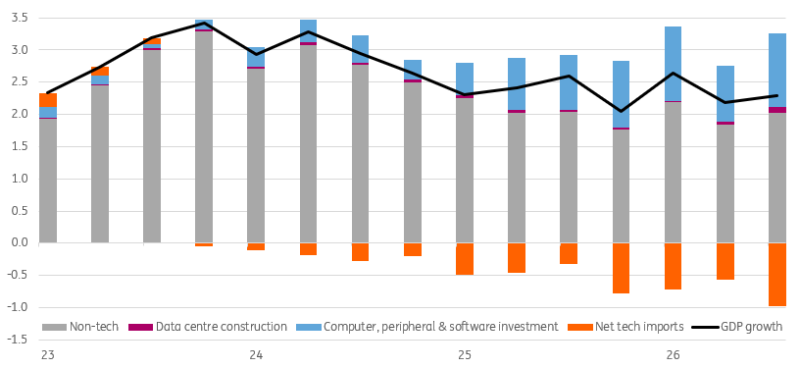
Durable goods orders – a good lead indicator for business capex – were also softer than anticipated for October, rising 0.2% MoM at the headline level (0.7% expected) and 0.6% at the core (non-defence capital goods orders ex-aircraft) versus 0.8% expected. The tech sell-off, while probably not putting any dent in fourth-quarter investment spending, may start to prompt a cooling for later in 2027 as funding comes under a little more pressure. Even if it does cool, we have to remember that many of the inputs are imported. The chart below shows that this is a net subtraction to overall growth. Cooler tech investment growth would mean less of a drag from net trade, so it wouldn’t be a disaster for the US growth story. Moreover, if we get a cooling of tech investment, it could give room to other parts of the economy to breathe and step up.
Contributions to US YoY (%) GDP growth
Given these offsetting stories – a stronger past, slightly weaker future – we aren't seeing much of a reaction in markets. Even the good jobless claims story of 189k versus 200k expected, is failing to move markets as we head into the holiday.



Comments
Log in or sign up to join the conversation.