


US Treasuries resisting bearish pressures
Treasuries are showing remarkable resilience to a set of data that as a whole can only be described as upbeat. Core PCE inflation at 3.3% year-on-year, jobless claims below 200k and GDP revised up on consumer spending. Yet, the 10yr UST yield is holding steady in the low 4.8% area. The bigger picture compression of energy prices, and the wider commodity complex, is one explanation. As is the ongoing risk-off tone in equities, with a particular AI-concern tint.
There may also be a long weekend effect where being long bonds might not be a bad option. But still, it’s been a week so far in which Treasuries have ignored valid reasons for yields to rise. Monday saw the Nvidia reversal, Tuesday the firm consumer confidence reading, and now today sees a string of validation that should be pressuring yields higher. We’ve got to respect price action of course, but it still looks a tad stretched given all of that.
Belly could continue to outperform on growth concerns
Despite more fragile risk sentiment, the conviction for near-term policy tightening remains broadly intact. For both the Federal Reserve and European Central Bank (ECB), markets still price in more than 90% of a 25bp hike in December. With recent inflation data still printing hot numbers, central banks are not left with much wiggle room in the near term.
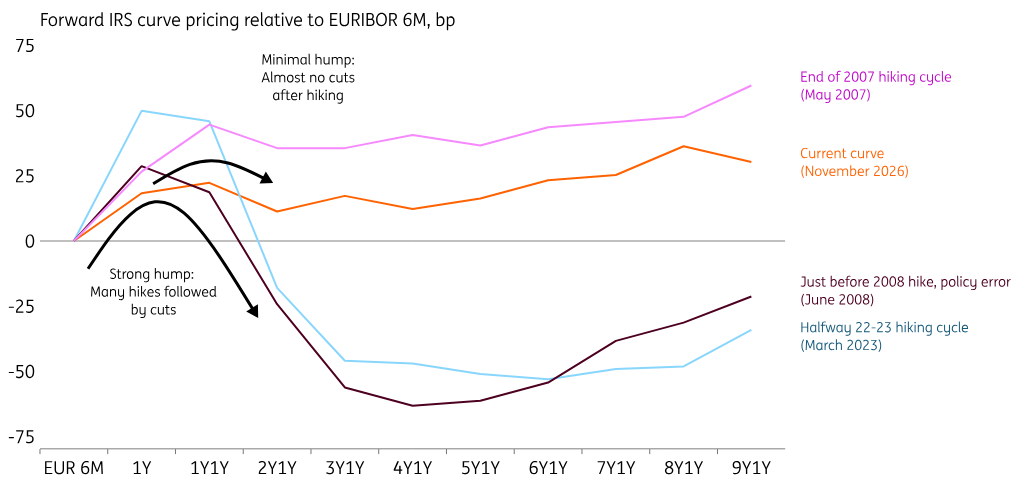
We do think worsening risk sentiment could start translating into a lower terminal rate for both the US and eurozone. Current yield curves suggest more interest rate hikes in 2027 but very little easing thereafter. This is in contrast with the curves in 2008 and 2023. In both cases, markets were more pessimistic about the growth outlook but maintained the view that central banks would be focused on near-term inflation.
Especially the belly of the curve could outperform if growth expectations were to worsen. This need not happen concurrently in both EUR and USD rates given different macro environments. For the US, recent growth data look more robust but is also closely tied to the optimism around the AI sector. The European economic outlook is more fragile but arguably more broadly supported. Therefore, a further decline in AI equities should have a relatively softer impact on euro rates.
Growth concerns can trigger a significant repricing of the belly of the curve
ECB minimum reserve change to come only in 2027, if at all
The ECB convened on Wednesday for a non-policy-setting meeting, reportedly also to discuss a possible increase of the minimum reserve requirement for banks. There was no official news, but Bloomberg reported that officials are unlikely to make any imminent change, citing disagreement and the notion that any decision could wait until next year. Even if it were still to be decided this year, we would have suspected that changes would only become effective next year so as not to disrupt the approaching turn of the year, which is usually marked by already tight liquidity conditions.
Thursday’s events and market view
The US is on holiday for Thanksgiving. In the eurozone, we will get the ECB’s M3 money supply data as well as the accounts of the October ECB meeting.



Comments
Log in or sign up to join the conversation.