

The IMF's latest World Economic Outlook provides a valuable snapshot amid the ongoing pandemic. Compared to April, the fund expects a deeper recession in 2020 (-4.9% vs -3.0%) and a more modest recovery in 2021 (+5.4% vs +5.8% in April), meaning that it will take longer for the global economy to recover lost output while plenty of uncertainty remains.

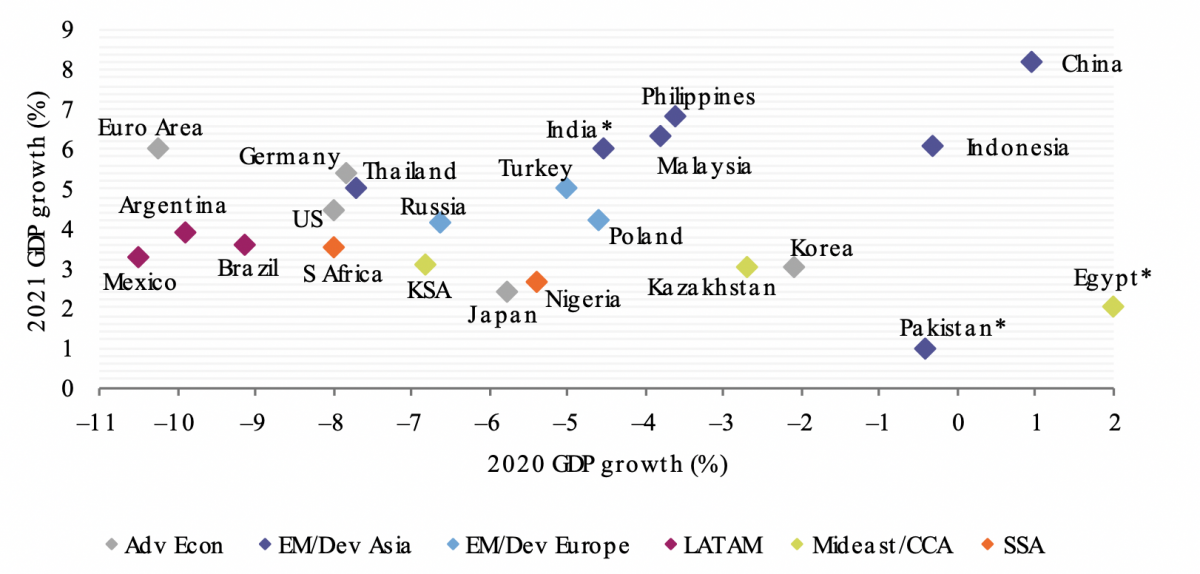
GDP growth projections for 2020 and 2021 (% YoY)
(Click on image to enlarge)
Sourc: IMF World Economic Outlook (Jun 2020), ING
* Fiscal year basis
Latin America, South Africa and oil exporters face steepest recessions
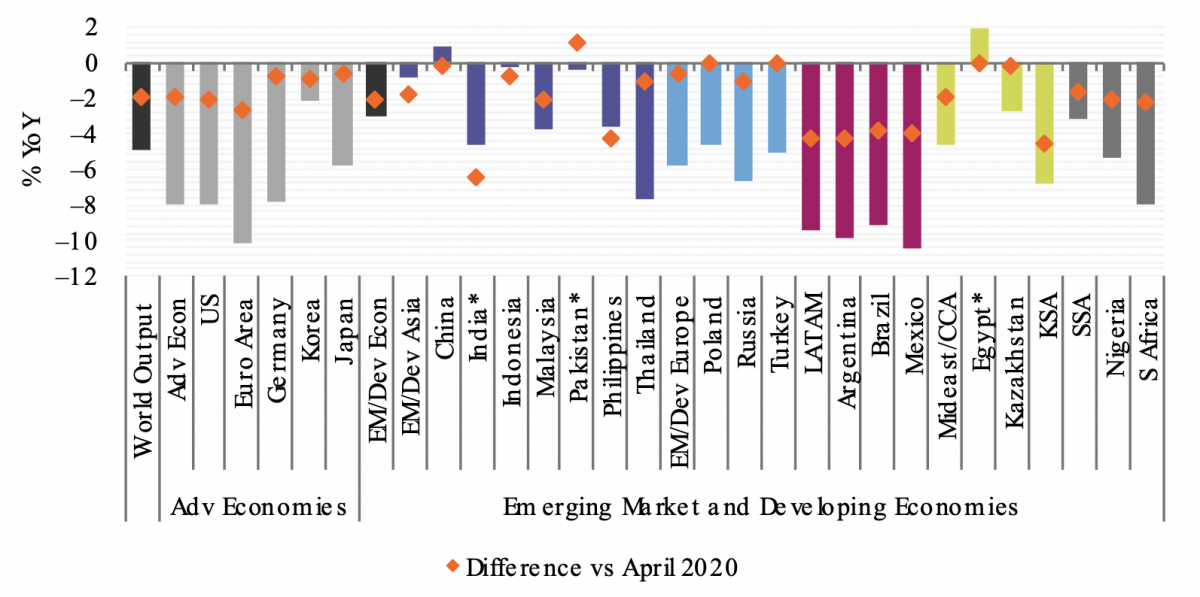
The slump in advanced economies is deeper for 2020 (-8.0% vs -6.1% in the April WEO) but growth has been revised up slightly for 2021 (+4.8% vs +4.5%). We remain concerned about the growth outlook in many emerging market and developing economies. Altogether, they are seen contracting by 3.0% this year (vs -1.0% in April) with a depressed recovery in 2021 (+5.9% vs +6.6%). Notwithstanding, the heterogeneity means that deviations across regions and countries are substantial:
- Asia (-0.8% in 2020; +7.4% in 2021) faces a more modest contraction, with China holding up (+1.0% in 2020; +8.2% in 2021) thanks to policy. India is the exception, with growth revised down by 6.4ppt to -4.5% in 2020. Asia remains best positioned for the recovery with growth seen recovering to 7.4% in 2021.
- Latin America (-9.4%; +3.7%) has seen the steepest downward growth revision since April (-4.2ppt), with Argentina, Brazil and Mexico facing a contraction of around 10% as those countries have been struggling with containing the virus.
- In between those two extremes, we find EM Europe (-5.8%; +5.3%), Middle East & Central Asia (-4.7%; +3.3%) and Sub-Saharan Africa (-5.4%; +2.6%). Among them, commodity exporters and South Africa (-8.0%; +3.5%) are facing steeper declines.
GDP growth projections for 2020 (% YoY) and difference vs April 2020 WEO
(Click on image to enlarge)
Source: IMF World Economic Outlook (Jun 2020), ING
* Fiscal year basis
EMs have limited fiscal scope with debt sustainability at risk for some
In response to the Covid-19 outbreak, most economies have followed a combination of containment measures and policy stimulus. Notably fiscal balance sheets are seeing a meaningful deterioration in 2020 due to the weak growth outlook and larger fiscal deficits as we highlighted in a note on the risks of sovereign debt distress on 2 April. In addition to the growth forecasts, the IMF has therefore also provided updated fiscal projections for a small subset of DM and EM economies.
Global gross debt/GDP is expected to rise from 82.8% in 2019 to 101.5% in 2020. Both the high absolute number and the increase over 2020 are skewed upwards by advanced economies (with debt/GDP seen increasing from 105.2% in 2019 to 131.2% in 2020). Emerging markets, on balance, carry a much lower debt burden and see a reasonably modest increase (from 52.4% to 63.1%). Yet, it is here that we are more concerned about debt sustainability, as many advanced economies benefit from reserve currency status and ultra-low interest rates. In turn, EMs are using limited fiscal resources compared to DMs in the fight against Covid-19 (see the IMF’s Covid-19 Fiscal Monitor).
Gross debt projections for 2020 (% of GDP) and difference vs April 2020 WEO
(Click on image to enlarge)

Source: IMF World Economic Outlook (Jun 2020), ING
LIDC: Low-Income Developing Countries
Fiscal deficits for emerging market economies and low-income developing countries (LIDC) are expected to run at 10.6% and 6.1% of GDP, respectively, in 2020. However, a varying degree of fiscal support, economic output, commodity exposure and debt structure result in large divergences across EM economies:
- Among those, Brazil (-16.0% of GDP), South Africa (-14.8%), China (-12.1%), India (-12.1%) and Saudi Arabia (-11.4%) will run deficits above the 10% of GDP threshold. Mexico’s deficit is lower at 6.0% of GDP but the deep recession means that it will join the above mentioned to see gross debt/GDP rising by more than 10ppt.
Positively, 2021 will see debt/GDP rising more modestly in most cases as growth recovers. The exceptions are China (+6.6ppt) and South Africa (+4.7ppt) which will see their debt/GDP ratio rising further, with debt sustainability a big concern to us in the latter (despite attempts at fiscal consolidation). In contrast, Brazil’s debt/GDP ratio is set to decline (-1.7ppt) in 2021, but it is the highest ratio (above 100%) among its peers and warrants monitoring.
- Interestingly, Saudi Arabia (-11.4% of GDP) has seen an upward revision in its fiscal balance vs April (+1.2ppt), reflecting fiscal austerity efforts due to the slump in oil prices. EM Europe (-6.9%), also thanks to limited budget support measures in Russia and Turkey, will run relatively low deficits. This is also the case for low-income developing countries, as they face tighter financing conditions (notably weaker access to external funding and some having asked for debt suspension).
Fiscal balance projections for 2020 (% of GDP) and difference vs April 2020 WEO
(Click on image to enlarge)

Source: IMF World Economic Outlook (Jun 2020), ING
LIDC: Low-Income Developing Countries



Comments
Log in or sign up to join the conversation.