


The ECB will end its asset purchase program in Dec. but will keep negative rates "at least through the summer of 2019".
The ECB is in a tight spot with the Fed hiking and tapering. The ECB would like to hike, but data in the Eurozone, especially Germany has been weak. And before it will hike it at least needs to end its asset purchasing program.
Today the ECB played it halfway. It announced an end to asset buying in December but it simultaneously pledged to hold rates low for longer than the market expected.
As a result, the Euro slid 1%, On Track for Steepest Slump Since October.
ECB to End Bond-Buying Program in December
The Wall Street Journal reports ECB to End Bond-Buying Program in December as Crisis-Era Policies Wind Down.
The European Central Bank is closing a chapter on one controversial policy, government bond purchases, while extending the life of another: negative interest rates.
The central bank Thursday laid out plans to wind down its giant bond-buying program by the end of this year, but said it likely would wait “at least through the summer of 2019” before raising its deposit rate, now at minus 0.4%.
The ECB “has done everything it can to prevent investors from pricing in rising interest rates,” said Joerg Kraemer, chief economist at Commerzbank in Frankfurt. “There is no sign of a real rate hike cycle.”
Critics argue the ECB’s purchases coincided with steep increases in the prices of property and other assets and made it easier for unviable “zombie” firms to stay alive. Some countries, notably Greece and Italy, still have large volumes of nonperforming loans.>
Negative interest rates tend to hurt savers and banks, but Mr. Draghi argued Thursday that savers could invest in other assets while profits at bank and insurance companies hadn’t been hurt.
ECB vs Fed

ECB Asset Purchases

Negative Interest Rates Hurt Banks
Negative interest rates clobber savers and hurt the banks. The US recapitalized banks by giving them free money.

For further discussion, please see Free Money Calculation: Fed Will Give $36.93 Billion of Taxpayer Money to Banks.
Bubbles Galore
The Fed and the ECB's policy have two things in common.
- Both sets of actions blew bubbles.
- Both sets of actions created zombie corporations.
Today's Interesting Treasury Reaction

Today's excellent retail sales report in the US should have sent US treasury yields higher. Instead bond yields fell.
For discussion, please see Spending Like Crazy: Retail Sales Jump but Bond Yields Lower
Purportedly, this action is due to the ECB's announcement. I am not so sure.
News Related Reaction?
It's easy to assign a reaction to the news.
But the bond market could just as easily be reacting to something else, like yesterday's news: Fed Hikes Again, Modifies Accommodation Language, Plans on 2 More Hikes in 2018
The long bond can also be looking ahead.
Break Theory
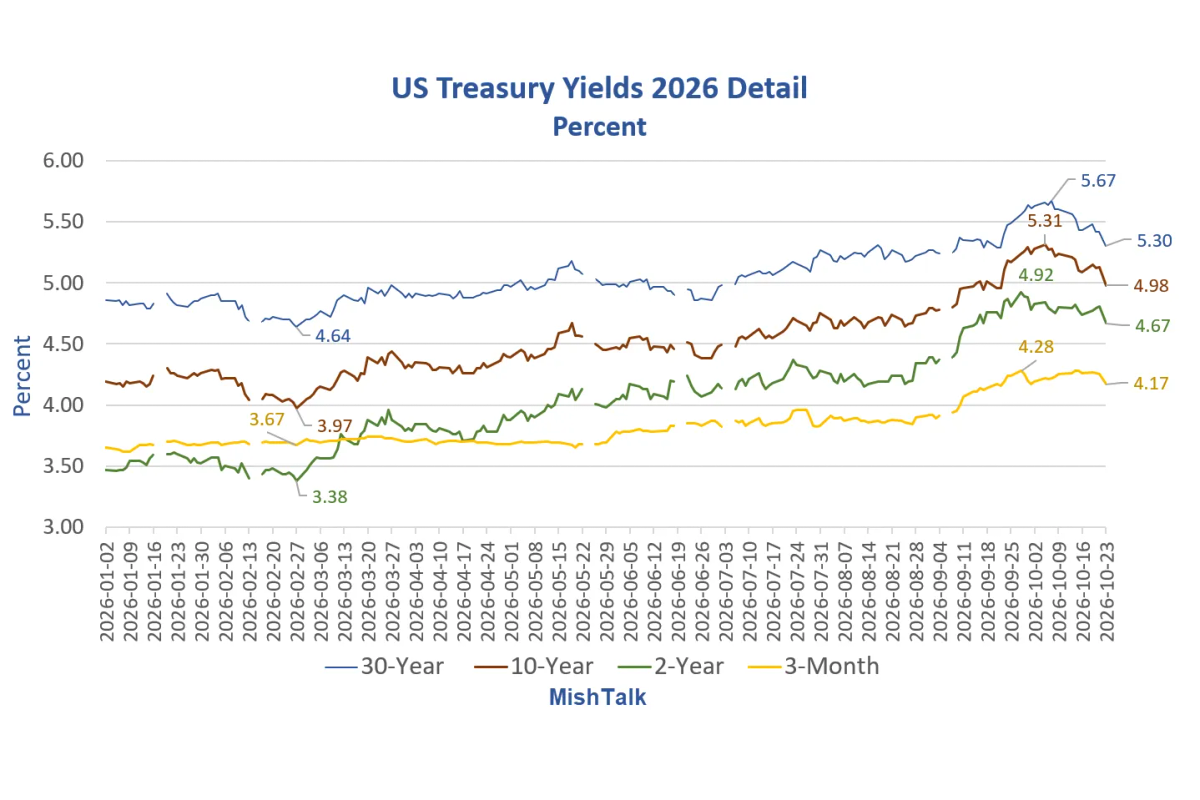
The US yield curve keeps getting flatter and flatter.
The consensus is the Fed will keep hiking "until it breaks something". The consensus is wrong.
— Mike Mish Shedlock (@MishGEA) June 14, 2018
The Fed's and ECB's balance sheets and all the bubbles are proof enough things are already broken beyond repair.
No Decoupling
The other common wisdom of the day is the US will decouple from the global markets.
This is the reverse of the 2007 decoupling theory that stated China would decouple from the US economy.
The decoupling theory was wrong then, and it's wrong now. The US is not immune to a slowdown in Europe and China. And it is not immune to an emerging market collapse in general.
We are in a very late-stage position here.
The Fed is nearly done hiking.
The bursting of asset bubbles will be a very "deflationary" thing. I suspect the long bond senses that.

Comments
Log in or sign up to join the conversation.