

The Dutch flexible labor market is slowly improving, although a broad-based recovery has yet to emerge. Growth is concentrated among smaller, niche players while larger agencies continue to struggle. Labor shortages, stricter regulation, and technological change are forcing temporary employment agencies to rethink their business model.
Modest growth in 2026
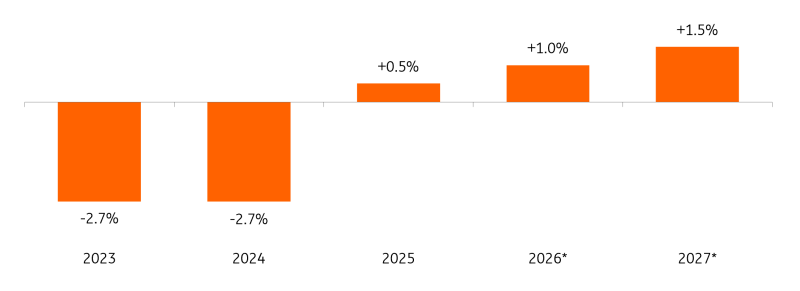
The outlook for the Dutch flex sector, which includes temporary staffing, secondment and recruitment agencies, is moderately positive. As economic growth gradually gains traction, businesses are creating more room for investment, supporting a slow recovery in demand for flexible labour. ING Research expects the number of hours worked in the sector to increase by 1% in 2026, followed by a further recovery in 2027 with growth of 1.5%.
Slight growth in demand for flexible workers in 2026 and 2027
Volume growth in the flexible employment sector in the Netherlands, year-on-year
Source: CBS, *forecasts 2026 and 2027 ING Research
Market conditions remain challenging
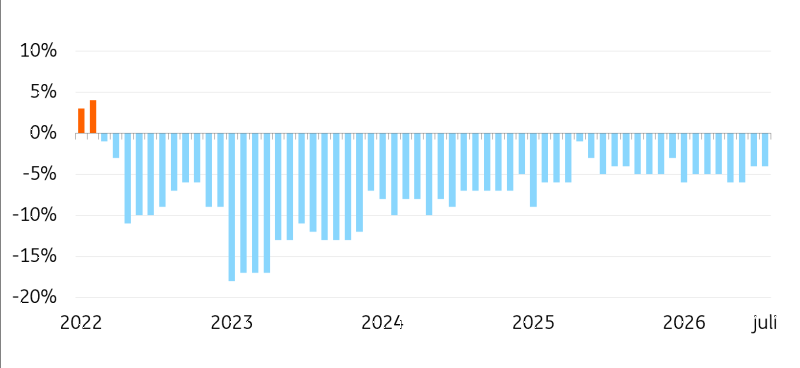
Despite the fact that the sector seems to be cautiously finding its way up, market conditions remain challenging. After two years of contraction, hours worked increased by just 0.5% last year. The recovery also remains uneven; growth is concentrated among smaller and specialised staffing firms, while larger temporary employment agencies continue to face declining volumes. Among agencies affiliated with the industry association ABU, hours worked have fallen continuously since March 2022. Although the contraction has become less pronounced since early 2025, a meaningful recovery remains elusive.
The decline in temporary employment hours continued into 1H26
Temporary employment hours of large temporary employment agencies in the Netherlands affiliated with the industry association ABU, year-on-year
New collective labor agreement makes temporary workers more expensive
The new collective labor agreement, introduced at the start of this year, has significantly increased the cost of hiring temporary workers and marks a major overhaul of the Dutch staffing industry. Under the new rules, temporary workers are entitled to employment conditions that are at least equivalent to those of employees in comparable roles at the client company. In addition, pension accrual now starts from day one, rather than after one year of employment. As a result, the cost of hiring temporary staff has risen sharply, particularly for short-term assignments such as covering sickness absence or meeting peak demand.
6.5% higher rates in 2026
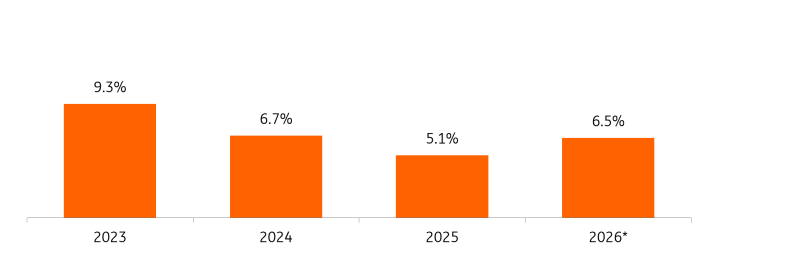
To offset rising costs, the staffing industry is expected to raise rates by an average of 6.5% in 2026. However, higher rates do not fully compensate for rising expenses. Long-term contracts with fixed pricing often limit firms’ ability to pass on cost increases to clients. At the same time, growing investments in IT, digitalisation and compliance continue to weigh on profitability. As a result, margins remain under pressure despite rising rates.
Significantly higher rates in the flexible employment sector in 2026 due to stricter regulation
Selling prices in the flexible employment sector, year-on-year
Source: CBS, *forecasts 2026 ING Research
Mandatory certification to accelerate market shake-up
The regulatory burden on flex companies is set to increase further in the coming years. Following the renewed enforcement against false self-employment and the introduction of a new collective labour agreement, the Temporary Employment Agencies Admission Act (Wtta) will come into force on 1 January 2027. Designed to tackle malpractice in the sector, the legislation introduces mandatory certification for businesses that supply temporary workers. To qualify, firms must demonstrate compliance with labour and tax regulations and provide a 100,000 euro financial guarantee.
The new requirements are expected to drive further consolidation in the staffing industry by increasing compliance costs and administrative burdens. Smaller temporary employment agencies, in particular, often lack the scale and financial resources needed to meet the stricter standards, making acquisition by larger players an increasingly likely outcome.
Strategic repositioning necessary
Structural labour shortages, stricter regulation, technological change and ongoing margin pressure are forcing staffing firms to rethink their traditional business model. The focus is shifting from volume-driven to value-driven growth. While success in the past was often based on scale, flexibility and price, technology, expertise and sector specialisation are becoming increasingly important competitive advantages. Investments in digitalisation and AI can improve efficiency and productivity, while expanding into HR services, training and career development creates new growth opportunities.


Comments
Log in or sign up to join the conversation.