


The Dutch construction sector is expected to stabilise in 2026 after a weak start to the year. In 2027, building volume will grow slightly again, mainly because more building permits issued will gradually lead to more housing construction. Nevertheless, the recovery remains limited.
More permits, but no quick breakthrough yet
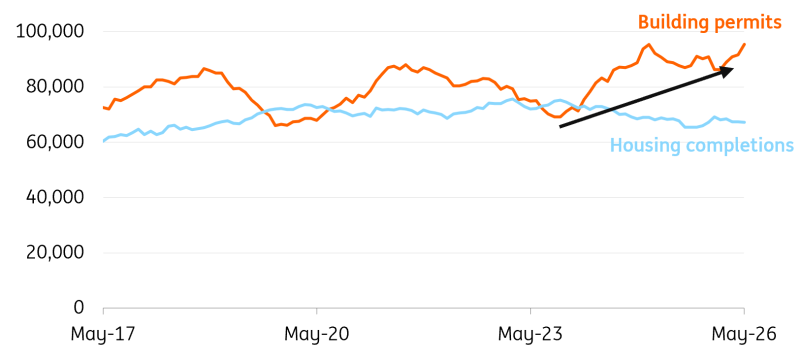
In May, 10,628 building permits were issued for new-build homes, the highest monthly number since the start of the current measurement method in 2015. However, permits do not translate directly into new homes. Projects can be delayed while homes are sold, plans revised, or permits renewed. As a result, the number of housing starts typically trails the number of permits issued by 10,000 to 15,000 each year.
Number of building permits on the rise again
Number of Dutch new-build homes, rolling annual total per month up to and including May 2026
71,000 new-build homes in 2026 and 74,000 in 2027
In the first four months of 2026, 7% fewer new-build homes were built than in the same period last year. That shortfall will need to be recovered over the remainder of the year, which is why we expect only a modest increase to around 71,000 completed homes in 2026, rising further to 74,000 in 2027.
Infrastructure sector remains an important driver, but growth is levelling off
The infrastructure sector remains the strongest subsector within Dutch construction. The outlook for the infrastructure sector is also positive. Since 2020, production in the infrastructure sector has shown persistently high growth rates, with volume growth of 10.5% in 2025. However, we do expect volume growth to be much lower in 2026 and 2027.
The growth rate in the infrastructure sector is slowing down due to high construction costs, staff shortages, nitrogen restrictions and limited government budgets. Because of these limited budgets, the government has decided to prioritise maintenance instead of new construction. The recent closure of the Merwede Bridge for trucks due to overdue maintenance also shows that this is needed. However, production levels in the infrastructure sector remain high – they are more than 40% above the level of five years ago.
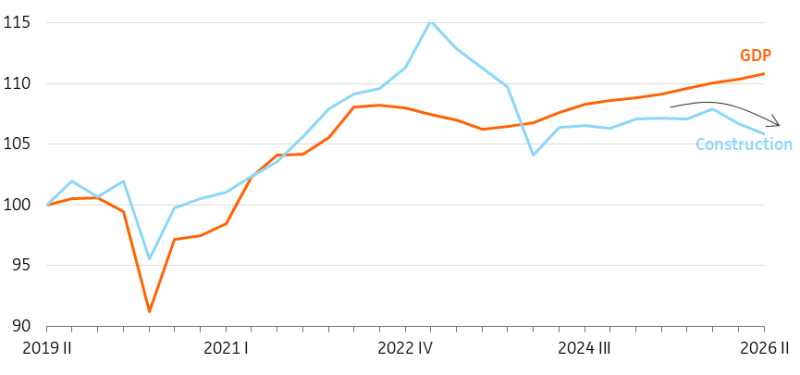
Construction output falls in first half of 2026
Volumes Dutch construction sector in value added (index Q2 2019= 100)
Recovery remains fragile
Total Dutch construction production contracted by around 1% in both the first and second quarters of 2026. This means that construction has lagged behind the growth of the Dutch economy as a whole since the beginning of 2024.
For the entire year of 2026, ING Research expects zero growth on balance. Slight growth of 1% is expected to follow in 2027, helped by the previous increase in the number of building permits.


Comments
Log in or sign up to join the conversation.