


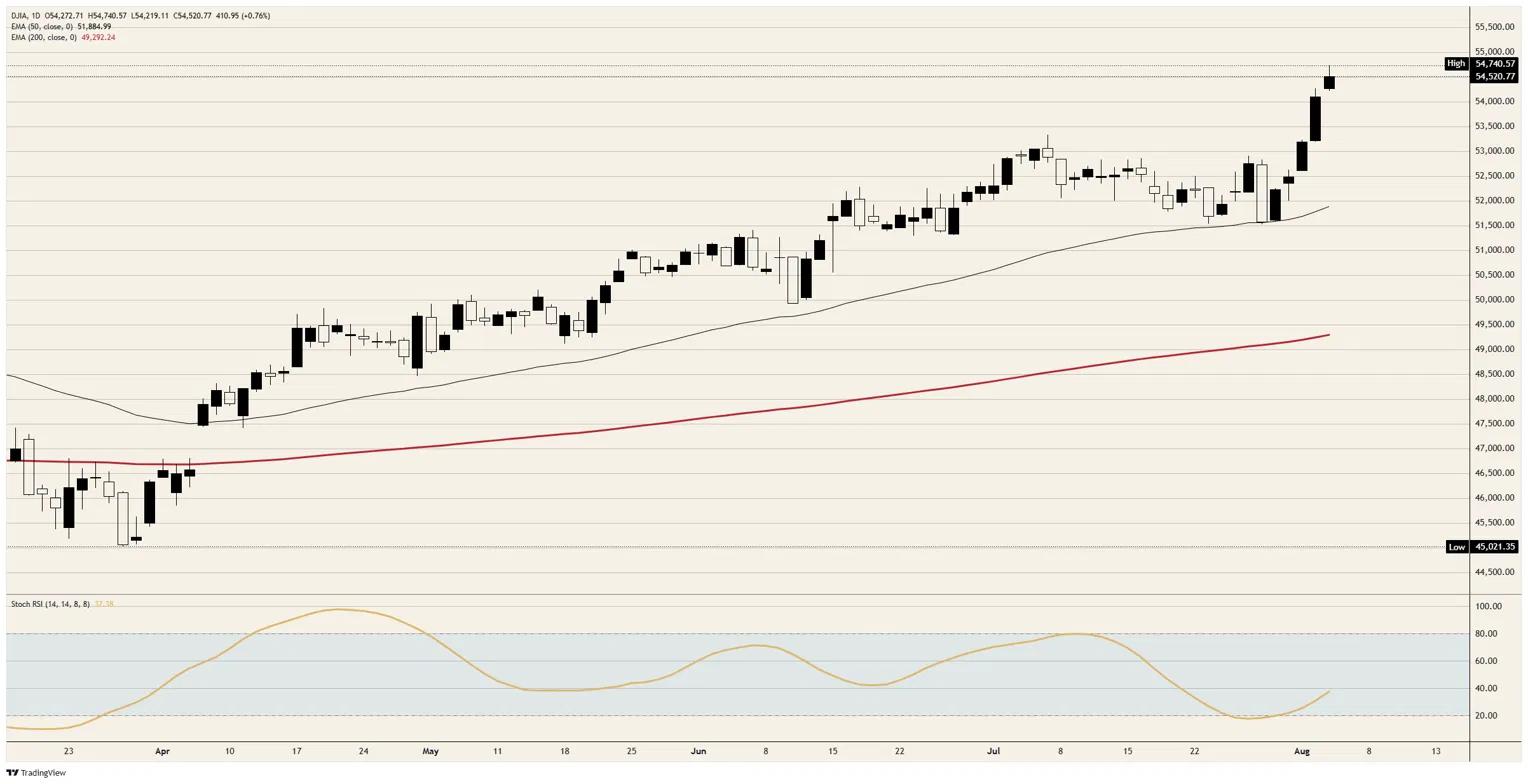
The Dow Jones Industrial Average (DJIA) trades near 54,500 on Wednesday, 0.76% higher and at a fresh record, roughly 1,400 points above the high it set in early July. The bid rests on the Strait of Hormuz reopening within days, after Washington called off a fresh round of strikes and pointed at talks. The draft terms of that reopening, reported during the same session, would route inbound traffic through Iranian waters and attach a fee to cargo that has never paid one.
A reopening with a price attached
The negotiation runs between Tehran and Muscat rather than Tehran and Washington, and the text on the table sets up a temporary 60-day arrangement in which ships entering the Gulf transit a northern lane inside Iranian territorial waters while outbound traffic runs south through Omani waters, coordinated with Iran. Tehran is seeking a transit fee of 5% to 7% of cargo value. Muscat has floated something nearer 3%, and Washington wants no fee at all.
Before the war, the Strait was open to all shipping at no charge, so the reopening now being bought as relief would convert the most important chokepoint on the map into a metered one, run by the party that shut it. Regional officials pushed back in wire reporting on the claim that agreement is close, saying the definition of control and the fee mechanism are both open. Equities looked through five months of a shut Strait as though the closure cost nothing, and are paying a record for the reopening.
The concession reads better alongside the supply position. Commanders advised in July that the campaign was running short of munitions, and wire reporting now has the US Army down to the last of its long-range precision missiles. A pause sourced to magazine depth was already an inventory problem rather than an agreement, and these terms are what that becomes once the counterparty prices it.
Hiring cracked and prices did not
Private payrolls added 44K in July against a 70K consensus, from 98K, and the Institute for Supply Management (ISM) services survey said the same thing from the other side. The headline Purchasing Managers Index (PMI) held expansion at 54.1 against 54.5 expected, from 54, and new orders strengthened to 57.2 from 55.1. The employment index fell to 47.4 from 51.2, into contraction and the weakest reading since March.
Prices went the other way inside the same release, with the ISM prices paid index rising to 70.3 from 67.7 and its twelve-month average reaching the highest since April 2023. Demand firming while hiring contracts and input costs accelerate is the whole services economy in one survey, and it is not the survey that pairs with an all-time high.
A soft labour print usually buys a cut, and this strip has none to give, with the 30 July capture pricing zero cut probability at every 2026 meeting and at least one hike at 59.2% by 16 September. The calendar scored two Fed speeches before the New York open, one hawkish and one neutral, and the neutral score belonged to a July dissenter who spent the session arguing that policy is not restrictive and that the time has come to start moving up.
A record built out of thirty share prices
The averages stopped agreeing as the session matured. All three were higher at their peaks, the blue-chip index by more than 1%, only for the S&P 500 to flatten and the Nasdaq Composite to turn lower while the Dow Jones Industrial Average held three quarters of a percent.
Inside the index, the artificial intelligence (AI) trade netted out, with Alphabet (GOOGL) falling significantly after confirming a reshuffle of its AI divisions and the departure of its chief scientist after 27 years, against Nvidia (NVDA) rising significantly after SpaceX (SPCX) said it would build its AI computing infrastructure exclusively on Nvidia processors. Both are components.
The two heaviest declines of the day sat outside the index, with Advanced Micro Devices (AMD) dropping significantly on adjusted earnings that only edged estimates and SpaceX dropping significantly on its first quarterly report since June's listing, in which second-quarter capital expenditure jumped sixfold to 18.4 billion Dollars. The price-weighted structure blamed for this index lagging the technology trade sorted the day's largest losers out and kept the winner in.
Friday is the number that matters
Nonfarm payrolls land Friday at 12:30 GMT with an 80K consensus against 57K prior, the unemployment rate at 4.2% from 4.2%, average hourly earnings at 0.3% MoM and 3.5% YoY, participation last at 61.5% and the broader underemployment measure last at 7.9%. Thursday brings initial jobless claims at 202K from 197K, with preliminary second-quarter productivity and unit labour costs alongside them.
Given private payrolls at 44K and a services employment index in contraction, an 80K consensus is the number to fade, and the earnings line matters more because it feeds the cost story the services survey has just printed. There is no meeting this month, so two payroll reports arrive before the September decision.
Levels
Resistance: Nothing sits above the tape, so the session high just short of 54,750 is the first mark, with 55,000 the next round objective above it.
Support: The session low near 54,200 is the first shelf, with the 54,000 handle beneath it and the early-July record near 53,300 the reclaim line under that. The 50-day Exponential Moving Average (EMA) near 51,900 sits more than 2,500 points below spot and is not in play this week.
Bias: Bullish above 54,000. The daily Stochastic Relative Strength Index (Stoch RSI) near 37 leaves an index at an all-time high with its momentum oscillator in the lower half of its range, which reads as unspent rather than exhausted after the July flush. Invalidation on a daily close beneath 54,000, and the risk to this call is a headline rather than a level, because the same peace trade has been sold back four times since April.
Dow Jones daily chart



Comments
Log in or sign up to join the conversation.