

DoorDash Inc. (DASH) confirmed it will offer $65, payable at least 75% in cash, and also new DASH stock to buy Instacart (Maplebear, Inc.: CART) for about $17 billion, according to CNBC. It also delivered strong Q3 FCF.
As a result, DASH has risen. It's up 6% today alone at $190.07, defying the market downturn. Moreover, since Oct. 26, when it closed at $168.44, DASH is up 12.8%.
The deal, which was announced with Q3 earnings on Oct. 29, could take a year or longer to close. This article discusses some ways to play DASH.
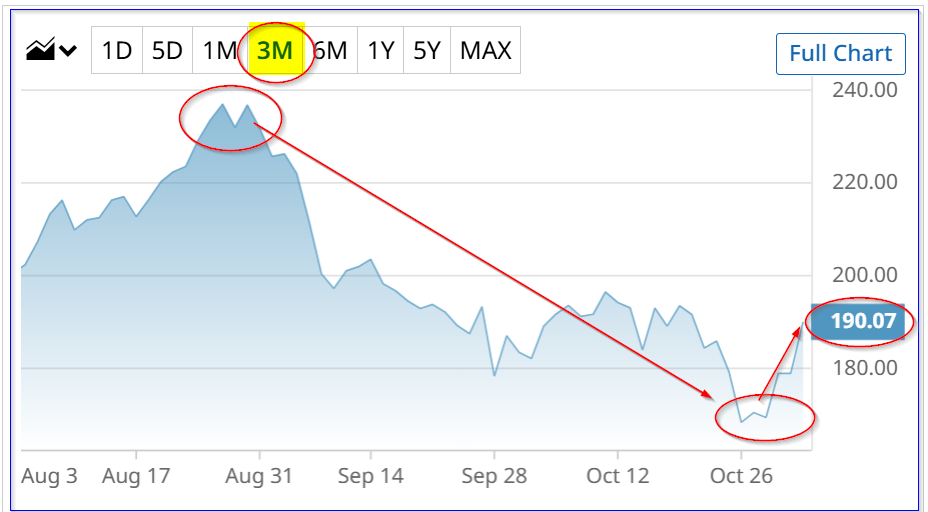
DASH stock - Barchart - As of Nov. 2, 2026
Strong FCF Results
I discussed DoorDash's past results and its valuation in a pre-earnings release article on Oct. 28, “Huge, Unusual Call Options Volume with DoorDash Ahead of Earnings - Is DASH Undervalued?”
I discussed how DASH could afford the takeover at $17 billion and also why it might be worth $100 billion or $231 per share if it can maintain an 18.6% FCF margin. That's still over 21% above today's close.
The Q3 results show that its FCF has remained strong. For example, DoorDash's FCF in Q3 was $904 million (higher than the $883 million last quarter, and 11.9% over last year's $808 million).
Moreover, its Q3 FCF represented 19.6% of revenue, according to Stock Analysis. Revenue also rose 34% YoY, and its FCF was up 17.4% to $2.691 billion over the trailing 12 months (TTM). Moreover, its TTM margin stayed strong at 15.77%.
Forecasting Dash FCF
However, that's lower than our 18.6% assumption. As a result, the valuation could be lower.
However, on further review, it appears the TTM figure is being held back by the Q4 2025 9.28% FCF margin. So, if Q4 remains strong at about 15%, Dash could generate $3.0 billion in FCF in 2026 (based on an $18 billion revenue est.), and its TTM margin will likely average 17%.
So, using analysts' 2027 revenue forecasts of $21.69 billion, and using a 17.5% FCF margin, next FCF could hit $3.8 billion.
And, just as in my last article, using a 25x multiple, that implies DASH stock will be worth $95 billion. That is still 15% over its present $82.57 billion market cap.
As a result, the new price target (PT) for next year is $218.85 (i.e., 1.15x $190.07). However, other analysts have much higher PTs: $251.23 (Yahoo! Finance survey) and $254.21 (Barchart).
Note: I did not account for any merger costs, as the deal won't close until the end of 2027 or early 2028. Moreover, the combined FCF of both companies will likely cover those costs.
So, what is one of the best DASH plays now?
Shorting OTM DASH Puts
One play is to sell short puts with lower-than-market-price strike prices in near-term expiry periods. The advantage is that the investor collects income immediately for the obligation to buy shares at that lower strike price.
The bet is that the stock won't dip to that lower strike price. But even if it does, the extra income lowers the breakeven point for the buy-in.
For example, the Dec. 4, 2026, expiry shows that the $175.00 put strike price contract, which is 7.93% below the closing price, has a midpoint premium of $5.13.
That represents an expected yield of 2.914% over the next month (i.e., $5.13/$175.00).
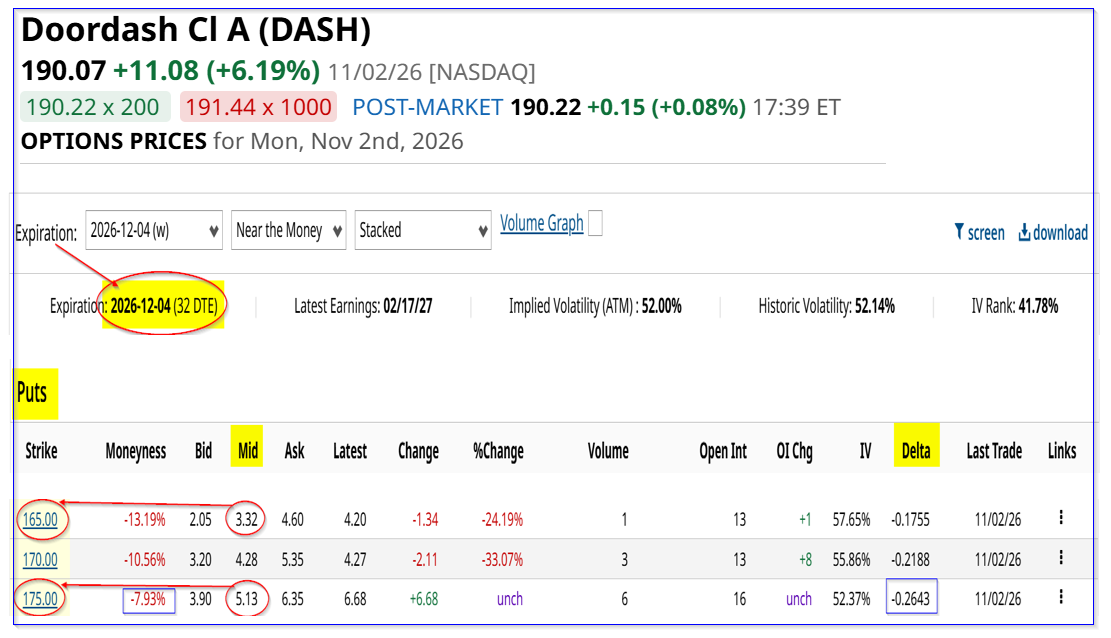
DASH puts expiring Dec. 4, 2026 - Barchart - As of Nov. 2, 2026
However, the investor must commit 100% of the purchase cost as collateral (i.e., $175 x 100 = $17,500).
The $513 already collected (i.e., $5.13 x 100), lowers the potential cost to buy 100 DASH shares to $16,987 (i.e., $169.87 per share) if DASH falls to $175.00 on or before Dec. 4.
That is 10.63% below the Nov. 2 close, so this is an attractive play for value investors.
However, many investors aren't able to post $17,500 in collateral for this play. One way around that, with higher risk, is to do a put credit spread.
DASH Put Credit Spread
This involves adding one more leg to the short-put play - i.e., buying a lower strike-price put. In this example, that could be buying a $165 put for $3.31.
So the net put credit is: $513 - $332, or $181. However, the brokerage firm will require the investor to post just $1,000 in collateral (i.e., ($175-$165) x 100).
So, the at-risk capital (i.e., it can be lost if DASH drops to $165.00 or lower), is $1,000 - $181, or $819. As a result, the expected return (ER) is very high:
$181 / $819 = 22.1% ER
That is much higher than the 2.914% short-put return. Moreover, if an investor did 3 put credit spreads, the income would be similar.
For example, 3 put credit spreads bring in $543 ($181 x 3). The collateral requirement is just $3,000, and the net at risk is $2,457.
That compares to $513 with a short-put play and $17,500 in collateral. However, the risks are higher for the put credit spread. For example, the breakeven is now higher at $173.19 (i.e., 175-$1.81), vs. $169.87 with the put credit spread.
And a put credit spread could result in a 100% loss of collateral, which won't happen with the short-put play (just a potential unrealized loss).
The bottom line is that these are two ways to play DASH, now that it has made a bid for CART and produced its strong Q3 results.



Comments
Log in or sign up to join the conversation.