

The Fed will not be cutting rates any time soon.
Dangerous Brew of Inflation
Greg Ip at the Wall Street Journal comments on The Dangerous Brew That’s Rattling Bond Markets
The question for bond markets isn’t why yields rose so much in the past week, but why this didn’t happen sooner.
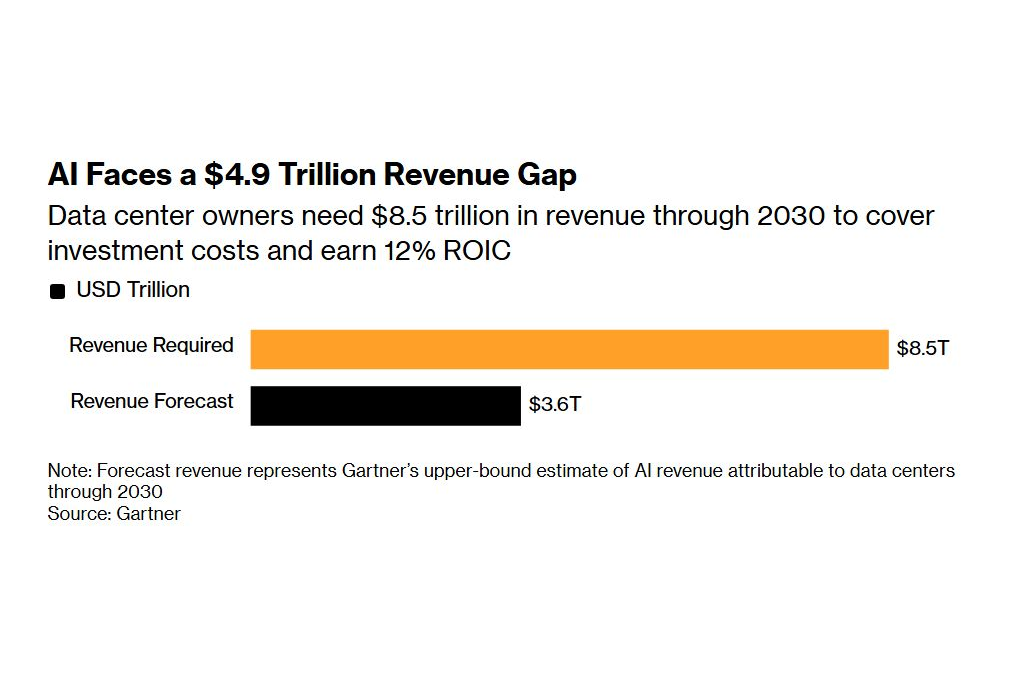
Government borrowing—everywhere, and especially in the U.S.—has been out of control for years. Inflation in the U.S. has been stuck above the Federal Reserve’s 2% target since 2022. Add in heavy corporate borrowing to fund the AI build-out, and you wonder why long-term interest rates aren’t higher.
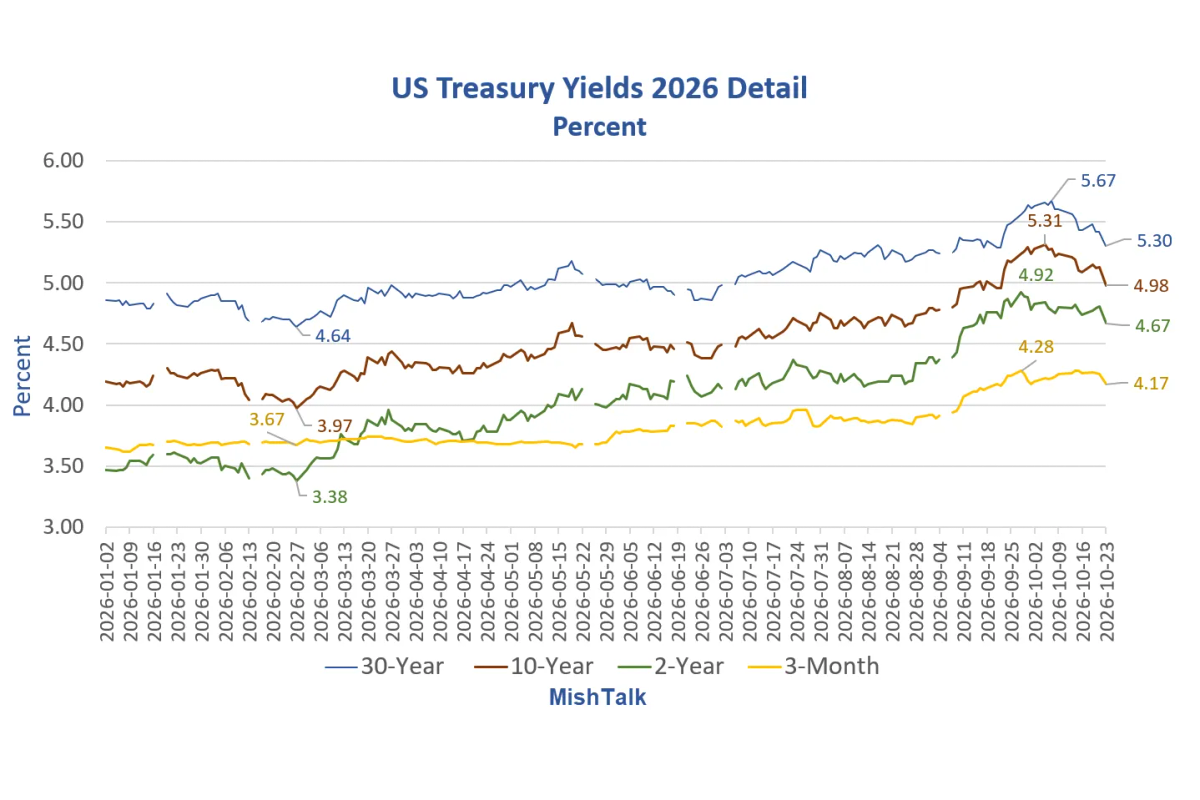
To be sure, the selloff (when bond yields go up, their prices go down) has been mild in the scheme of things. The 30-year Treasury yield hit a 19-year high of 5.18% Tuesday. Yet the more closely watched 10-year yield, at 4.67%, was lower than in October 2023. Both dropped back Wednesday on hopes oil will resume flowing through the Strait of Hormuz.
The story of debt
Before 2020, elected leaders usually preached the virtues of austerity even if they didn’t practice it much. Since then, they have responded to almost every shock by borrowing more.
President Joe Biden’s 2021 stimulus was followed by President Trump’s 2025 tax cuts. His administration projects the budget deficit rising 16% this fiscal year to $2.1 trillion. Trump has requested a record $1.5 trillion for the Pentagon for next year. That is a lot of debt for investors to absorb.
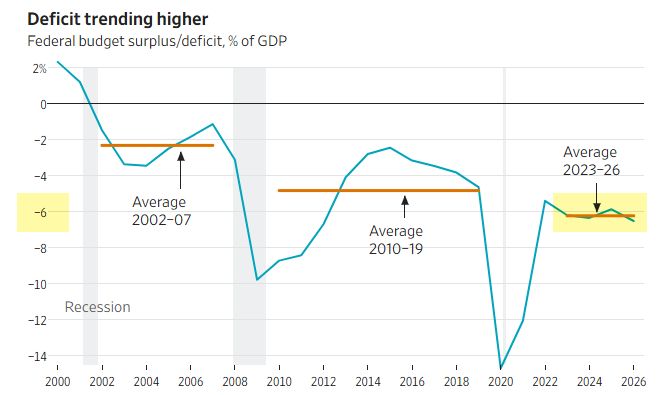
From 2023 through 2026, U.S. deficits will have averaged 6.2% of gross domestic product, unprecedented outside war, recessions or emergencies. That’s up from the 4.8% average from 2010 to 2019, and 2.3% from 2002 to 2007.
In the U.S., Trump has proposed suspending the federal gasoline tax, which would cost $3.5 billion a month according to the Committee for a Responsible Federal Budget.
Inflationary ‘one-offs’ keep coming
Until 2020, big economic shocks tended to push inflation lower: China’s entry into the World Trade Organization, the U.S. mortgage crisis, the euro crisis, the shale oil revolution, the initial wave of Covid-19.
Since then, shocks have tended to push inflation higher: the supply-chain disruptions following Covid, Russia’s invasion of Ukraine, Trump’s tariffs, and the closure of the Strait of Hormuz.
We think of these as “one-off” events after which inflation will naturally return to 2%.
But what if they are symptoms of a world more prone to supply shocks because of war, geopolitical rivalry, protectionism, populism and extreme weather? As the shocks accumulate, the public may expect higher inflation indefinitely.
Kevin Warsh, to be sworn in as Fed chair Friday, thought he could cut rates as AI boosted productivity and cut costs. And he might yet. One supportive sign: There is no cost pressure coming from the labor market.
Slight Disagreement With Greg Ip
Until that last paragraph I had no disagreement with Ip. That last paragraph above added two.
First, Warsh only has one vote. He is not the Fed. So Warsh cannot by himself cut rates.
Second, while anything might happen, the odds are it won’t. The futures market is gearing up for hikes and correctly so,
If Warsh votes to cut interest rates in June, he will be the first Fed Chair since the 1930s to dissent.
Fun Fact
Marriner Eccles is the only Federal Reserve Chair in history to ever cast a dissenting vote on monetary policy, opposing three decisions in the late 1930s.
Prepare for Trump Howls
The next FOMC meeting and first with Warsh as Fed chair is in 27 days, June 17.
According to CME Fedwatch there is a 99.5 percent chance the Fed holds pat and a 0.5 percent chance the Fed hikes.
Trump appointed Warsh expecting a rate cut. That ain’t happening.
Warsh will look like a fool if he dissents. Will he? I don’t know. But if he does expect to hear the name Marriner Eccles come up everywhere.
And if Warsh doesn’t dissent, Trump is going to immediately scream (perhaps anyway if Warsh does not deliver what one vote can’t).
Trump’s war on Iran, one of the dumbest wars in history, spiked oil prices and will increase military spending needs. It was the final straw that eventually sent bond yields soaring.
I like Ip’s lead “The question for bond markets isn’t why yields rose so much in the past week, but why this didn’t happen sooner.“
Related Posts
May 16, 2026: Lacy Hunt, a Bond Bull for 44 Years, Now Forecasts Higher Inflation
“I did not have this on my bingo card,” quipped John Mauldin.
May 20, 2026: Meta Begins 8,000 Layoffs, Another 6,000 Job Openings Cancelled
The 8,000 job cuts are about or 10% of staff. Meta needs to offset the cost of its AI investments. The implications are sobering.
May 19, 2026: A WSJ Opinion Article Tries to Explain “Why Everything Feels More Expensive”
The WSJ explanation is hugely lacking. Let’s discuss.
Add all of those up. Does it look stagflationary or not?
Comments
Log in or sign up to join the conversation.