


Wall Street’s relief rally carried into Asia as another leg lower in oil prices eased inflation concerns and gave risk assets room to recover after a volatile central-bank week. MSCI’s Asia Pacific benchmark rose 0.8%, supported by the strongest S&P 500 and Nasdaq 100 performances since early August. The rebound was led by technology and semiconductor names, with Samsung Electronics and SK Hynix rallying on renewed optimism after Nvidia’s upbeat outlook helped repair some of the damage from the recent AI valuation wobble. US equity futures pointed to further gains, though European markets were set for a slightly softer open.
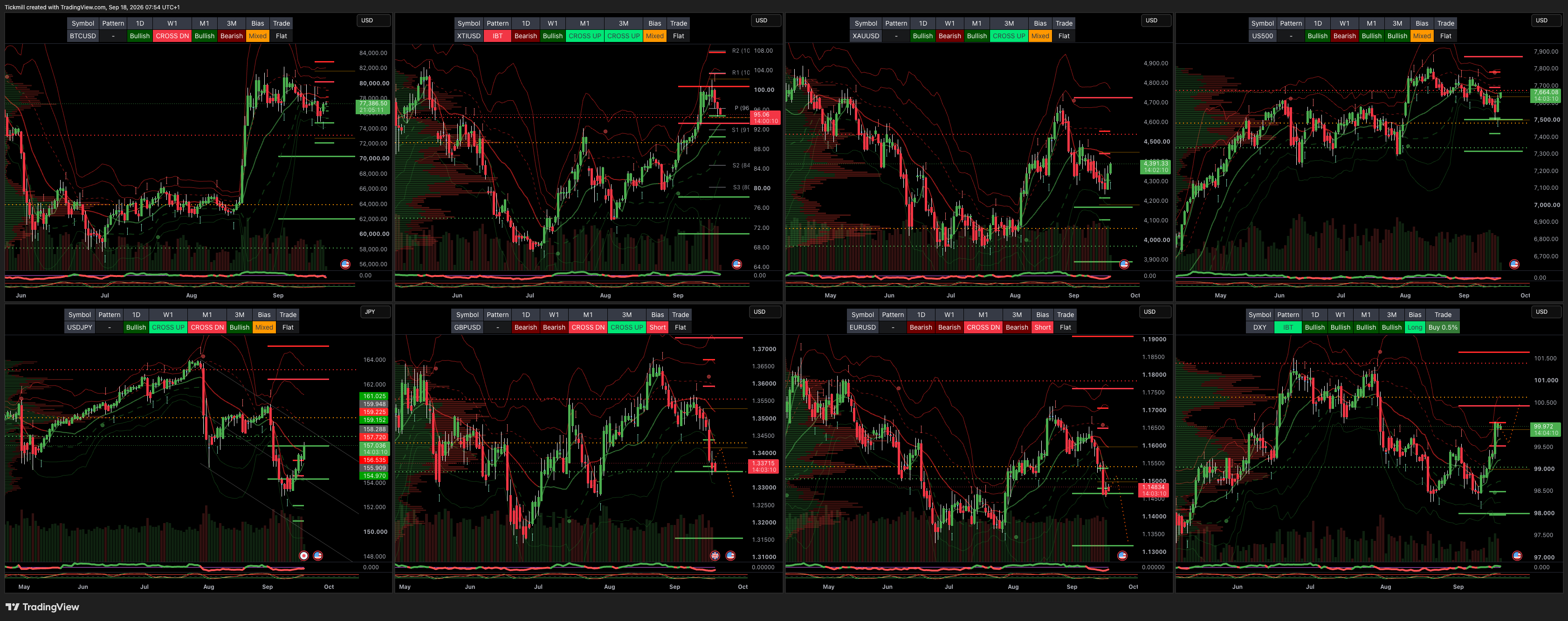
The oil market remains the key macro swing factor. Brent crude fell 1.3% to around $103.50/bbl, marking a third consecutive daily decline as immediate Middle East supply concerns continued to ease and traders shifted attention toward diplomatic efforts around the US-Iran conflict. The retreat from last week’s highs has taken some pressure off inflation expectations, duration and equity multiples. But crude remains elevated enough to keep central banks cautious, especially as the energy shock continues to work through consumer prices, corporate margins and inflation expectations. The Yen was the major FX mover, weakening to around 157.10 per Dollar after the Bank of Japan raised its policy rate by 25 bps to 1.25%. The decision came despite two board members dissenting, underlining the controversial nature of the move. Normally, a rate hike would be expected to support the currency, but the Yen sold off as investors focused on Governor Ueda’s cautious communication, the still-wide US-Japan rate differential and the fact that the Federal Reserve’s hawkish stance continues to dominate global FX pricing. The Nikkei 225 gained 1.7%, with Yen weakness supporting exporters and easing concerns over a disorderly unwind of risk positioning.
Ueda’s press conference (ongoing as of writing) is reinforcing the sense that the BoJ is tightening, but still trying to avoid triggering excessive market volatility. He said Japan’s economy is recovering moderately, albeit with some weakness, and is likely to continue growing at a moderate pace. He also noted that financial conditions remain accommodative, while warning that the stage for policy conduct has changed and that the BoJ’s short-term objective has shifted significantly. Most importantly, Ueda said the Bank would keep raising rates in response to developments in the economy and prices. The inflation message was clearly more hawkish. Ueda warned that underlying inflation could overshoot the 2% target if firms’ wage- and price-setting behaviour becomes more aggressive and if medium- and long-term inflation expectations continue to rise. He also flagged the need to monitor the Middle East situation, AI-related demand expansion and FX moves for their impact on Japan’s activity and prices. However, his refusal to comment on short-term market moves suggests the BoJ is not yet prepared to directly lean against Yen weakness, even as imported inflation pressures remain a concern. The Yen remains a focal point for global markets because Japan is now tightening into a world where the Fed has also restarted its hiking cycle. The currency had previously rallied on expectations of faster BoJ normalisation, a partial unwind of Yen-funded carry trades and speculation that Japanese pension funds might increase domestic allocations. Today’s price action shows those flows are not one-way. With US yields still elevated and the Dollar supported by Chair Kevin Warsh’s inflation-fighting message, the Yen remains vulnerable unless the BoJ signals a more forceful path or US yields retreat more decisively.
In fixed income, Treasury yields stayed elevated after the US 10-year briefly touched 5.02% following the Fed decision. The long end remains the central market barometer. Investors have so far accepted Warsh’s hawkish hike without forcing a renewed disorderly selloff, but the bond market is still demanding a high risk premium for inflation uncertainty, fiscal supply and energy volatility. Australian and New Zealand government bonds gained in Asia, broadly tracking the stabilisation in Treasuries, while Japan’s rate outlook remains increasingly sensitive to FX and oil. Gold extended its recovery, trading around $4,360/oz after rising nearly 2% on Thursday and reclaiming much of the ground lost over the prior three sessions. The move reflects the dual nature of the current macro backdrop: lower oil and firmer equities support risk appetite, but geopolitical uncertainty, elevated inflation risk and questions over fiscal sustainability continue to sustain demand for hedges. The Yuan also strengthened to its highest level against the Dollar in more than four years, supported by resilient Chinese exports and ongoing central-bank support.
In the UK, August retail sales delivered a firmer-than-expected signal for domestic activity. Ex-fuel sales volumes rose 0.6% month-on-month, compared with expectations for a 0.2% decline, rebounding from July’s weakness. The data are noisy, with World Cup effects, extreme weather and bank holiday timing all complicating the interpretation. Still, a clear theme is emerging: the fuel price shock appears to be weighing more directly on motor-fuel volumes than on broader discretionary spending. The ONS noted that consumer habits may be changing in response to high fuel prices, with the rising prevalence of electric vehicles potentially contributing to that shift.The August rebound should support a recovery in the retail and wholesale component of monthly GDP after July’s weakness proved a drag. More importantly for the Bank of England, ex-fuel retail sales volumes running at 2.7% year-on-year add to evidence that the UK economy is performing more firmly than expected despite the energy shock. That resilience sits uncomfortably alongside the Bank’s increasingly hawkish inflation assessment and makes it harder for the MPC to dismiss the risk that demand remains too strong for inflation to return smoothly to target.
The BoE left Bank Rate unchanged at its September meeting, but the minutes gave strong hints that policymakers are leaning toward a November hike. The decision still depends heavily on Middle East and energy-market developments, but the language was notably firmer. Bailey, Breeden, Lombardelli and Ramsden all ended their individual paragraphs with explicit references to the possibility that policy may need to tighten or that it is becoming increasingly appropriate for Bank Rate to respond. Having already judged that inflation risks are tilted further to the upside and that CPI is now expected to peak above 4% early next year, the Bank looks increasingly likely to follow the Fed and ECB unless energy prices fall materially and geopolitical uncertainty eases.
Quantitative tightening was the other major UK policy development. The BoE announced a fundamental overhaul of the process for reducing its gilt holdings, providing greater clarity over the expected pace and shape of the portfolio unwind over the next eight years. On average, around £46bn of QT is scheduled each year between now and 2034. The most market-friendly element was confirmation that no long-dated gilts will be sold as part of active QT, where demand has been weaker and market sensitivity higher. The Bank also announced that while the operational design of selling gilts to the Debt Management Office rather than directly to end-investors is finalised, there will be a six-month pause in active QT. That is a marginal positive for gilts, especially as markets had expected an uninterrupted QT pipeline. The new structure should reduce uncertainty around long-end supply and help avoid unnecessary pressure on the part of the curve most exposed to fiscal and pension-demand concerns. Gilts responded strongly, with long-dated yields falling around 15 bps. The rally reflected a combination of factors: a credibility boost from the BoE’s hawkish Bank Rate messaging, relief that long-dated active QT will be avoided, and the temporary pause in sales. The move could also prove helpful for the Chancellor if the decline in yields falls within the observation window used by the OBR to calculate debt-interest costs for the Budget projections.
Macro to Micro, the market has been given a temporary reprieve by falling oil prices, stabilising bonds and central banks that are tightening without yet breaking risk appetite. But the underlying story remains one of policy normalisation under inflation pressure. The Fed has restarted its hiking cycle, the BoE is clearly preparing markets for a possible November move, and the BoJ has raised rates while warning that Japan’s inflation dynamics are changing. The relief rally in equities can continue if oil keeps falling and the US 10-year yield remains contained, but the bar for disappointment is low. Watch the Dollar, Yen, Gold and long-end yields closely: they will show whether investors believe central banks are regaining control, or whether markets are simply enjoying a pause before the next inflation, energy or fiscal shock.
Overnight Headlines
China Presses Iran To Help Rein In Houthis After Saudi Appeal
Pakistan Army Chief Urges Iran To Restrain Houthis
Trump Administration Approves $24B Sale Of F-35 Jets To Saudi
RBA’s Bullock Warns Inflation Risks Are Materialising
BoJ Hikes Rates At Fastest Pace Since 1990 As Inflation Persists
Yen Drops Against Dollar After BoJ Raises Rates As Expected
Chinese Yuan Hits Strongest Level Since 2022 After PBoC Fixing
JPMorgan Sees BoE Hiking Rates In February
KKR Ups Its US Treasury Yield Call, Sees Fed Keeping Rates High
Traders Eye Xi-Trump Meeting For Clues On AI Rivalry And Yuan Outlook
China Urges Stable Coal Output As Prices Rise To Three-Year High
Venezuela Nears Deal To Move $4B Gold Reserve To New York
Nvidia Commits $2B To Brookfield AI Infrastructure Fund
Putin Signs Decree To Seize Control Of Nestle Assets In Russia
US Regulator Opens Markets To Tokenised Stock Trading
FX Options Expiries For 10am New York Cut
(1BLN+ represents larger expiries and is more magnetic when trading within the daily ATR.)
EUR/USD: 1.1400 (EU4.15b), 1.1500 (EU2.18b), 1.1200 (EU2.11b)
USD/JPY: 155.00 ($4.21b), 150.00 ($3.27b), 120.00 ($1.73b)
AUD/USD : 0.7200 (AUD1.96b), 0.6975 (AUD915.8m), 0.7055 (AUD423m)
USD/BRL: 5.2500 ($529.5m), 5.1000 ($480m), 5.3940 ($443.1m)
USD/CAD: 1.3800 ($669.8m), 1.3695 ($482m), 1.3815 ($452.6m)
USD/CNY: 6.7700 ($699.3m), 6.8000 ($395.2m)
GBP/USD: 1.3440 (GBP619.7m), 1.3300 (GBP569.2m), 1.2970 (GBP498.9m)
USD/KRW: 1350.00 ($374.6m), 1275.00 ($360m)
NZD/USD: 0.5700 (NZD553.1m), 0.5725 (NZD401m)
CFTC Positions as of 11/9/26
Equity fund speculators increase S&P 500 CME net short position by 29,085 contracts to 336,643
Equity fund managers cut S&P 500 CME net long position by 19,683 contracts to 907,770
Speculators trim CBOT US 5-year Treasury futures net short position by 113,020 contracts to 1,267,493
Speculators trim CBOT US 10-year Treasury futures net short position by 74,492 contracts to 834,783
Speculators increase CBOT US 2-year Treasury futures net short position by 46,589 contracts to 929,107
Speculators trim CBOT US UltraBond Treasury futures net short position by 24,171 contracts to 345,140
Speculators increase CBOT US Treasury bonds futures net short position by 1,016 contracts to 200,517
Bitcoin net long position is 1,524 contracts
Swiss franc posts net short position of -29,985 contracts
British pound net short position is -58,836 contracts
Euro net short position is -42,616 contracts
Japanese yen net long position is 10,796 contracts
Technical & Trade Views



Comments
Log in or sign up to join the conversation.