

Production expands amid subdued capacity utilisation
Czech real industrial production gained 1.5% year-on-year in April and 1.4% month-on-month when adjusted for the number of working days, coming in well above market expectations yet broadly in line with the ING view. We think the Middle East conflict will start to bite, albeit with a delay, perhaps from late 2Q26 onward. The nominal value of new orders grew by 2.7% YoY, with foreign new orders adding 3.5% and domestic ones higher by 1.1% from a year earlier. The value of new orders gained 3.3% MoM in April. Construction output increased by 7.7% YoY and picked up by 0.6% MoM in April.
Manufacturing lags behind construction output
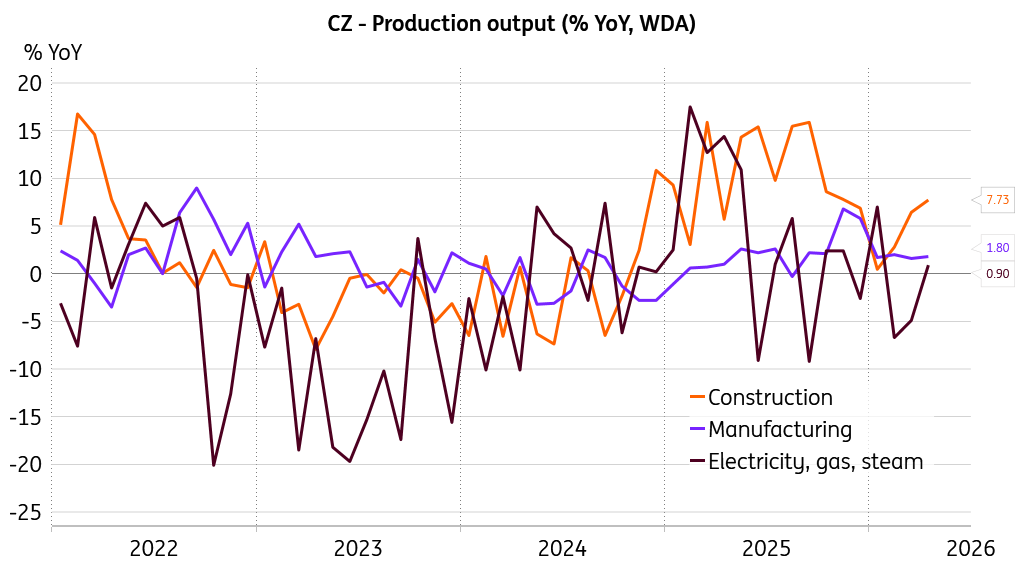
However, the average number of employees in industry fell 1.0% YoY in April and nominal wage growth slowed down to 5.8% YoY. Average employment in construction picked up by 2.1% YoY in April, while nominal wage dynamics eased significantly to 2% YoY in the same month. We saw accelerating wages in both industry and construction throughout the first quarter of the year, followed by softening in April. We believe that wage dynamics are going to come under pressure in the coming months, as firms face higher energy and material input costs coupled with elevated global competition.
The economy seems to have reserves
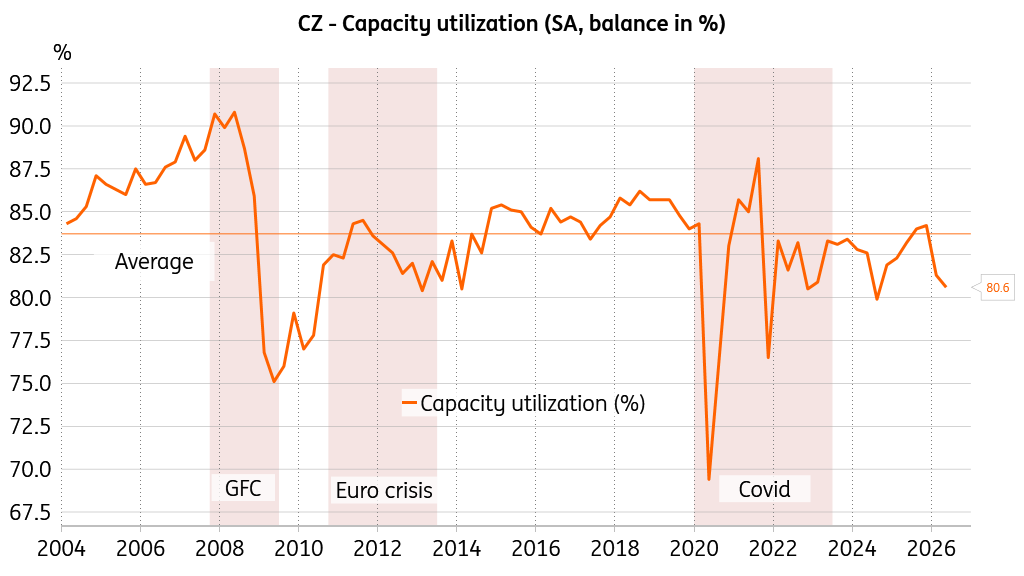
The long-term average of the annual growth pace of industrial production is 2.5% in real terms. Meanwhile, in times when the economy is doing well and grows at 3.6% YoY on average, such as between 2014 and 2019, real industrial production also rises by 3.6% annually on average. So, with April’s 1.5% annual growth rate and risks of a slowdown ahead, we remain far from operating at full capacity. This is also reflected in the latest capacity utilisation survey, which shows that the Czech economy used around 80% of its production capacity in 2Q26, well below the long-term average of 83.7% and the peak levels seen in 2008 and 2018.
Strong housing market and credit offer reasons for a hike
We still see the residential market remaining in a boom phase, with the annual price growth of flats softening only slightly to 12.9% in 1Q26 on average. Based on realised transaction prices, annual growth stabilised at around 16% last year. Data for 2Q will be available next Monday. In any case, annual rent growth has remained above 5% since January, marginally increasing. Volumes of new mortgages have continued to break successive highs, while loans to households continued to expand by more than 9% in April.
New mortgages fly high
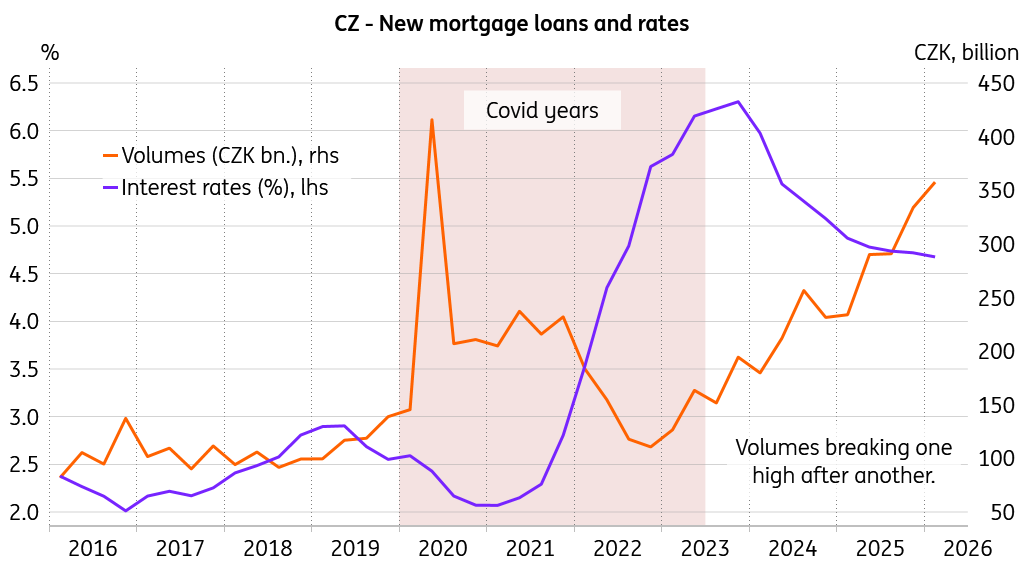
Indeed, rapid credit growth argues for a tighter monetary policy stance, especially as such strong dynamics in household borrowing have only been observed, since 2010, in the wake of pandemic-related distortions. Moreover, ample credit creation means more liquidity circulating in the economy, and we see that annual growth in the M2 monetary aggregate accelerated to 5.7% in April. While this pace remains below the long-term average of just over 7%, it could approach that level if borrowing appetite remains strong and continues to feed through into new lending in the near future.
M2 is cointegrated with CPI and picks up
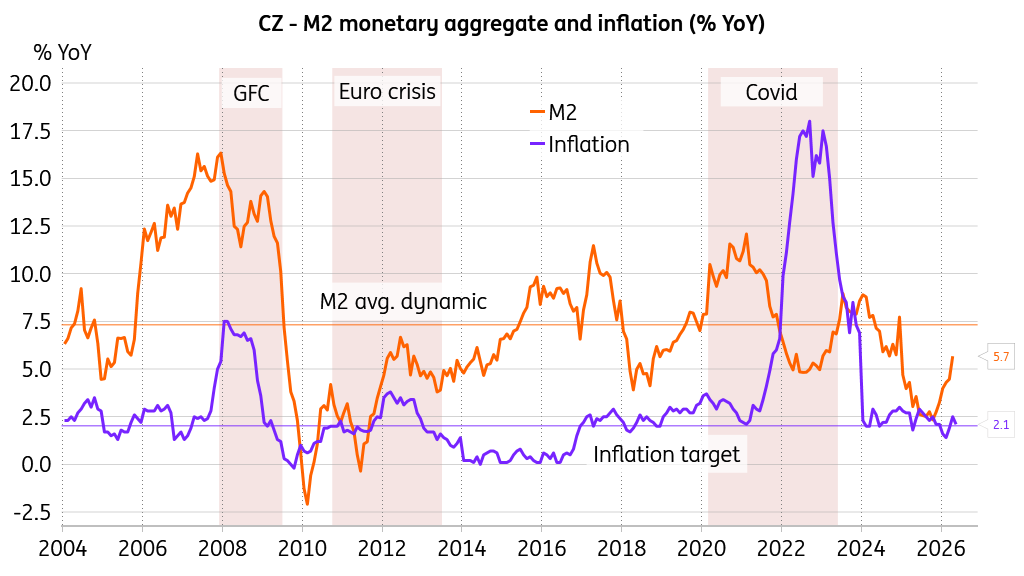
And as we know together with Milton Feedman’s MV = PY (where M is money supply, V is velocity of money, P is price level, and Y is real output): Persistent inflation is always and everywhere a monetary phenomenon. So yes, excess demand over supply in the housing market, together with buoyant credit growth, provides a solid rationale for proceeding with a rate hike in June.
And yes, M2 and CPI are well cointegrated and therefore tend to move together over the longer term. Moreover, our econometric test confirms a clear one-way Granger causality from M2 towards CPI, leaving little doubt that money in circulation is closely related to the overall price level. The question remains whether we are in a period of persistently high inflation right now or whether this remains a risk further along the monetary policy horizon.
Real wages catch up with economic performance
Solid wage dynamics of 8.1% in 1Q26 represent another potential reason to hike in June. However, there are a few caveats. First quarter wage growth was reached partially on the back of previous downward revisions, so it is not really elevated when assessed in level terms. Also, the real wage level has just surpassed its pre-Covid level but is still not above the peaks of the Covid years. Also, given the sharp and protracted deterioration in real wages during 2022 and 2023, real wages are just catching up to real GDP performance since 2019.
Real wages make up for preceding losses
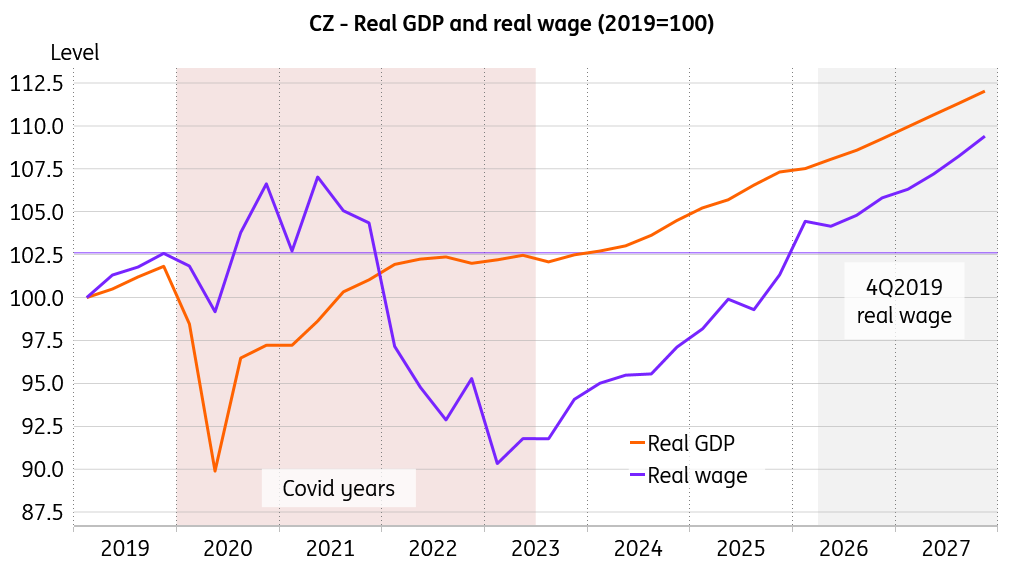
For sure, the punchy first quarter wage growth lifts our wage outlook to 7.3% in nominal terms and to 5% in real terms for this year, which is well above the assumed 2% real economic expansion. At the same time, we see this growth figure as being at risk of a potential downward revision should the impact of the Middle East conflict become tangible in the real economy. We also expect real wage dynamics to move much closer to real GDP growth over the next year. So, does the sanguine 1Q26 wage growth figure represent a reason for tighter monetary policy? Well, we are not convinced, as we don’t see any kind of wage-price spiral unfolding right now or when looking ahead. Still, the strong wage growth in 1Q26 could provide some additional justification for a higher policy rate, if desired. Let’s treat the wage issue as a borderline case.
Reasons to keep rates unchanged
Meanwhile, there are reasons to keep rates unchanged. We take the stance that the Czech economy is not in an overheating phase from 1Q26 and will stay below its potential at least until early next year. Also, with headline inflation close to the target and the core rate decelerating, we don’t see an imminent risk of persistently high inflation when looking ahead. On the contrary, we still expect the negative effects from the Middle East conflict to hit the global economy, with profound consequences for Czech exporters, overall economic performance, and the health of the labour market.
There is also a relatively new development: Czech government representatives have been openly complaining about what they see as an overly tight monetary policy stance, particularly compared with the European Central Bank.
We take the view that somewhat higher rates give the CNB room to adopt a genuinely prudent wait-and-see strategy in the face of a negative global supply shock, as it has done until now. We see this as a monetary policy dividend that the CNB has managed to preserve, unlike some other central banks.
However, should the CNB proceed with a hike, as recent hawkish comments suggest, questions may arise as to whether this is a counterreaction to government pressure. This would bring the issue of the CNB’s independence back into the spotlight. After all, a counterreaction is still a reaction.
All in all, while the government is of course entitled to comment on the CNB’s stance, such interactions are always delicate and tend to have unintended consequences and lingering aftereffects.
Real rates set to remain in the restrictive area
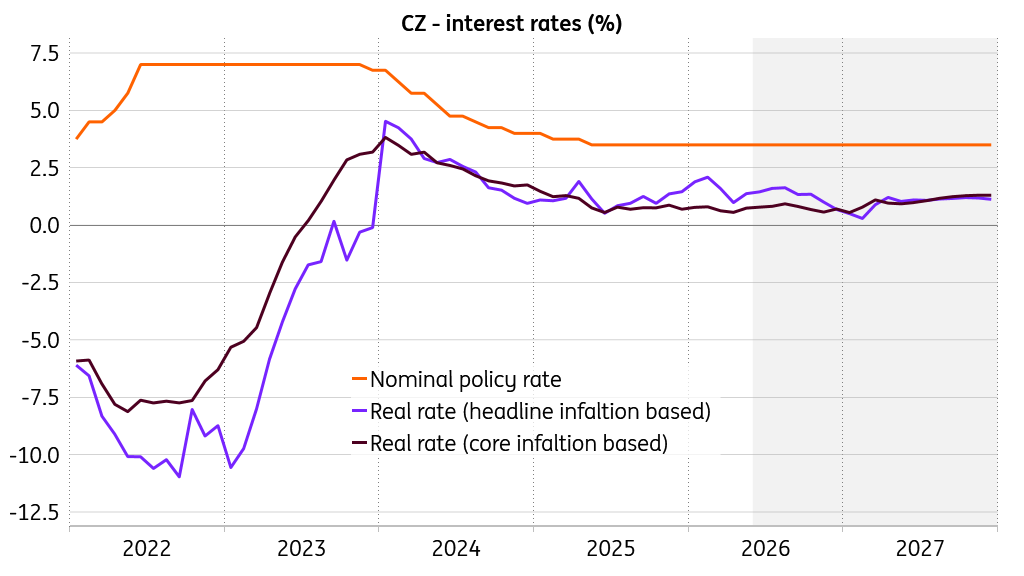
Our baseline view remains unchanged for now: we expect the policy rate to stay on hold at least until August, which we consider the optimal setting given current economic conditions and the outlook. But what we think is one thing, how individual board members perceive the situation, outlook, and risks is another. And ultimately, the outcome will depend on how the voting process plays out. Should we witness more hawkish comments and a shift towards some of the arguments we have outlined in favour of a hike, we would quickly adjust our expectations towards somewhat tighter monetary policy. But only modestly.



Comments
Log in or sign up to join the conversation.