

Congratulations Mr. President. What’s your encore?

Long Feared Oil Squeeze Arrives
The Wall Street Journal reports The Long-Feared Persian Gulf Oil Squeeze Is Upon Us
“In the whole written history of the strait, it has never been closed, ever,” said JPMorgan Chase analyst Natasha Kaneva. “To me, it was not just the worst-case scenario. It was an unthinkable scenario.”
On Saturday, the Abu Dhabi National Oil Co. signaled it too was slowing production so tanks didn’t overflow. If the strait is still closed this Friday, daily output in the region could fall by more than four million barrels, Kaneva estimates. The decline could reach around nine million by the end of March, representing almost a 10th of global demand.
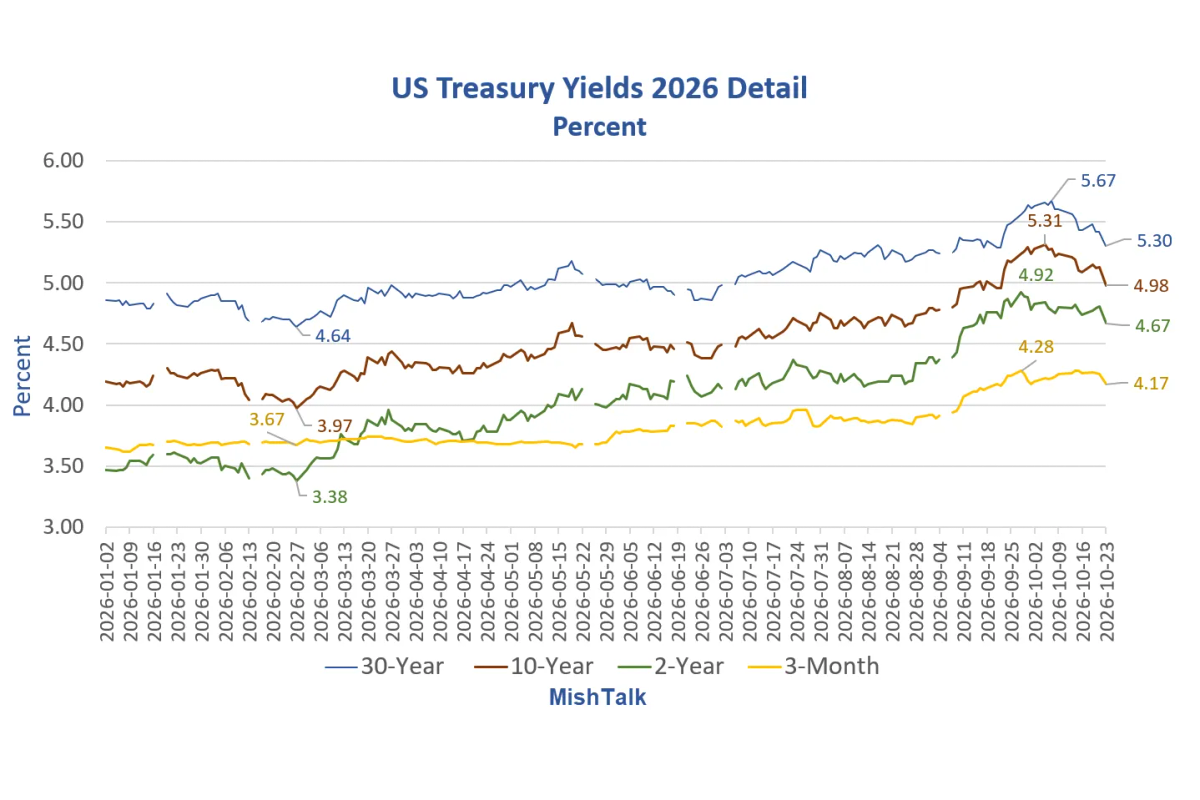
One week into President Trump’s war on Iran, the most severe shock to energy markets since the 1970s is cascading through the world economy. The disruption quickly fed into higher gasoline and diesel prices at the pump, and higher mortgage rates and borrowing costs for the U.S. government, endangering Trump’s economic priorities.
To be sure, the U.S. has more shock absorbers this time around. Oil is a far smaller component of gross domestic product than it once was, and the U.S. has become a top energy exporter in its own right.
Appearing Sunday on Fox, U.S. Energy Secretary Chris Wright said that “energy will flow soon” through the Strait of Hormuz. He blamed the rise in prices on “the unknown that this could be some long, you know, drawn-out crisis. But it won’t be.”
But the impact will still reverberate, especially in Europe and Asia. For decades, the U.S. military and its allies have spent billions of dollars ensuring the Strait of Hormuz stays open. Just 21 miles across at its narrowest stretch, and flanked to the northeast by a sworn enemy of the West, the channel between Oman and Iran is a superhighway for about a fifth of global supplies of oil and liquefied natural gas.
Massive amounts of fertilizer sail through these waters, feeding crops on every continent. The few ships that have left the strait since the start of the war were mostly carrying Iranian oil. Traders say crude markets could soar even higher if the strait doesn’t open within days, either with U.S. naval escorts or because shipowners think the danger has receded.
Force Majeure – Not Just Oil
The strait’s closure is spilling through commodity markets. Aluminum prices hit multiyear highs after Middle Eastern smelters declared force majeure—a legal maneuver that means suppliers aren’t liable if they fail to deliver. Norsk Hydro, which is curtailing output in Qatar, said a full restart could take six to 12 months.
“We are looking at what is by far the biggest disruption in world history in terms of daily oil production,” said energy historian Daniel Yergin. “If it goes on for weeks, it will reverberate across the global economy.”
That is exactly what Iran wants, Yergin said. Attacking energy facilities and shipping appears to be a Hail Mary attempt to make the war so painful for the American and allied economies that Trump backs down—as when Russia slashed natural-gas supplies in a failed bid to splinter Ukraine’s backers in 2022.
Traders fear that both sides will ramp up targeting of energy infrastructure. Saudi Arabia intercepted a drone heading toward an oil field on Saturday, likely from Iran, officials said. Israel said it struck several fuel-storage complexes in Iran over the weekend, lighting up the sky in Tehran.
Big Winners China and Russia
prices surge toward record highs of $150 a barrel, as some on Wall Street forecast. Saudi Arabia built a pipeline to its western coast, which it has activated to divert some sales via the Red Sea.
But elsewhere in Asia, which imports around 80% of the petroleum that sails through the Gulf, many countries are more immediately vulnerable. In recent days, Myanmar’s junta launched a rationing system for cars, while Thailand suspended some fuel exports. The Philippines told government offices to turn off computers at lunch and set air conditioning no lower than 75 degrees Fahrenheit.
When Israel and the U.S. launched their attacks, officials were initially sanguine that it would play out as previous conflicts had. Several shared memes of Mr. Bean giving the middle finger, likening Iranian retaliatory attacks on the Gulf to the bumbling comedic character.
In Kuwait, the oil-rich monarchy whose industry was all but destroyed when Iraq invaded in 1990, officials suddenly had the problem of what to do with all their oil. With most of Kuwait’s production close to export facilities on the coast, the emirate never bothered to invest much in storage, officials said.
Without enough storage, producers need to turn off wells, a process known in the industry as “shutting in.” Unlike a kitchen faucet, an oil tap isn’t easy to turn back on.
Natural gas hit
One way this crisis is different from the past: Qatar’s emergence as a giant exporter of supercooled natural gas. Over the past 20 years, European and Asian economies have pivoted away from oil and coal to the cleaner-burning fuel.
But doing so has fostered another dependence that is being brutally exposed by Doha’s decision to halt output after Iran fired drones at its Ras Laffan gas complex.
With Qatari gas off limits, a bidding war for cargoes from elsewhere broke out on the high seas. Clean Mistral, an LNG tanker, was cruising toward Spain from the U.S. midweek when it made a 90-degree turn to head toward of Asia. As traders who handle export logistics spotted the chance to profit in the more lucrative market, several tankers made similar pivots, according to ship-tracking data.
Qatari production won’t recover straight away if the strait reopens. A liquefaction train, which cools the gas, is like a giant refrigerator, but unlike an unplugged fridge at home, restoring it could take weeks.
“Small Price to Pay” Says Trump
Short term oil prices, which will drop rapidly when the destruction of the Iran nuclear threat is over, is a very small price to pay for U.S.A., and World, Safety and Peace. ONLY FOOLS WOULD THINK DIFFERENTLY!President DJT
When idiots make big mistakes and fail to do any rudimentary planning, they always declare the cost as a “small price to pay”.
An Amazing Parlay
Trump created a crisis in oil, natural gas, aluminum, fertilizer, jet fuel and water, all at once.
This is not an easy feat. Mere mortals would have struggled to do this,
Might I suggest the Nobel Peace Prize?
Related Posts
March 7, 2026: US Ground Troops to Iran? Trump Now Says “If Very Good Reason”
Hey, let’s completely fight Israel’s war that we started.
March 7, 2026: Trump Threatens Iran with “Complete Destruction and Certain Death”
Iran rejects surrender and Trump delivers an amazing rant.
March 8, 2026: Attacks on Desalination Plants Make Water a New Issue in the War With Iran
Let’s discuss more repercussions of a foolish war with Iran surface.
Yep, Trump even created a water crisis.

Comments
Log in or sign up to join the conversation.