

Copper seems to be struggling to extend further gains from here as it now stands at a crossroads. We doubt risk appetite will return to copper and the broader industrial metals group in the near term.
1. ‘Phase one’ rally delivered; eyes on next week’s China ‘Two Sessions’
The market was complacent during late March, and throughout April, as Covid-19 hit the global economy. Since hitting a nadir on 19 March (US$4,371), prices have rebounded by more than 13%. What's driven the rally? First, unprecedented monetary easing by central banks as well as fiscal stimulus have helped to stem the risk-off sentiment and lift expectations for a recovery in demand. Second, the rally in copper prices over the last couple of weeks may have been driven by a combination of demand recovering in China and supply disruptions. However, the funds communities don't seem to be convinced enough to add to their bullish bets just yet (See Fig 1).
In May, the rally appears to have lost steam and prices have barely moved over the last two weeks. As the first round of price recovery pauses here, copper may be struggling to find its next engine to drive direction in the short term. Meanwhile, investors will be keeping a close eye on China's 'Two (Twin) Sessions' later next week. Our economists have pointed out that this will be the key risk event for markets (China Twin Sessions dominate).
Fig 1. Comex copper 'money managers' remain net short on copper
(Click on image to enlarge)

Source: Bloomberg, ING
2. Making up the lost demand, but indicators may be deceptive for now…
As China returns to work from deep lockdowns during February, a recovery in demand is not a big surprise. However, multiple indicators have been suggesting that this strength in demand may be exaggerated. With construction sites aiming to deliver projects on schedule, workers on some sites have been working in shifts to keep operations going continually. Semis-fabricators have also been cranking out a backlog of orders that they hadn’t been able to deal with during the lockdown. We also think that some indicators in the short term may be a bit deceptive. Nevertheless, it’s questionable as to whether this is sustainable going forward. Here are some examples:
- Record sales in excavators in March and April: The sector has been closely tracked as a barometer of the nation’s construction activities. After record-high sales in March (11.6% year-on-year), sales units hit another record in April, up by 59.9% YoY, according to the latest data from the China Construction Machinery Association (CCMA). However, the heavy-duty vehicle industry is due to transition to the new National IV emissions standards. So it’s questionable to what extent the incremental demand in excavators is actually going to replace the old ones.
- Car sales sprung to life: Car sales in China posted surprisingly positive year-on-year growth, at 4.4%, in April, the first positive figure in over 21 months, according to the China Association of Automobile Manufacturers (CAAM). So far, some municipalities have already come up with different measures to encourage car sales. We have also been told that there has been a jump in car demand post-lockdown, as some people wanted to avoid public transportation. However, the CAAM still forecasts a 15%-25% drop over the full year, with the key downside risk coming from the ex-China market.
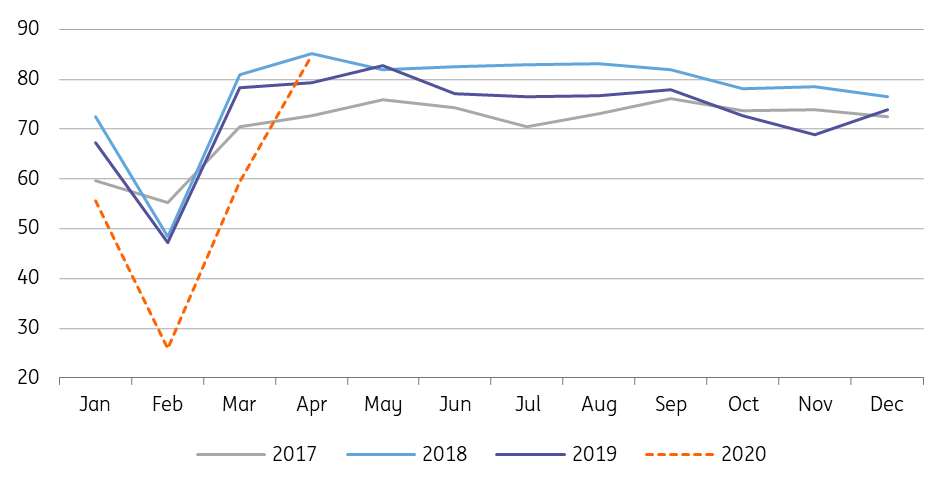
- Strong utilization rate at wirerod mills: The operating rate at wirerod mills increased to a level that has even surpassed similar periods in previous years, particularly at the large-sized mills (See Fig 2).
Fig 2. Operating rates at large-sized copper rod mills (percentage %)
(Click on image to enlarge)
Source: Bloomberg, ING
3. The key fundamental hasn’t changed
While some lockdowns have ended, the key focus for the market remains Covid-19 and its associated economic impact. A flurry of data releases from many economies suggests a high risk of recession. Even though it is ahead of the curve, China's macro data for the month of April doesn’t offer any sign of relief (see China: activity data suggests long recession).
To make things worse, trade tensions have flared up again. Meanwhile, some countries are seeing a second wave of Covid-19 cases, with the number of new cases rising in South Korea and Shulan city in China. These have cast a shadow over the recovery path, particularly as some nations in Europe have just started to ease lockdowns from the first wave.
We doubt risk appetite will return to copper and the broader industrial metals group in the near term. What could complicate matters for copper is an asymmetric growth trajectory in the global economy. Historically, moves in copper prices have been in line with manufacturing PMIs. During the 2008 financial crisis, copper-bottomed along with PMIs from major economies. However, there is no guide for copper. More recent April data has suggested that manufacturing is still struggling to keep its head above water. Elsewhere, the indicator is pointing to a deep contraction.
Fig 3. Manufacturing PMIs
(Click on image to enlarge)

Source: Bloomberg, ING
4. Trapped between faltering supply and weak demand
For now, copper is perhaps trapped between faltering supply and weak demand, and it's hard to see any scope for prices to move either way.
Mine disruptions continue to be a major short-term risk in copper supply as Covid-19 still holds a firm grip on major mining countries. According to the latest figures, lockdowns have already led to a 26.6% fall in Peruvian March copper production. Tightness in concentrate will be felt by smelters and the low spot treatment charges are likely to keep refined production growth largely muted over the remainder of the quarter. However, currently, we still expect full-year production to see positive growth of 3.5% from China assuming no further curtailments.
Meanwhile, the supply of scrap, primarily imported scrap, continues to be a major uncertainty, as it is an important piece of the jigsaw in overall copper supply to China. In 1Q20, scrap imports volume (in gross weight) plummeted by 37% YoY despite adequate approved import quotas. We estimate that contained copper supply to China has fallen by 86kt compared to the prior year. Going forward, the trend is very unclear as disruptions to the supply chain are complicated. The implication here is that if scrap supply can’t recover any time soon, cathode will still be likely to fill the void.
Fig 4. China copper scrap imports (1'000 tonnes)
(Click on image to enlarge)

Source: China Customs, ING
We expect the recovery in demand to be asymmetric, as the manufacturing PMIs suggest, with strength in demand diverging between China and ex-China going forward. Currently, our base case is for China's consumption growth to contract by 1.3% YoY and 4.7% YoY in the ex-China market. A major downside risk with the China growth forecast stems from the export market due to global supply chains dislocations.



Comments
Log in or sign up to join the conversation.