

Another benign inflation report following hot on the heels of a poor July jobs report has seen markets increasingly doubt the resolve of Fed hawks to deliver rate hikes this year. We see four key reasons for the disinflation trends to continue and expect the Fed to hold rates steady for a prolonged period
Inflation continues to cool
US consumer price inflation has come in as expected in July. After a remarkably benign June report, headline prices rose 0.1% month-on-month in July while core CPI (ex-food and energy) rose 0.2% MoM. This brings the year-on-year rate of inflation down to 3.4% from 3.5% for headline while core inflation is now running at 2.5% versus 2.6% previously. In terms of 3M annualised core inflation, we are now down to just 1.6%, which, after the poor jobs report last Friday, should leave the Fed hawks less confident on the need for a rate hike, but we do have another job and inflation print plus the annual Jackson Hole symposium before the next FOMC meeting on 16 September. This will limit the scope for significant market reaction today.
In terms of the details, gasoline prices fell 2.9% MoM while shelter was subdued at just 0.1% MoM with food (+0.1%), apparel (+0.1%) and new vehicles (+0.1%) and other goods & services (+0.1%) all very well-behaved. Used cars and trucks (+0.4%) and medical care (+0.4%) and education (+0.6%) were the main areas of elevated price pressures, but all experienced falls in June and the underlying story looks OK. The main issue remains airline fares (+2.2% MoM/ 25.5% YoY), which mainly reflects higher jet fuel. That can quickly correct lower on a deal in the Middle East. Overall, nothing here to change our view that the Fed is set for a prolonged pause well into 2027.
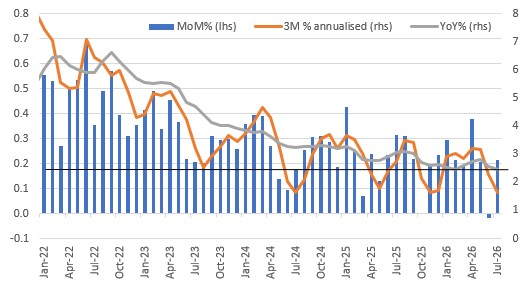
The chart below shows core CPI under different metrics. The black line represents 0.17% MoM, which is what we need the blue bars to average to bring the YoY rate to 2% over time.
Core inflation metrics
Four reasons for inflation to slow into 2027
Gasoline can continue to contribute to lower headline inflation – remember that the current oil price of around $83/bbbl is historically consistent with US retail gasoline prices of $3.80/gallon – below the current AAA measured average US price of $4 given refining margins have widened a touch. As such, if we get a deal to reopen the Strait of Hormuz and flow resumes, we should see margins compress, which will deliver lower gasoline costs.
Secondly, the heaviest weighted component in CPI is shelter, at 35% of the basket of goods and services, which is currently running at 3.2% year-on-year. Affordability is stretched by high prices and elevated mortgage rates with the current number of housing transactions on a par with the 2008-12 post-GFC environment. Consequently, home prices are barely rising 1% and rents are now falling outright in a growing number of states, according to data from Zillow and Realtor.com. We expect this dominant component to exert steady downward pressure on overall inflation over the next 12 months.
Thirdly, the biggest cost input for US corporates is not tech, tariffs or energy. It's the cost of workers. We’ve gone from a situation where, in 2022, there were two job vacancies for every unemployed American to being in balance today. This has taken a huge amount of froth out of wages. Moreover, the plunge in the quits rate – a measure of labour market churn – means companies are no longer having to pay up to retain staff. Private wage growth, according to the Employment Cost index, is rising just 3.1% YoY, the same as average hourly earnings. That is fully consistent with 2% consumer price inflation.
Then, rounding out the story, we have tariffs. They represent a one-off step change in prices. Now that we've arguably entered a less onerous tariff regime that includes lots of exemptions, we’re increasingly confident that their upward influence on inflation will rapidly fade. Federal budget data show the International Emergency Economic Powers Act (IEEPA) 'Liberation Day' tariffs, that were struck down by the Supreme Court, are now being repaid to corporate America. In May, the new tariff system revenues were fully offset by the initial repayments of the IEEPA tariffs. June data showed the Treasury actually paid out $25.5bn more in IEEPA refunds than it received under all other tariffs, and we expect the July numbers, to be released later today, to show an even bigger net refund. This boost to corporate cash flow should mitigate cost pressures elsewhere and therefore maintain the disinflationary trend.
'Chipflation' fears are overblown
The rising cost of semi-conductors, attributed to the surge in demand from data centre construction, has led to fears of 'chipflation' with anticipated price hikes for laptops, mobile phones and games consoles featuring heavily in the media. But we should remember that computer and communication have a very small weight within the basket – just 0.7pp versus 35% for housing. They also use hedonic pricing, so quality improvements come into the calculation. Hence, why within CPI smart phones are currently falling 10.9%YoY, yet the base level for most phones has not changed – camera improvements, better quality battery life, more powerful processors mean that you get more for your money. For the purpose of the inflation calculation, it results in a price fall.
Prolonged pause from the Fed
We recognise that the Fed has missed its inflation target for the past five years. Nonetheless, progress does appear to be being made and consumer inflation expectations are within tolerable ranges, suggesting little risk of second-round price effects from the energy spike. Meanwhile, market inflation expectations are benign, with 10Y break-even inflation rates in line with their 25-year average. The market is still pricing a rate hike from the Fed, but we see the more likely course of action is for the Fed to hold rates steady for a prolonged period, well into 2027.
Comments
Log in or sign up to join the conversation.