

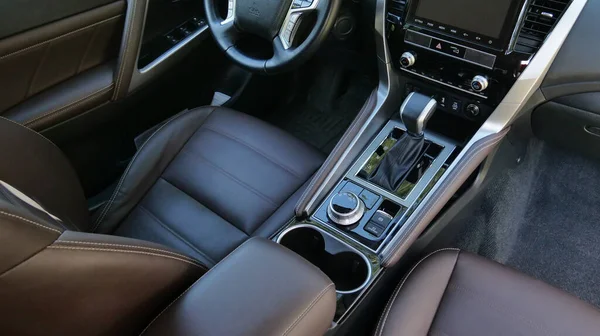
If you want to pay more and get less, it’s a great idea.
Chinese Cars Have Arrived in Small Numbers
The Wall Street Journal reports The U.S. Wants to Ban China’s High-Tech Cars, but They’re Already Here in El Paso
Just 5 miles from the U.S. border, a bustling commercial strip here offers the buzzy Chinese car brands currently blocked from the American market.
A Geely dealership features the all-electric EX2, a sleek compact that starts at only around $20,000. A bulky hybrid pickup truck sits next to a charger outside a BYD dealership. Great Wall Motors boasts some beefy gas-powered sport-utility vehicles, one advertised with the slogan “Be More Tank.”
Luis Hernandez, a Geely salesman, said he has poached many longtime Ford and Chevrolet owners attracted to the affordable sticker prices and whiz-bang Chinese technology. He recently sold two Geely Emgrand sedans, which start at around $17,000, to a Mexican family for their two daughters to commute to college in El Paso, where the sleekest Chinese cars are now attracting attention.
“If they were allowed to be sold in the United States,” Hernandez boasted of the Chinese models, “they would destroy the American car market.”
“I’m telling you, it is very difficult—not to say impossible—to compete,” said Hyundai Motor Chief Executive José Muñoz. “We cannot compete at the same price as the Chinese in the market where we operate. Otherwise, we will be losing money.”
So far, the many Chinese car companies that want to expand into the U.S. have been kept at bay. The U.S. has applied sky-high tariffs to vehicles imported from China, and regulations make it nearly impossible for such vehicles purchased in Mexico to be registered in the U.S. A trio of senators has urged the Trump administration this month to ban Chinese vehicles sold and registered in Mexico and Canada from entering the country; several dozen House lawmakers sent a similar letter this week. A Senate bill to prohibit China’s carmakers from building cars in the U.S. is being crafted.
BYD, Geely and Great Wall Motors are now among the biggest carmakers in the world. They have been gobbling up market share in Europe and other parts of Asia. In Mexico, Chinese vehicles account for a quarter of total sales. Soon, Canada will allow tens of thousands of inexpensive Chinese EVs to be imported.
Sen. Bernie Moreno (R., Ohio) said the bill he plans to introduce would “hermetically seal” the U.S. from Chinese automakers. Chinese cars from Canada or Mexico couldn’t be driven into the country. American car companies couldn’t pursue joint-ventures with Chinese automakers. Chinese car companies that own U.S. brands, such as Geely-controlled Volvo and Polestar, would have to divest themselves of those brands by 2030.
At Geely’s dealership, Hernandez, the salesman, said the store’s top seller is the entry-level, gas-powered Emgrand, which would compete in America against compact cars such as the Nissan Sentra or Hyundai Elantra.
Hernandez said he was in the process of selling one to a Mexican local who works as a lifeguard in El Paso. “People come, they see the difference, and they’re impressed,” he said.
That is exactly what U.S. car executives are preparing for.
“The Chinese are going to find a way to get to the U.S. market,” said Nissan Americas Chairman Meunier. “It will happen.”
Edmonds Review
Please consider Tested: The Geely Galaxy M9 Proves Chinese Cars Could Be Seriously Competitive in America
The Geely Galaxy M9 is a three-row SUV made in China and sold outside the U.S.
This extended-range plug-in hybrid offers a Geely-estimated 800-plus-mile range, blending the best of gas and electric power.
The Galaxy M9 starts around the equivalent of $25,000, but it would theoretically compete with vehicles costing twice as much, like a fully loaded Hyundai Palisade, Kia Telluride or Toyota Grand Highlander.
In track and on-road testing, this three-row SUV exceeded almost all of our expectations. Chinese cars are ready for prime time in America.
Geely Galaxy M9: What is it?
Geely is one of the world’s largest automakers, selling millions of cars each year in markets all over the globe. Within the company’s portfolio are a few brands you recognize, like Volvo, Polestar and Lotus, along with a few you probably don’t, like Lynk & Co. and Zeekr.
The Galaxy M9 is Geely’s new flagship, a three-row SUV similar in size to a Kia Telluride. It runs on both gas and electricity, and in this highest-performance all-wheel-drive Pilot trim, makes 858 horsepower and 859 lb-ft of torque. It also offers a Geely-estimated 808 miles of driving range — 130 of which are purely electric. In China, Geely’s home market, the Galaxy M9 starts around $25,000 when converted to U.S. currency. And while that obviously doesn’t translate to a theoretical American price tag, even at $50,000 or $60,000, the M9 would hold its own against a fully loaded Hyundai Palisade or Kia Telluride.
The Galaxy M9 can offer solid range thanks to its large 41-kWh battery pack — that’s bigger than what’s used in most other plug-in hybrids — and a turbocharged 1.5-liter four-cylinder engine. The gas engine can act as a generator to charge up the battery when it’s dead or power the wheels directly, if some extra oomph is needed.
Track tested
On our scales, the Galaxy M9 weighs in at 5,771 pounds with a full tank of fuel. That’s a bit heavier than a BMW X5 plug-in (5,627 pounds) but a bit less than a fully electric Kia EV9 (5,838 pounds).
On our acceleration straight, the M9 hits 60 mph in 4.2 seconds; Geely estimates a 0-to-62-mph time of 4.5. The M9 completes the quarter mile in 12.9 seconds at 98.6 mph. That puts it in great company with the BMW X5 plug-in (4.6 seconds to 60 mph; 12.8 seconds in the quarter mile at 107.4 mph). A three-row luxury SUV like the Lexus TX 550h plug-in is left in the dust by comparison, needing 5.6 seconds to hit 60 mph and 14 seconds in the quarter mile.
One of the M9’s best showings is in our 60-to-0-mph emergency braking test. It takes just 110 feet to come to a stop — that matches a BMW X5 M, a bona fide performance SUV. Another notable number for the M9 comes in our sound test, which measures how quiet (or not) a car is at idle and on the move. The M9 registers 32.5 decibels at idle, a figure that even whomps the Rolls-Royce Spectre. Clearly, Geely isn’t messing around when it comes to luxury.
The M9’s only non-superlative showing happens on our 200-foot skidpad, where it achieves 0.86 g of lateral grip. While that’s not poor, it’s worse than the EV9’s 0.91 g and the X5 PHEV’s 0.89 g. When pushed hard around a corner, the M9 is a step behind the competition.
How about electric range?
Geely’s advertised 130 miles of all-electric range is huge — it bests any other plug-in hybrid on sale right now. That warrants a loop on the Edmunds EV Range Test, where we aim for a 40-mph average speed and 40/60 split between highway and city driving. Unfortunately, at the end of our test, our testing equipment showed 101 miles traveled, which is less than expected but still very notable for a plug-in hybrid. That’s plenty of electric range to handle multiple daily commutes.
And commuting is where this SUV excels. The Geely is well-suited to easygoing driving, whether in the city or on the highway. Its suspension is super softly sprung, which is kind of a double-edged sword. On one hand, the M9 does a remarkable job of defeating potholes and subpar pavement. But it also means this SUV moves around too much while driving, like the car is unsettled.
The rest of the driving experience is lovely. When the M9’s engine does kick on, it does so quietly and without interruption. There’s always more than enough power to get the M9 up and moving in a hurry. And regenerative braking can bring the car down to a stop smoothly without the need to touch the brake pedal.
All the tech and then some
When you first open the door, it is impossible to notice anything other than the 30-inch screen. This display offers 6K resolution and has iPhone-like responses. Tesla and Rivian are among the best in terms of infotainment responsiveness, and this Geely is right up there with them.
Because this M9 is a Chinese-market vehicle, some of its functions — like navigation and web browsing — are not available for testing in the U.S. But there are still a lot of cool features. For example, the car has an exterior-mounted speaker that can play songs or, um, whistle at pedestrians. More interesting is the flip-down entertainment screen in the second row that has the same excellent resolution as the one up front and offers content streaming and games. There are also USB-C ports for every passenger to keep their devices charged.
So, what’s the verdict?
Could the Geely Galaxy M9 work in the U.S.? Yes, absolutely. This could be an incredibly competitive SUV in a class full of strong contenders. The generous electric range is a great feature to have, and the ability to travel hundreds of miles with a gas extender is a feature that would put many EV skeptics at ease.
Global market and political factors continue to muddy the waters for Chinese brands entering the U.S., but the door is neither completely open or closed. If Geely can pull it off, the Galaxy M9 has a big chance of finding success here.
Want a Great Commuter Car for $25,000?
Would you want one of these for $25,000? How about $35,000? That would be a 40 percent tariff.
Trump said China could sell cars here if it built them here. But Congress wants to stop that too.
How Might China Respond?
Congressional and administrative nitwits never address such questions.
This is how the war in Iran started.
What if China passed a law in response banning US car production in China?
This is the big vulnerability. U.S. firms have massive exposure:
Tesla: Giga Shanghai produces ~40-50% of global output (hundreds of thousands annually, serving China + exports). Retaliation could include regulatory delays, higher taxes/fees, favoritism for domestic EV giants (BYD, etc.), or supply chain squeezes. Tesla has already faced pricing pressure and competition there.
GM: 1.8–1.9 million vehicles via JVs in 2025 (30%+ of global volume). Highly exposed to any crackdown on foreign JVs.
Others (Ford, Stellantis via partners): Smaller but still at risk, especially with ongoing JV talks.
China could slow approvals, impose “national security” reviews, boost local content rules, or use antitrust/anti-monopoly tools—without a full ban, just enough to raise costs and erode market share.
Even under the fragile U.S.-China trade truce (from late 2025, expiring Nov 2026), China has expanded options:
Tighter rare earth/mineral export controls (already disrupted U.S. auto supply chains before).
Laws punishing companies that shift supply chains away from China.
Mandates for domestic substitution (e.g., 50%+ local equipment in chips, bans on certain foreign AI/cybersecurity tech in state sectors).
Potential curbs on solar/tech exports, investigations into foreign firms, etc. reuters.com
A U.S. ban on Chinese auto plants could trigger targeted actions against U.S. brands in China.
China often prefers calibrated responses to avoid self-harm (its economy faces headwinds; foreign investment is still valued). But precedent favors retaliation if core interests (EV/tech dominance) are hit.
In short, yes—China would likely hit back, targeting the profitable U.S. presence in its massive auto market and critical inputs. This is what makes auto policy a high-stakes poker game. Protectionism protects some U.S. jobs, at huge expense. And it risks broader supply chain pain for Tesla and GM. The result is higher costs for consumers.

Comments
Log in or sign up to join the conversation.