

Czech policymakers still view domestic factors as inflationary, while the foreign environment poses risks to future economic activity. Tight labour and housing markets are seen as the main concerns. Indeed, imputed rents remain a key driver of core inflation. We therefore use scenario analysis to gain a better understanding of the matter.
Wait and see mode is possible for now
Czech policymakers left interest rates unchanged at 3.75% at the August meeting in a unanimous vote. Inflation is expected to remain in the upper part of the tolerance band for almost the entire forecast horizon, with broadly stable interest rates forming the baseline scenario. The Bank Board assessed the current monetary policy setting as appropriate, as the June interest rate increase provided additional tightening. Such a situation now allows for an ongoing assessment of the monetary policy impact on the economy.
Real interest rates remain in restrictive territory
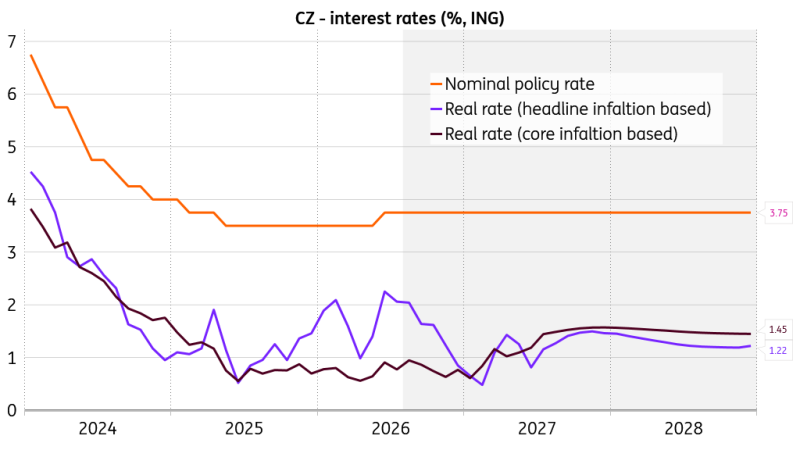
According to CNB Board member Jakub Seidler, the case for tighter monetary policy remains intact, mainly due to persistent demand-driven inflationary pressures in the domestic economy combined with possible secondary impacts from higher commodity prices. Nevertheless, incoming data has been reassuring from the perspective of domestic inflationary risks, reducing the acute need for further action and allowing time to assess future developments. The most hawkish Board member, Jan Kubicek, sees three conditions for further rate stability – an easing of the robust wage growth, the long-awaited softening in core inflation, and less forceful credit creation.
Housing market and Hormuz drive uncertainty
Jan Prochazka noted that a low statistical base implies an increase in headline inflation at the turn of the year. However, this increase is expected and is therefore not viewed as evidence of renewed inflationary pressures. At the same time, high core inflation is considered problematic, also driven by strengthening annual dynamics of imputed rents. The future development of house prices represents a substantial source of uncertainty. The Board sees signs of some easing in the housing market, but the magnitude and speed of this slowdown have yet to be seen.
The implications of the Hormuz conflict remain difficult to quantify as the situation drags on, with the key question being the extent to which elevated commodity prices feed through into second-round inflationary effects. Jan Frait identified potential risks stemming from excess capacity in certain sectors, which could ultimately have disinflationary repercussions.
The GDP growth figures since the beginning of the year were considered to be rather disappointing but mostly connected to the external environment. A fully-fledged economic expansion is expected only when global developments improve and foreign demand rebounds. Still, wage dynamics are seen as an important inflationary factor, despite heightened uncertainty in the wage data. This may be linked to the launch of a single reporting place for employers, which could result in reporting inconsistencies during the implementation phase.
Imputed rents and the rest of core inflation
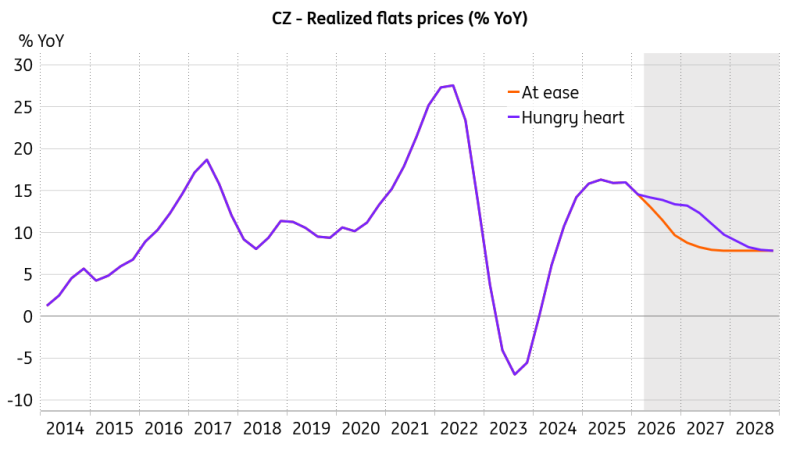
We have updated our what-if analysis of the core inflation profile based on alternative assumptions of future house price developments. This time, we consider only two scenarios, as a decisive cooling of the housing market does not appear to be on the agenda at this point. The Hungry heart scenario assumes that quarterly property price growth will pick up again over 2Q and 3Q, and annual price growth will ease only marginally this year to 14% on average from 16% recorded in 2025. Under this assumption, imputed rents would quicken and peak at almost 7% year-on-year in 1Q27. In such a case, core inflation would peak at 3.6% in January next year and would prove slow to moderate thereafter.
Rent dynamics set to remain punchy
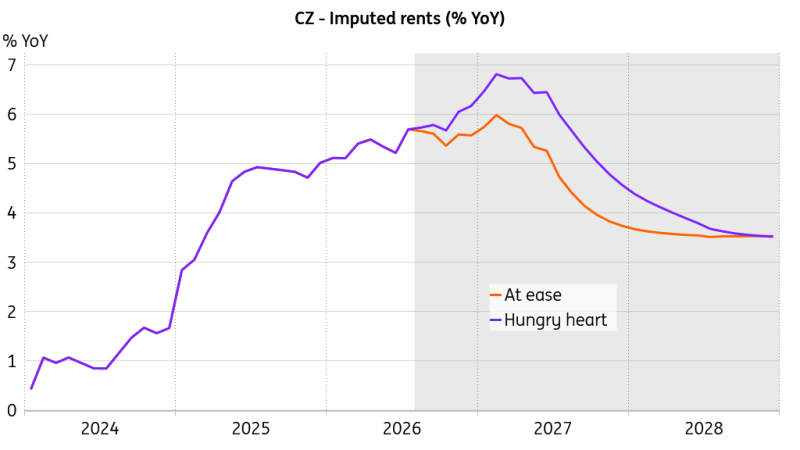
In the At Ease scenario, we assume that quarterly house price growth slows down further, to 2% by year-end. This would bring annual house price inflation below 10% in the final quarter of the year and reduce average annual house price growth to 12% in 2026. Under this scenario, imputed rents would peak at around 6% year-on-year in 1Q27, before entering a rather swift disinflationary phase. Core inflation would peak at 3.3% early next year and then decelerate more noticeably. This is close to our baseline scenario for the core rate, which is derived from a model that does not explicitly incorporate house prices or imputed rents, given the substantial lag with which real estate data becomes available.
Rents and core rate like Castor and Pollux
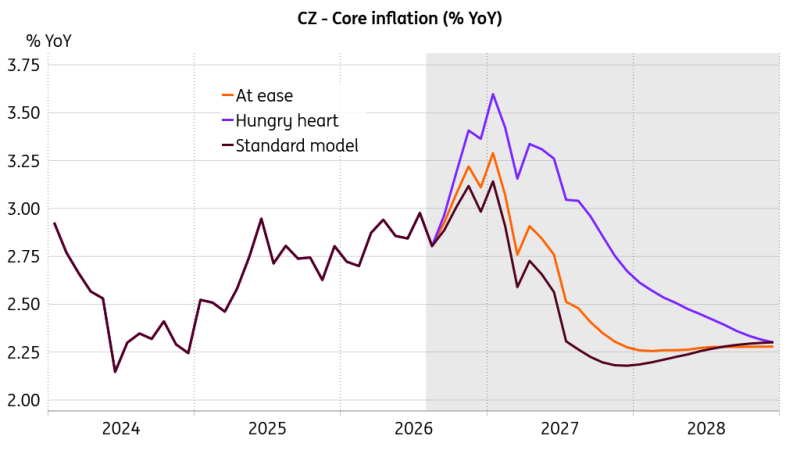
Compared with our March exercise, house prices and imputed rents have followed a path close to our upper-bound scenario, while core inflation has tracked the lower-bound scenario. We draw the quick and dirty conclusion that there is a trade-off between rents and the rest of the price dynamics in the core inflation consumer basket.
Double-edged sword of rising rents and risks to activity
And yes, rents are likely more affected by the external environment, including developments in Ukraine and migration flows into Czechia. It seems that things have worsened for Ukraine over recent months, with Russia intensifying rocket attacks.
This is one of the key reasons why any meaningful relief in house prices and rental inflation may not be in sight. At this point, money is flowing into the Czech housing market from domestic and foreign buyers, and the CNB has very limited options to do anything about it without killing the economy through prohibitively high interest rates, say around 7%. Even then, success would be far from guaranteed given the depth of demand from wealthier buyers. As a result, rents and the rest of the core inflation basket may continue to diverge. The million-dollar question is whether, and how, monetary policy should respond.
Resources to buy are still available
For now, we take the stance that risks to future economic performance are still too high, and holding interest rates steady is the right answer. Indeed, the CNB faces two opposing risks. On the one hand, economic growth could turn out weaker than expected, generating disinflationary pressures. On the other, the housing market could heat up even further, with significant implications for rents and core inflation. At this point, we are just trying to stay one step ahead to see which of the two forces will prevail.


Comments
Log in or sign up to join the conversation.