

China inflation rebounded in August after last month's surprisingly low read, as higher tech and energy prices overcame the drag from food and rental prices. The economy still contains pockets of deflation, but consumer prices appear poised to settle into a low, positive range
CPI inflation rebounds in August
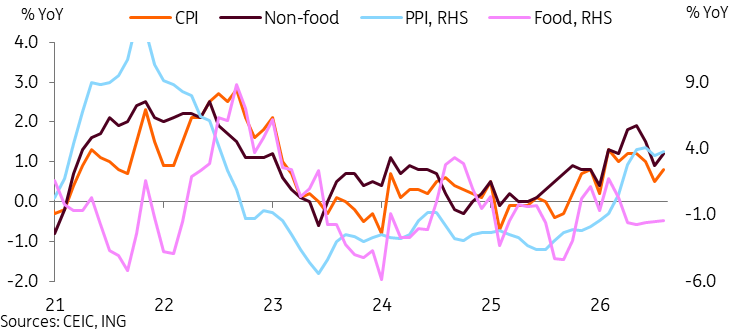
China’s headline CPI inflation rose to 0.8% year-on-year in August, up from 0.5% in July. This was in line with expectations (market: 0.8%, ING: 0.9%). Core inflation edged up as well to 1.0% YoY, up from 0.9%.
Food prices remained a considerable drag on headline inflation, coming in at -1.4% YoY. This was the fifth straight month of negative food costs. The bright side is the drag from pork prices (-11.8%), though still significant, appears to be diminishing gradually, with the YoY levels moving higher for a third straight month.
Rent inflation came in at -0.6% YoY for a fifth consecutive month in August. Overall, the broader residence subcategory came in at -0.3% YoY.
Consumer prices remain under pressure because food (30% of the CPI basket) and housing (22%) have acted as persistent drags on China’s reflation in recent months. On the other side, we continue to see the impact of higher tech input prices and energy prices in the CPI data. Tech prices led communication appliance prices to a 10.6% YoY increase, while transportation fuels rebounded to 8.3% amid fuel price hikes in August.
Other subindices such as clothing (1.3%), daily use products and services (0.7%), tourism (2.7%), and healthcare (2.7%) generally showed low, but positive, inflation.
Inflation saw a modest rebound across the board in August
PPI inflation rebounds amid higher energy prices
PPI inflation rebounded to 3.8% YoY, up from 3.5% in July. In month-on-month terms, the 0.4% move was the first positive read in 3 months.
We saw large ex-factory price spikes for coal (26.6%) and crude oil (10.5%) extraction on the month. Non-ferrous metals (21.1%) mining continued to see high year-on-year levels but fell month-on-month once again.
However, various industries remain in deflation. Food (-1.2%), beverages (-5.3%), apparel (-1.2%), pharmaceuticals (-3.7%) and autos (-2.2%) manufacturing industries are examples where ex-factory prices are still down.
The inflation data shows a clear sector‑by‑sector split, mirroring the broader economy’s uneven momentum. Overall, though, higher input prices look likely to support reflation moving forward. We continue to look for around 0.9% YoY CPI inflation for the full year. Inflation is below the 2% target set at the Two Sessions. But it’s unlikely to play a major role in monetary policy decision-making this year.



Comments
Log in or sign up to join the conversation.