

Everyone keeps waiting for the big dramatic moment when China dumps the dollar.
It’s not coming…
Beijing’s strategy is slower than that, and better designed.
Their strategy has two parts. Buy the one reserve asset no rival can freeze. Then build the market where that asset gets priced, cleared, and stored… on China’s side of the world.
Both parts hit new milestones this summer.
Let’s start with the buying.
Reuters reports:
China’s gold reserves rise by most since October 2023 as buying pace quickens
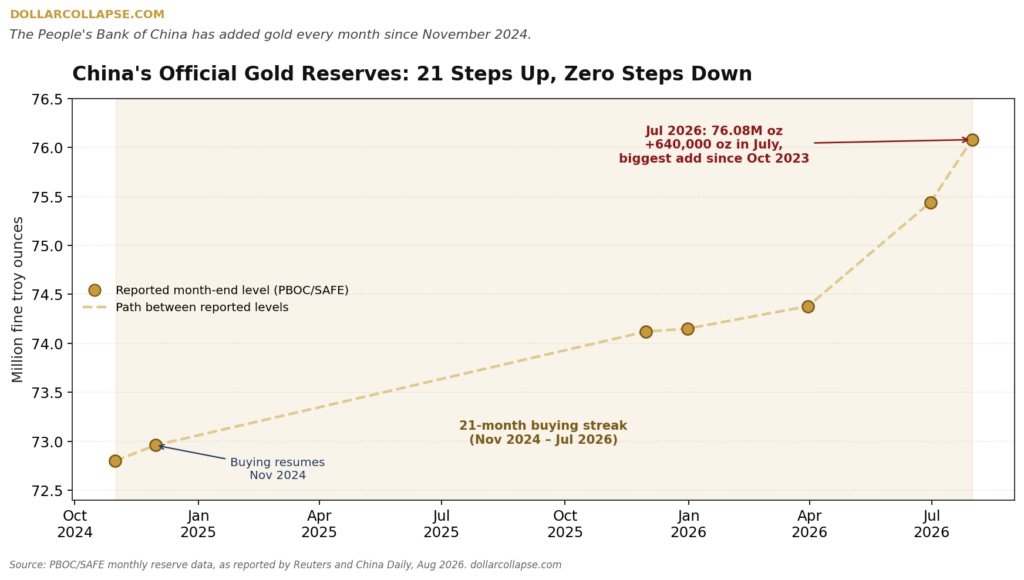
“The People’s Bank of China extended its gold-buying run to a 21st consecutive month, with reserves rising to 76.08 million fine troy ounces at the end of July from 75.44 million a month earlier… The 640,000-ounce increase, equivalent to nearly 20 metric tons, was the biggest monthly addition since October 2023… The pace of purchases has increased each month since March, when the central bank added 160,000 ounces.”
China has been buying gold every month for nearly two years. Twenty-one months without a miss. Since March, the pace picked up every month.
China’s reserve managers are like every other reserve manager around the world. They don’t chase charts. They simply accumulate collateral. And after Western sanctions froze Russia’s central bank reserves in 2022, more reserve managers outside the Western bloc drew the same conclusion: an ounce of gold in your own vault has no counterparty… no one you have to depend on.
Here’s the staircase, straight from the PBOC’s monthly reports:
Now the second part, the one most people are missing right now. On July 7, Hong Kong switched on a central clearing and settlement system for gold. From the Hong Kong government’s own announcement:
Hong Kong’s gold central clearing and settlement system commences trial operation
“The system provides efficient and reliable clearing and settlement services for bilateral and over-the-counter (OTC) gold transactions… Building a thriving gold trading ecosystem… will further enhance the richness, depth, and breadth of our financial markets.”
The Shanghai Gold Exchange sits on the clearing company’s board. A new benchmark, the HAU, now prices gold during Asian trading hours, and an RMB gold futures contract is in the works. In addition to that, the airport authority is building vault capacity for more than 2,000 tonnes of metal within three years (a free trade, zero tax on gold haven).
China is building the 2,000-tonne vault to support international gold trade and investment inside their own country.
For the past century, gold has been priced in London and New York. Metal priced and stored there lives inside the Western financial system, subject to Western rules. Metal priced in Hong Kong, cleared through a Chinese-linked clearing house, and vaulted beside the Hong Kong airport lives somewhere else.
That “somewhere else” is supposed to be the international product China is selling.
And Hong Kong is a shrewd storefront. The city keeps an open capital account, which the mainland does not. So a foreign central bank or fund can buy metal, settle the trade, and store the bars inside China’s orbit without ever touching Beijing’s capital controls.
Now, here’s the part the loudest dollar permabears get wrong.
The yuan is not about to replace the dollar. Beijing knows it. Capital controls and a trust deficit cap the currency’s reach, and the IMF’s numbers show it: the renminbi is 1.99 percent of allocated global reserves as of the first quarter of 2026 while the dollar is 57.13%.
So the strategy routes around the yuan’s limits. China doesn’t need the world to hold its currency. It needs the world to have somewhere besides the dollar system to keep reserves, which lowers dollar reserves. Gold, priced and cleared in Asia, is that somewhere.
And here’s what that looks like in the dollar’s market share nearly over the last three decades:
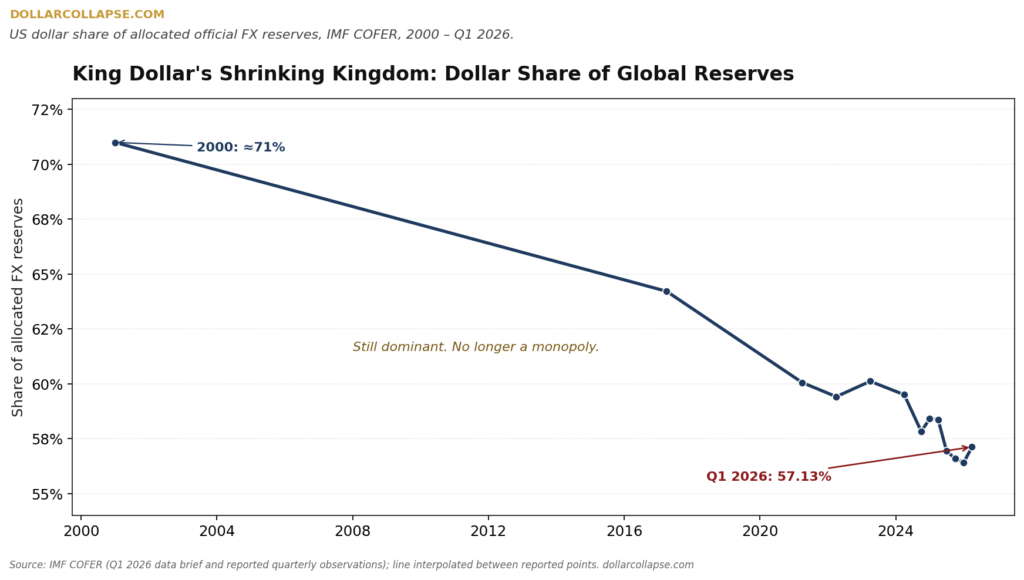
What you’re see above is a monopoly turning into a market share, a slow loss of dominance.
The dollar’s share of global reserves was about 71 percent in 2000. It’s 57 percent today. Call it 14 points in a quarter century, while central banks bought gold on the other side of the ledger. Slowly, and deliberately the world is moving in one direction, away from the US dollar.
The dollar will still settle most of the world’s trade tomorrow morning.
And the morning after that…
But dominance and monopoly are different things, and the monopoly is what’s ending.
It is ending with China’s strategy among many others since US seized Russia’s international reserve assets in 2022. And that strategy is: Buy the gold, then build the market.

Comments
Log in or sign up to join the conversation.