


Buy the S&P 500 and you own 500 companies. On paper, that’s right.
In practice, a third of the money sits in seven of them. Nvidia (NVDA), Apple (AAPL), Microsoft (MSFT), Amazon (AMZN), Alphabet (GOOGL), Meta (META) and Tesla (TSLA) now make up 33.5% of the index, based on the latest SPY holdings. When ChatGPT launched on November 30, 2022, the same seven made up about 20%.
Here’s how fast the basket filled up…
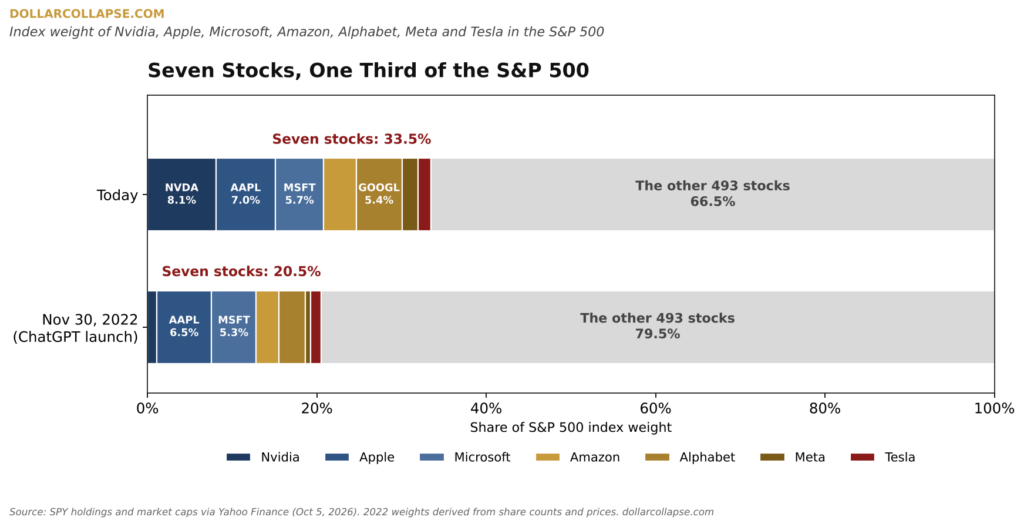
In under three years, seven companies took 13 points of index weight from the other 493.
So what did the AI boom actually add for a plain index investor?
Since ChatGPT’s launch in 2022, the S&P 500 is up 91%. Strip out the seven and the rest of the index is up 59%. The seven’s combined market value more than tripled.
Now stretch that across 20 years…
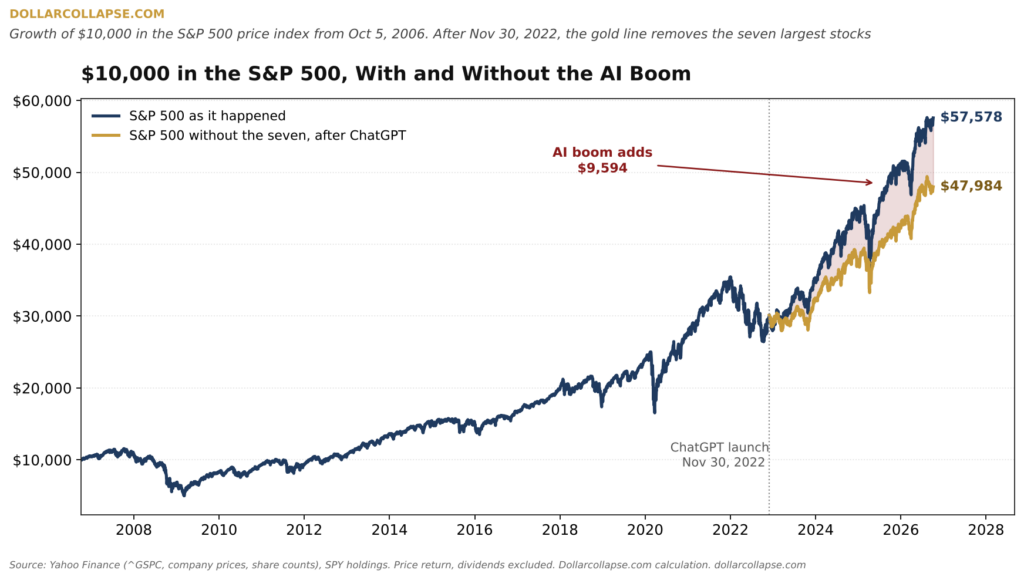
$10,000 put into the S&P 500 in October 2006 is worth $57,578 today, before dividends. Without the seven after ChatGPT’s AI launch, it would be worth $47,984.
So, it’s about a $9,594 gap is about one-fifth of 20 years of gains, delivered by seven stocks in less than three.
Take the AI boom away and the index sits near 6,490 instead of 7,790. Annual growth drops from 9.2% to 8.2%. A respectable market, just not a miraculous one.
And concentration works in both directions. The seven stocks that added $9,594 on the way up are a third of every dollar on the way down.
Owning the S&P 500 used to mean owning the American economy, but since 2022, things have changed. The old 60/40 portfolio isn’t producing returns the same way as it has the past 50 years.
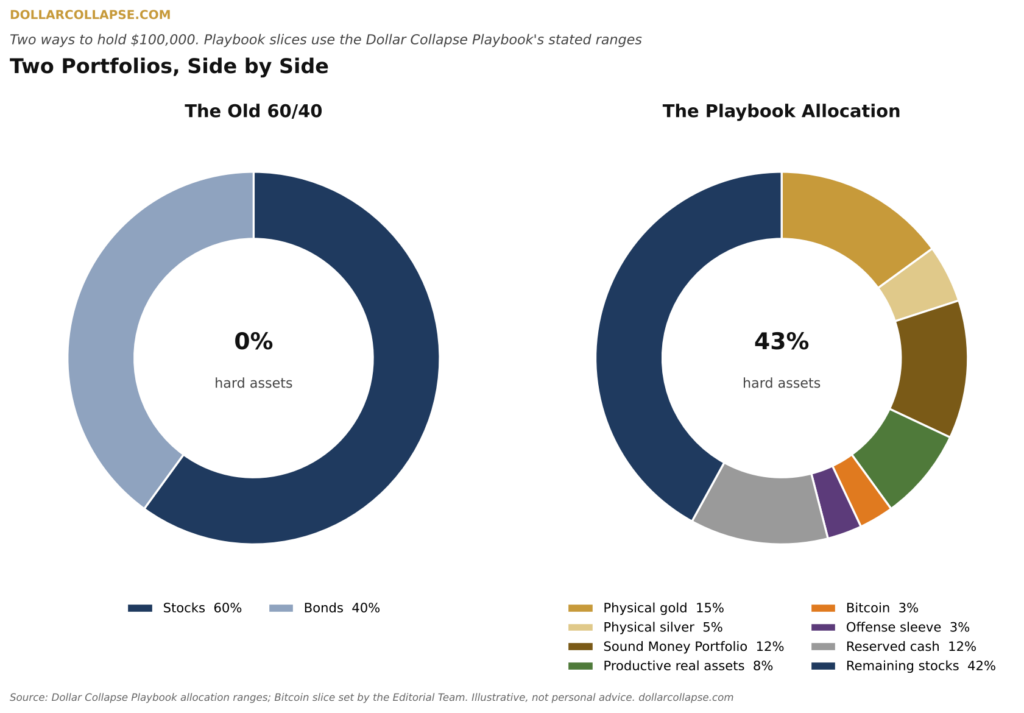
The inferred allocation that comes out of the Dollar Collapse Playbook builds it differently. Physical gold and silver, the Sound Money Portfolio, productive real assets and a sliver of Bitcoin (BTC.X) make up 43%. Add 12% in reserved cash and a 3% offense sleeve, and ordinary stocks drop to 42%. That cuts the seven-stock exposure to about 14 cents per dollar.
Here’s what the two look like side by side…
Now put $100,000 into each one on January 3, 2022, and rebalance every January…
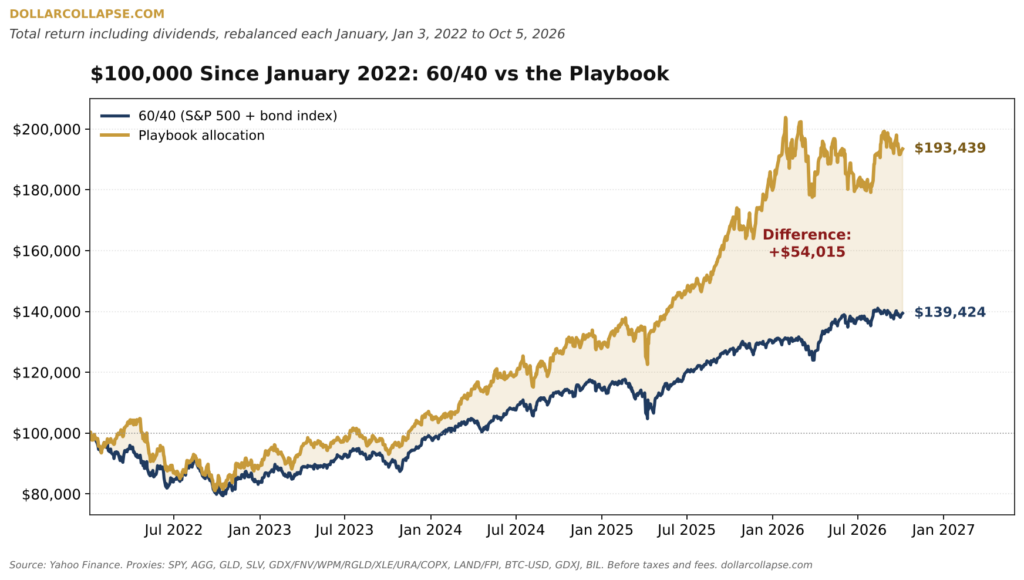
The 60/40 grew to $139,424. The inferred allocation that comes out of the DollarCollapse Playbook grew to $193,439. That’s $54,015 more, on the same starting dollar.
It also beats a portfolio of 100% S&P 500, which finishes at $172,809, with just 42% in the broad market.
The bond half did the 60/40 investor no favours. The bond index lost 2.4% in almost five years. Gold more than doubled.
And the ride wasn’t rougher. At the worst point, the 60/40 was down 21% and the Playbook was down 23%.
Owning the S&P 500 used to mean owning the American economy.
Today it means owning seven companies and a prayer, whereas the inferred allocation that comes out of the DollarCollapse Playbook keeps the stocks and drops the prayer.

Comments
Log in or sign up to join the conversation.