

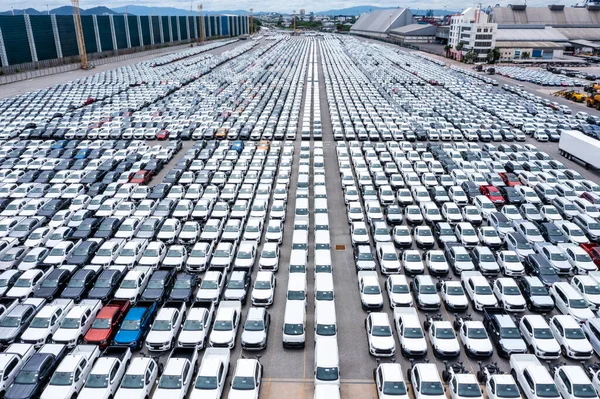
Despite tariffs, Chinese car exports have soared to record levels.
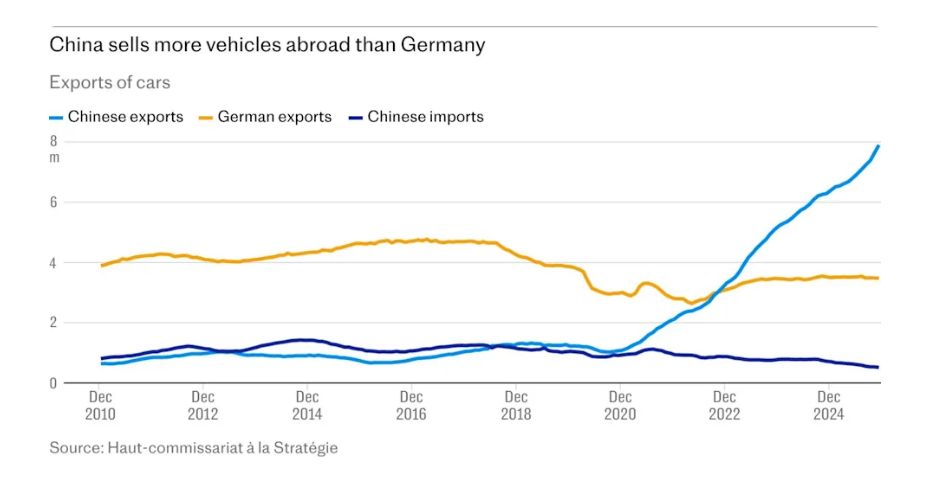
1.1 Million Car Exports in June
Please note China Exports Over One Million Cars per Month Despite Tariffs.
China has exported more than one million cars in a single month for the first time, putting further pressure on Europe’s beleaguered automotive industry.
Chinese car shipments surged to 1.1 million in June, up 71pc from a year earlier, as the Iran war drove up fuel prices and turbocharged demand for electric vehicles (EVs) in Asia and Europe.
Wang Jun, the deputy director of China’s general administration of customs, hailed the figures as confirmation that the country’s “green product offerings” were suited to “the global shift toward green and low-carbon development”.
But the figures will trigger fresh alarm in Europe, where tariffs on cut-price Chinese EVs have failed to stop the likes of BYD, Geely, Chery and Leapmotor eating into the market share of the bloc’s traditional car giants.
The EU has imposed tariffs of up to 35pc on Chinese EV imports. However, Chinese carmakers are either absorbing the tax cost rather than raising prices, or switching to selling hybrid vehicles, which are not covered by the levies.
Chinese cars still account for under 10pc of those sold in Europe, but their market share has almost doubled in a year, according to Schmidt Automotive Research.
The European Commission imposed a tariff on Chinese-made tyres on Tuesday and officials are reportedly considering extending its tariff regime to hybrid cars.
The bloc’s looming “Made in Europe” regime, which mandates that vehicles sold on the Continent be built with 70pc EU parts, may push Chinese carmakers to build more factories in Europe.
China’s total exports jumped 27pc in June to a record high, fuelled by shipments of EVs, semiconductors, computer equipment, ships, batteries and wind turbines.
Brad Setser
Evidence
(if Chinese exports outperform global trade, someone else has to underperform)
Trend is Clear
Volkswagen Planning to Cut up to 100,000 Jobs Gobally
The BBC reports Volkswagen Planning to Cut up to 100,000 Jobs Gobally
The chief executive of the German car giant Volkswagen Group has confirmed it is looking to cut up to 100,000 jobs – twice as many as previously stated.
The group, which includes Porsche, Audi, Seat and Skoda as well as the VW brand, had previously said it would axe some 50,000 posts in Germany by 2030.
It suffered a steep decline in profits last year – the result of falling sales in key markets, as well as increasing competition from Chinese brands moving into Europe.
In a widely-reported memo to staff, chief executive Oliver Blume said the Group’s costs were 20% higher compared to rival businesses, and it would need to reduce its outgoings even further.
“We are currently assessing across all brands, companies and regions how many adjustments are actually necessary and feasible,” he said.
“We need to become more efficient, more robust and simpler. We must reduce our costs.”
He added the company had been “unable to confirm” alternative uses for four factories in Germany which have previously been threatened with closure.
The group has been badly hit by a fall in sales in China, once one of its most lucrative markets. In the first six months of the year they were down 26% compared to last year.
In the US, sales fell more than 7%, in part due to the impact of tariffs on car imports introduced by the Trump administration.
Meanwhile Chinese brands have been moving aggressively onto international markets, introducing new technologies while benefitting from lower production costs than European rivals.
China’s Cars
Cars manufactured in China are cheaper yet better with more features and miles per charge.
In June of last year I reported Ford CEO: China’s EV Costs, Tech, and Quality “Far Superior” to the West
Ford’s affordable EV project faces Chinese competitors with 20 years of experience and intense government backing.
Between the lines: China built massive overcapacity that creates export power.
The country has 20 million units of domestic demand but 40 million units of manufacturing capacity, meaning they can flood global markets without building additional plants.
That manufacturing base also gets government support American companies don’t receive.
“We cannot get any high power magnets without China,” Farley said.
“Drivers get in the car and their phone pairs automatically, and an AI companion equivalent to ChatGPT handles everything from navigation to entertainment. The vehicles also have facial recognition that knows which seat someone is in and adjusts media preferences.“
The Western manufacturers do not have that at any price.
Imagine buying a car for about $7,780 or a luxury EV for around $32,800.
Tariffs Cannot Fix the Problem
Trump’s tariffs inhibit innovation. And Trump’s tariffs on Steel and Aluminum are very counterproductive.
Unions costs are a big issue and they will fight the job losses that are guaranteed once the gasoline engine goes away.
But the key problem is lack of a trade enforcement mechanism. Gold provided that.
Fundamental Problem
President Nixon closed the gold redemption window on August 15, 1971. There have been no constraints on fiscal deficits or trade imbalances ever since.
When Nixon removed the gold redemption window, it allowed government expansion of debt at will, creating a reserve currency curse.
US consumers because the world’s consumers of last resort. Initially, Germany took advantage, but now it’s China flooding the world with subsidized exports.
The US is continually forced to choose between recession to slow demand or huge trade and fiscal deficits.
Very few understand the fundamental problem and why tariffs cannot and will not fix these imbalances.
Nixon Shock
I have been writing about the fundamental problem for nearly two decades. Here’s a synopsis from September 2019.
Please consider Nixon Shock, the Reserve Currency Curse, and a Pending Currency Crisis
On August 15, 1971 Nixon directed Connally to suspend, with certain exceptions, the convertibility of the dollar into gold or other reserve assets, ordering the gold window to be closed such that foreign governments could no longer exchange their dollars for gold. He also issued Executive Order 11615, imposing a 90-day freeze on wages and prices in order to counter inflation. This was the first time the U.S. government had enacted wage and price controls since World War II.
The American public believed the government was rescuing them from price gougers and from a foreign-caused exchange crisis. Politically, Nixon’s actions were a great success. The Dow rose 33 points the next day, its biggest daily gain ever at that point, and the New York Times editorial read, “We unhesitatingly applaud the boldness with which the President has moved.”
So Much for Temporary
The move was not temporary. There have not been any restraints on deficit spending since.
Wars became easy to finance. Deficits? No problem.
In 2011, Paul Volcker, who replaced William Miller as Fed Chair in 1979, expressed regret over the abandonment of Bretton Woods.
“Nobody’s in charge,” said Paul Volcker.
Related Posts
June 6, 2026: What Would It Take to End US Dollar Dominance Over Global Transactions?
Let’s discuss the right and the wrong answers.
July 6, 2026: Trump’s Tariffs Did Not Bring Back Manufacturing Jobs. What Will?
On average, tariffs are a jobs killer. They protect one industry while costing others.
July 7, 2026: Goods and Services Trade Deficit Expands 44 Percent to 77.6 Billion
Trump’s tariffs have done nothing to reduce the trade deficit.


Comments
Log in or sign up to join the conversation.