

China’s purchasing managers’ index data came in slightly stronger than downbeat expectations, but it doesn't suggest a major turnaround in June and a second-quarter slowdown is still likely. Sluggish domestic demand could potentially prompt further policy support, with markets looking ahead to July's Politburo meeting
China's manufacturing PMI rebounds in June
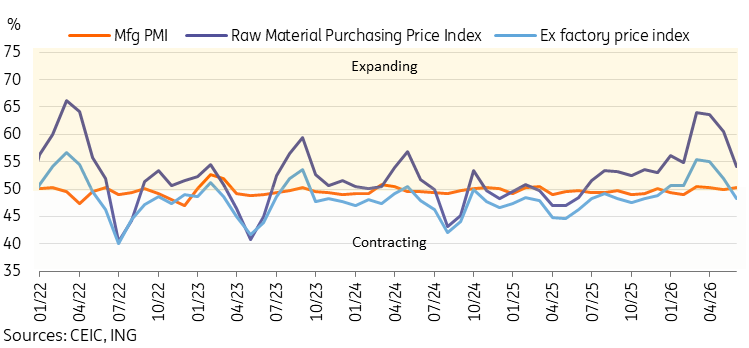
China's manufacturing PMI recovered to 50.3 in June, up from 50.0 in May, slightly beating expectations (market: 50.1, ING 50.1) for a smaller bounce. The PMI returned to the same level as April's reading.
Looking at the subindices, we generally saw positive signs in the June data. Encouragingly, new orders hit a 3-month high of 51.2, with export orders recovering to expansion territory at 50.1. Production also edged up to 51.4 on the month.
The price indices showed a notable drop-off in June as energy prices fell. The raw materials purchase price index remained in expansionary territory at 54.2, but it also fell for the third consecutive month. A key subindex to watch is the ex-factory price index. We saw a surprise move back into contractionary territory at 48.2, the first time in 6 months this subindex has fallen below 50. We’ve seen a reflation trend so far this year, further supported by higher input prices from the war in Iran. But these early signs could indicate that the spectre of deflation hasn't been vanquished quite yet.
Overall, the correlation between the PMI and industrial production data has loosened somewhat in recent years. Yet the slight rebound in the manufacturing PMI is nonetheless favourable for a potential end-of-quarter boost to industrial activity, when it’s published alongside the 2Q GDP data next month.
Is China's reflation momentum going to be cut short?
PMI price subindices have been trending downward for a few months
Non-manufacturing PMI edges up in June to stay in expansion territory
June's non-manufacturing PMI edged up slightly to 50.2, beating market expectations for a drop back into contraction territory (market: 49.9, ING: 49.9) and instead matching a 10-month high.
Two subindices were largely responsible for the slight uptick. First, we saw a rebound in new orders, which rose to 48.0 from 45.0. While remaining in contraction territory for a 38th consecutive month, this was the highest level since December 2024. Second, we had a modest uptick in business expectations, which rose to a 5-month high of 55.3.
The other subindices were little changed on the month. Despite this slight uptick, momentum remains relatively soft this year amid sluggish domestic demand.
Markets are increasingly watching for July's Politburo meeting for further stimulus cues
Generally, the PMI data came in a little stronger than forecasts, but continue to show relatively tepid activity. We could see a slight improvement of monthly activity data in June, but the sluggish economic
Generally, the PMI data came in slightly stronger than forecasts but continues to indicate relatively tepid activity. There could be a slight improvement in monthly activity data in June, but the sluggish data from the past few months will likely result in a notable slowdown in second-quarter GDP. We’re looking for a slowdown to 4.6% year-on-year, with risks slightly balanced to the downside. After a strong first quarter, growth will still be within target for the first half of the year. However, this doesn't mean there are no concerns.
To us, the weakness of domestic demand indicators after high-level strategic commitments to pivot toward a domestic demand-driven growth model stands out. Both retail sales and fixed-asset investment are showing negative growth. There are extenuating circumstances for this weakness. They include the headwinds we're seeing from previously frontloaded consumption through the trade-in programme. Uncertainties from abroad which may have contributed to caution on new investment. However, it seems increasingly clear that the domestic demand engine of growth is sputtering, and further policy support would be beneficial and help avoid an increasingly unbalanced growth profile.
More market participants appear to agree that July's Politburo meeting will be closely watched for signals of further stimulus. A new, large-scale stimulus push doesn’t look too likely, given the increased focus on the quality of growth and on effective, synergistic investment. But support for consumption and investment could help stabilise the trajectory in the second half of the year. In monetary policy terms, we continue to see room for People’s Bank of China easing in the second half of the year. Whether this is done via the current 7-day reverse repo rate or through the new overnight reverse repo rate remains to be seen.



Comments
Log in or sign up to join the conversation.