

Central banks were once again net gold buyers in April, after large sales pushed gold accumulation into negative territory in March.
In March, global central bank gold reserves fell by 27 tonnes, driven by big sales by Turkey and Russia. The tide turned in April, with central banks adding a net 17 tonnes of gold.
The Gold Buyers
Poland continued to lead all buyers, adding another 14 tonnes of gold to its reserves in March. That was on top of an 11-tonne purchase the previous month. So far this year, Poland has increased its gold reserves by 45 tonnes.
These purchases come despite rumors that Poland might liquidate some of its gold holdings to fund increased defense spending.
The National Bank of Poland now holds 595 tonnes of gold, making up about 30 percent of its reserves.
Poland led central bank gold buying in 2025, adding 102 tonnes of gold to its holdings.
Late last year, the National Bank of Poland issued a statement saying it plans to purchase up to 150 more tonnes of gold, raising its holdings to a maximum of 700 tonnes.
NBP Governor Adam Glapiński said the increase in gold reserves would elevate Poland to an “elite” status.
“This will place Poland among the elite 10 countries with the largest gold reserves in the world.”
The Polish central bank already holds more gold than the European Central Bank. To put the country's gold reserves in context, in 1996, the NBP only held 14 tonnes of gold.
The People’s Bank of China bought gold for the 18th straight month and upped the pace of official purchases in April, adding 8 tonnes to its official reserves. That was the biggest official increase in Chinese gold holdings since December 2024.
The purchase pushed China’s official gold reserves to 2,322 tonnes, roughly 9 percent of its total reserves.
Notice the emphasis on "official."
China is among the central banks that are likely to hold significantly more gold than they publicly disclose. As Jan Nieuwenhuijs has reported, the People's Bank of China is secretly buying large amounts of gold off the books. According to data parsed by the renowned Money Metals researcher, the Chinese central bank is currently sitting on more than 5,000 tonnes of monetary gold located in Beijing – more than TWICE what has been publicly admitted.
Mainstream reporting has finally picked up on this.
The Czech Republic has been one of the most consistent buyers over the last few years. The trend continued in April with another 2-tonne purchase.
The Czechs have adopted a slow, steady approach, buying gold for 38 straight months. The country added 20 tonnes to its holdings last year, and it now holds 79 tonnes of gold. Czech officials say they plan to increase gold reserves to 100 tonnes by 2028.
The Gold Sellers
Russia continued to tap into its gold reserves in April as its economy struggles to cope with the stresses of war spending and economic sanctions. April net sales totaled 6 tonnes. It was the fourth month of Russian gold selling.
Uzbekistan flipped to a seller in April, decreasing its gold reserves by 1 tonne.
Up until April, the Uzbek central bank had purchased 25 tonnes of gold this year, boosting reserves to 416 tonnes. The country holds most of its reserves in gold, with the yellow metal accounting for around 88 percent of its total reserve assets.
It is not unusual for central banks that buy from domestic sources, such as Uzbekistan and Kazakhstan, to pivot back and forth between buying and selling.
Turkey was the biggest seller in March. In April, the Turkish central bank held its reserves steady.
According to weekly data reported by the World Gold Council, short-term gold/USD swaps matured in April, leaving only longer-term (1-3 month) gold/USD swaps outstanding.
The Big Picture
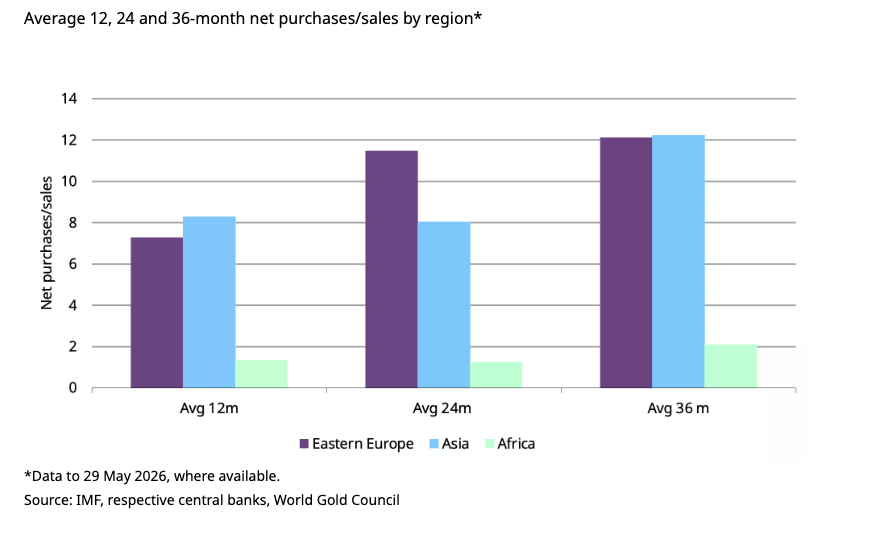
Asian and Eastern European central banks have dominated buying over the last several years. Over the past 36 months, central banks in Asia have added an average of 12 tonnes per month, with central banks in Eastern Europe averaging 11 tonnes per month.
Looking at the broader trend, central bank gold buying moderated in 2025 but remained far above the recent historical average. Official net full-year buying came in at 863.3 tonnes. That was down 21 percent year-on-year, charting the lowest level since 2021.
However, while central bank gold purchases declined last year, they were still well above the 2010-2021 annual average of 473 tonnes.
Last year was the fourth-largest expansion of central bank gold reserves on record. The all-time high was set in 2022 (1,136 tonnes). It was the highest level of net purchases on record, dating back to 1950, including since the suspension of dollar convertibility into gold in 1971.
The surging gold price was likely a factor in slowing central bank gold accumulation. As the World Gold Council put it, the higher price prompted “a more cautious approach.”
“This highlights that central banks are not insensitive to price dynamics, even as their long-term strategic interest in gold remains firmly intact.”



Comments
Log in or sign up to join the conversation.