


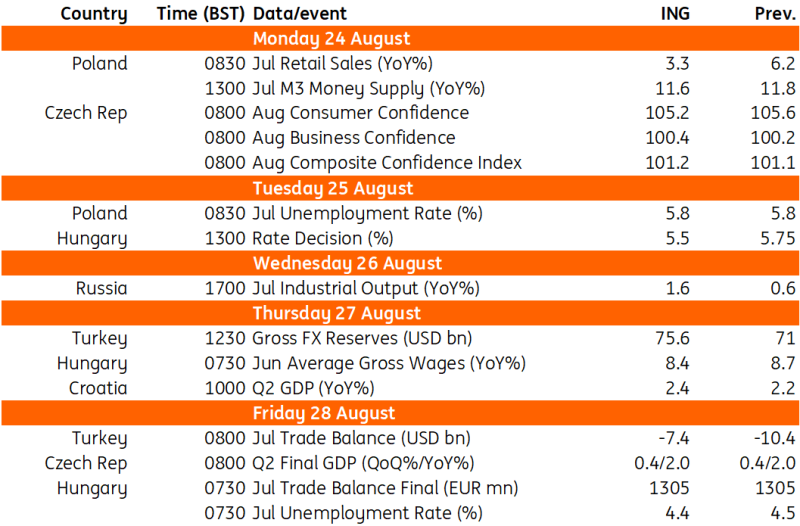
Next week, we're looking for an expected rate cut from the National Bank of Hungary at Tuesday's meeting. Key data releases from Poland and the Czech Republic are also in focus, including retail sales, labour market figures, confidence indicators and details of second-quarter GDP prints
Poland: Retail sales to feel the impact of higher fuel prices
Monday brings July retail sales data. The standard VAT rate on petrol and diesel (23%) was reinstated at the beginning of July following a temporary reduction to 8%. Together with another increase in crude oil prices, this pushed up retail fuel prices at the pumps. Given the relatively inelastic demand for fuel, particularly during the summer holiday season, it likely weighed on demand for other goods, as a larger share of household budgets was allocated to transport. Despite the fuel price shock, the impact on consumer demand appears to have remained limited so far, partly owing to fiscal measures that moderated the extent of price increases at filling stations in the previous months.
Tuesday sees the release of the registered unemployment rate, which we expect to have remained unchanged from June. However, the Ministry of Family, Labour and Social Policy reported a slight increase in the number of unemployed people last month, which could result in a marginal rise in the registered unemployment rate.
Hungary: Rate cut expected as focus shifts to further easing
The final interest rate decision of the summer on Tuesday is approaching, marking the last step in the previously announced mini-rate-cut cycle. However, we are almost certain that this isn’t the end of the story, and that the mini-cycle will evolve into a midi-cycle. The July inflation data clearly sets the stage for this.
At the same time, we doubt the August interest rate decision will concern anything other than the current situation. The central bank has made it quite clear on countless occasions that the decision on whether to continue the easing cycle will be made in light of the September Inflation Report. The 1.2% inflation rate in July falls outside the uncertainty range of the National Bank of Hungary's June forecast, meaning the overall inflation picture has clearly improved.
However, this is unlikely to prompt NBH Governor Mihály Varga and his colleagues to draw hasty conclusions or make premature announcements. In today's rapidly changing world, where geopolitical and global trade developments rewrite economic scenarios every 24 hours, the NBH is unlikely to commit to anything at this point. Forward guidance may, however, include a conditional statement regarding the inflation outlook that could signal continued interest rate cuts. According to our forecast, the Hungarian base rate could reach 4.75% by the end of 2026.
Czech Republic: Confidence indicators and GDP details in focus
Monday brings August consumer confidence data. We expect that it edged marginally lower in August yet remained well above its long-term average. That said, households are beginning to express concern about the impact of geopolitical unrest on the future performance of the Czech economy and potentially on their own financial position. Business confidence is set to have marginally picked up in the same month, while hovering only slightly above its long-term average values.
The driving force here is the relatively strong influx of new orders, while rising input costs remain a drag. The Statistical Office is about to confirm the 2Q26 real GDP figures, while we wonder about the resilience of consumption and fixed investment expenditure within the breakdown of a relatively soft GDP reading.
Key events in CEE & CCA next week



Comments
Log in or sign up to join the conversation.