

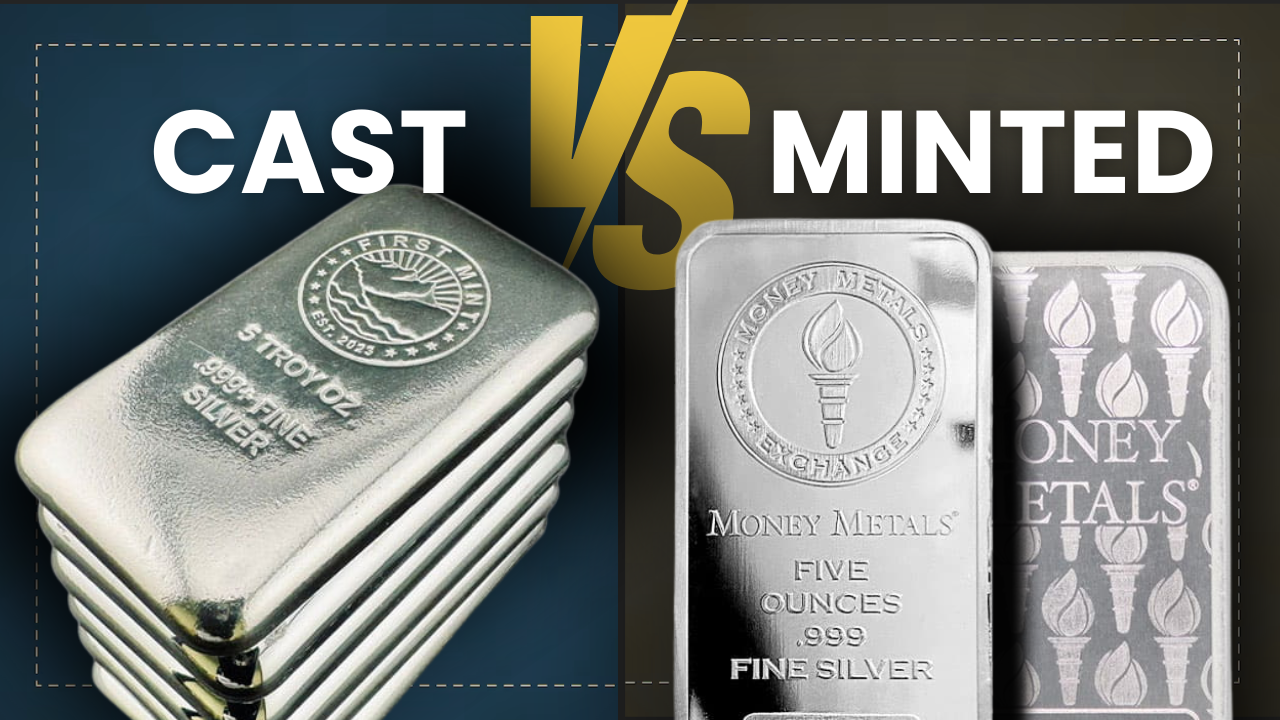
When comparing a cast bar vs minted bar, most first-time bullion buyers assume minted bars are automatically the better choice. Although these bars cost a little more in premiums, their polished finish and presentation appeal strongly to many investors. Sharp edges, mirror-like surfaces, and sealed assay packaging make these bars a stunning addition to any stack.
And yet, many experienced precious metals investors prefer the rougher looking cast bars. That surprises many newcomers to the bullion market.
Cast bars may look less refined, with uneven surfaces, cooling marks, and industrial finishes that seem almost unfinished. That is especially true when compared to the sleek minted bars from refiners like PAMP Suisse or Valcambi.
Seasoned stackers often view these imperfections as part of the appeal, not a downside.
The debate over cast bar vs minted bar goes far beyond appearance. Your choice can affect premiums, resale flexibility, durability, storage efficiency, handling, and even how comfortable you feel owning the metal long-term. Some investors want pristine bars they can admire, even if they rarely get to handle them. Others prefer heavy, low-premium bullion they can handle without worrying about fingerprints or scratches.
So, how can you navigate this choice? It ultimately comes down to mindset. Minted bars tend to appeal to collectors and presentation-focused buyers, while cast bars attract investors who see bullion primarily as tangible monetary insurance. Understanding those differences can help you decide which type of precious metal bar actually fits your goals.
Quick Answer
What is the difference between a cast bar and a minted bar?
Cast bars are generally cheaper, rougher, and favored by long-term stackers seeking low premiums. Minted bars are more polished, visually refined, and popular among collectors and first-time investors.
What Is a Cast Bar?
A cast bar is a type of bullion bar made by pouring molten gold or silver directly into a mold and allowing it to cool naturally. In contrast, minted bars are cut and stamped with precision machinery. Cast bars are produced using a much simpler manufacturing process that gives each piece a slightly different appearance. That makes every bar a little more individualized.
Once manufacturers melt the metal in a furnace, they pour the liquid metal into molds sized for a specific weight. As the bar cools and solidifies, it develops natural surface characteristics that many bullion investors find appealing. Depending on the refiner and production method, cast bars may include ripples, cooling lines, rounded edges, small dents, or uneven textures.
Investors do not see these as imperfections or flaws. Rather, they see these as part of what defines cast bullion bars.
Because the metal cools organically, no two cast bars look exactly alike. Some investors compare them to handcrafted products rather than mass-produced items. They have a more rugged appearance, which gives these bars a distinguished, industrial look. Many experienced stackers associate that with “real” bullion ownership.
Cast bars are most common when it comes to larger weights where minimizing premiums becomes more important than presentation. The following table shows some popular examples:
Common Cast Bar Sizes | Typical Use |
|---|---|
10 oz Silver Bars | Entry-level stacking |
1 Kilo Silver Bars | Low-premium investing |
100 oz Silver Bars | Bulk silver storage |
1 Kilo Gold Bars | High-net-worth bullion ownership |
400 oz Gold Bars | Central bank and COMEX vault storage |
There is also a historical reason cast bars carry so much credibility in the precious metals market. Large institutional bars held by central banks, sovereign vaults, and COMEX-approved depositories are traditionally cast rather than minted. The famous London Good Delivery gold bars stored in central bank vaults around the world are cast bars weighing roughly 400 troy ounces each.
That connection to institutional bullion helps explain why many serious investors prefer cast products. To them, cast bars feel less like luxury retail items and more like raw monetary metal valued primarily for weight and purity rather than appearance.
What Is a Minted Bar?
A minted bar is a bullion bar manufactured using precision-cut metal blanks that are stamped or pressed into their final form using specialized machinery. Unlike cast bars, which are poured individually into molds, minted bars are engineered for uniformity, sharp detail, and visual perfection.
The process begins with long sheets of refined precious metal. Refiners roll these sheets to a consistent thickness before individual blanks are cut out with precise dimensions and weights. The blanks are then polished and struck with high-pressure dies that imprint the refinery’s logo, weight, purity, and other identifying marks.
The end result is a sleek, highly refined product with smooth surfaces, crisp edges, and mirror-like finishes.
Most minted gold and silver bars also include additional security and presentation features such as:
Serial numbers
Tamper-evident assay packaging
Holograms
Micro-engraving
Assay certificates verifying authenticity and purity
Because of their polished appearance and presentation, minted bars often resemble luxury goods more than industrial bullion. These features make them popular with the following groups:
First-time precious metal buyers
Gift purchasers
Collectors
Investors buying smaller denominations such as one ounce or fractional bars
Popular minted bar brands include PAMP Suisse, Valcambi, Credit Suisse, and the Royal Canadian Mint. Many of these refiners place heavy emphasis on elegant packaging and recognizable branding.
These features make for excellent branding. That, in turn, helps minted bars to dominate bullion marketing.
Minted bars have highly polished surfaces, sealed packaging, and symmetrical designs, which makes for excellent photographic opportunities. Refineries can show these bars off on product listings, advertisements, and social media content. New investors benefit especially from this, as the appearance of these bars can generate an immediate sense of trust and authenticity.
A sealed minted bar often feels more “official” than cast bars. Its sleek appearance looks more professional, which brings many investors a sense of security.
In reality, both products contain investment-grade precious metal. The difference is largely in manufacturing style, presentation, and buyer preference:
Feature | Minted Bar |
|---|---|
Manufacturing Method | Cut and stamped |
Appearance | Polished |
Premiums | Higher |
Finish | Glossy |
Uniformity | Extremely high |
Cast Bar vs Minted Bar: Side-By-Side Comparison Table
At first glance, the differences between a cast bar vs minted bar seem purely cosmetic. After all, both bars contain the same metal content, both come from reputable refiners, and both have good liquidity in the bullion market.
Still, there are practical differences between the bars that go beyond mere appearances.
Premiums, durability, handling, storage, resale preferences, and even investor psychology can vary significantly between the two. Some investors prioritize visual perfection and presentation, while others care almost exclusively about acquiring the maximum amount of metal for the lowest possible premium.
That divide has created two very different types of bullion buyers.
Several stackers see cast bars as being like raw monetary metal. They are heavy, rugged, and unconcerned with cosmetic perfection. On the other hand, buyers who appreciate precision craftsmanship, sealed packaging, and collectible presentation often prefer minted bars.
The comparison below highlights the biggest differences between the two products:
Feature | Cast Bars | Minted Bars |
|---|---|---|
Manufacturing Method | Molten metal poured into molds | Cut and stamped from rolled metal sheets |
Appearance | Rugged, uneven, industrial | Smooth, polished, highly refined |
Premiums | Usually lower | Usually higher |
Resale Spreads | Often narrower on larger bars | Can retain stronger retail appeal |
Scratch Visibility | Less noticeable | More noticeable on polished surfaces |
Fingerprint Visibility | Minimal concern | Highly visible on mirror finishes |
Handling Comfort | Easy to handle freely | Often left sealed to preserve condition |
Packaging | Usually minimal or none | Often sealed in assay cards |
Stackability | Excellent for large storage | Excellent for small uniform bars |
Storage Efficiency | Ideal for bulk holdings | Slightly less efficient with packaging |
Aesthetic Appeal | Raw bullion look | Luxury presentation |
IRA Eligibility | Eligible if purity requirements are met | Eligible if purity requirements are met |
Counterfeit Considerations | Trusted refinery matters most | Packaging can provide added confidence |
Liquidity | Strong, especially in larger sizes | Strong, especially among retail buyers |
One of the biggest differences between the products is hard to quantify, but matters greatly. That difference is the way investors emotionally relate to their bullion.
Many experienced precious metals buyers describe cast bars as feeling more “authentic.” Their rough surfaces, cooling marks, and imperfections reinforce the idea that the bar exists primarily as stored wealth instead of a luxury retail product. Larger cast bars tend to resemble the institutional bullion held in vaults, central banks, and COMEX warehouses.
Cast Bar vs Minted Bar: Why Many Experienced Stackers Prefer Cast Bars
Cast bars simply feel more like “real” precious metals to many long-term bullion investors.
That may sound subjective, but listen to conversations among experienced stackers, and you will hear that sentiment quite often. Buyers love these bars for their weight, utility, and low premiums over presentation.
One of the biggest reasons is practical: cast bars are easier to live with.
A polished minted bar sealed inside an assay card often feels fragile. Owners often do not want to touch the bar because fingerprints, scratches, or damaged packaging can all hurt the bar’s visual appeal.
For this reason, some investors say that minted bars become “display pieces” that spend their entire lives trapped in plastic.
Cast bars create the opposite experience.
Generally, poured bars have a design meant to be handled freely. Small scratches, edge marks, or natural toning rarely bother owners because the rugged finish already embraces imperfections. Investors can stack them, hold them, and move them around without worrying about preserving flawless surfaces.
That has led many stackers to describe cast bars as “touch-friendly bullion.”
For some precious metals buyers, physically handling gold or silver is part of the appeal of owning tangible assets in the first place. Unlike stocks, ETFs, or digital assets on your screen, bullion is something that you can hold and feel. Cast bars reinforce that connection because they are not treated like delicate collectibles.
Lower premiums also play a major role.
Experienced stackers often focus on maximizing ounces accumulated over time. Since cast bars generally require less labor, polishing, packaging, and branding, they often carry lower premiums than their minted counterparts. Those savings can quickly become noticeable when you make large bullion purchases.
However, there is a deeper psychological appeal behind cast bullion bars.
Many investors associate cast bars with institutional wealth storage. Large central bank gold bars, London Good Delivery bars, and COMEX vault bullion are traditionally cast rather than minted. That industrial appearance gives poured bars a sense of seriousness and permanence that investors often find comforting.
Collectors often appreciate the individuality of these bars, too.
No two cast bars cool in exactly the same shape. Surface ripples, toning patterns, and slight asymmetry make each piece unique. Over time, wear and oxidation might even add character to the investment, rather than making these bars less appealing.
It might help to think of cast bullion bars as being like a vintage watch. Sure, there might be sleeker models available. However, both items have a beautiful, timeless appeal. Age and imperfections become part of the product’s identity, not drawbacks.
Cast Bar vs Minted Bar: Why Some Investors Prefer Minted Bars
Cast bars have their audience, but minted bars are extremely popular as well. There is a good reason for that. Their clean look, precise dimensions, and sleek presentation make them especially attractive to newer investors and retail buyers.
In short, these bars simply look more valuable to many investors.
Sharp edges, mirror-like finishes, engraved details, and tamper-evident assay packaging create a polished ownership experience that cast bars typically do not offer. Several refiners have gained global reputations by pursuing this presentation-focused approach.
That has proven to be very effective branding for several refiners, including:
PAMP Suisse
Valcambi
The Royal Canadian Mint
Newer precious metals investors often associate these bars with symmetry, shine, and sealed packaging – in short, with trustworthiness and authenticity. A perfectly polished bar inside an assay card is easy to verify, which adds a layer of psychological security.
This is one reason minted bars dominate retail marketing and online bullion advertisements. They photograph exceptionally well.
A polished one ounce gold bar sealed in assay packaging communicates refinement and precision. Cast bars, in contrast, often look rough or industrial to buyers who are new to the bullion industry.
Many people also love to make gifts of minted bars.
Their presentation feels more complete and professional. That makes them popular gifts for:
Birthdays
Graduations
Weddings
Long-term savings gifts
A sealed minted gold bar often resembles luxury jewelry packaging, making it easier for non-investors to appreciate visually.
Cast Bar vs Minted Bar: Which Has Lower Premiums?
Generally speaking, cast bars carry lower premiums than minted bars of the same weight and purity.
The reason comes down largely to manufacturing costs.
Cast bars use a relatively simple process for their manufacturing. It consists of four main steps:
Melting the precious metal
Pouring it into molds
Allowing it to cool
Stamping identifying information onto the finished bar
The process involves less polishing, machining, packaging, and finishing work. All of that leads to lower production costs.
Minted bars require significantly more labor and precision. The process includes the following steps:
Rolling the metal into uniform sheets
Cutting the metal into exact blanks
Polishing the metal
Striking the metal with engraved dies
Inspecting the metal for cosmetic perfection
Sealing the metal inside tamper-evident assay packaging
All of those extra steps increase manufacturing expenses, which are ultimately passed on to the buyer through higher premiums.
You can really see this in larger bars, such as ten ounce gold bars, kilo bars, or one hundred ounce silver bars. There are significant premium differences between their cast and minted forms, which will show across dealer exchanges.
That is one reason serious stackers often prefer cast bullion.
Long-term precious metals investors frequently focus on maximizing the amount of metal acquired for their budget rather than paying extra for polished finishes or decorative packaging. Over years of stacking, consistently choosing lower-premium products can result in owning significantly more gold or silver.
Product Type | Typical Premium Trend |
|---|---|
1 oz Minted Gold Bar | Higher |
10 oz Cast Gold Bar | Lower |
1 oz Minted Silver Bar | Higher |
100 oz Cast Silver Bar | Much lower |
That said, premiums constantly fluctuate based on market demand, refinery availability, and retail buying trends. During periods of strong investor demand, highly recognizable minted bars can sometimes command especially large premiums because buyers are willing to pay more for trusted branding and presentation.
Still, for investors primarily focused on bullion accumulation, cast bars generally offer the most metal for the money.
Are Cast Bars Harder to Sell?
Many first-time buyers assume cast bars are harder to resell because they look rougher and less refined than minted bars. In reality, both cast and minted bullion bars hold high liquidity – provided they are produced by reputable refiners.
Recognition is not just for appearances. It provides a boost of confidence for buyers.
Cast bars from trusted refiners like Johnson Matthey, Engelhard, Heraeus, or Asahi are widely accepted throughout the precious metals market. Dealers, wholesalers, and experienced private buyers care primarily about:
Weight
Purity
Refinery reputation
Authenticity
Whether the surface is polished or rugged usually matters far less. That said, there are environments in which minted bars sell faster.
Sealed assay packaging provides immediate visual reassurance for newer buyers, especially online. A polished minted bar with an intact assay card may feel easier for casual investors to verify and trust. This is particularly true for smaller bars such as one ounce gold products, where presentation and branding strongly influence buyer behavior.
Cast bars tend to appeal more to experienced investors. Many seasoned stackers intentionally seek out poured bars because they associate them with lower premiums, institutional bullion, and long-term wealth storage. Large cast kilo bars and 100 oz silver bars remain extremely popular in the secondary market for precisely that reason.
Dealer buyback practices also help support liquidity.
Most reputable bullion dealers publish standing buy prices for both cast and minted products from recognized refiners. In many cases, the difference in buyback pricing is minimal. However, that can change if the minted bar carries collectible demand or highly desirable branding.
Institutional markets also favor cast products in larger sizes.
COMEX-approved bars, London Good Delivery bars, and many vault-stored kilo bars are traditionally cast rather than minted. That institutional acceptance reinforces the long-term liquidity of cast bullion products.
Ultimately, neither format is inherently difficult to sell. The key factors are authenticity, refinery recognition, and market demand rather than whether the bar has a mirror finish or visible cooling marks.
Which Is Better for Long-Term Investing?
For long-term precious metals investing, neither cast bars nor minted bars are universally “better.” What you choose depends on the kind of investor you are, and what you want the bullion to accomplish.
If your goal is primarily to accumulate ounces, cast bars are often your best bet. Because these bars carry lower premiums, they allow buyers to gather more gold and silver for their stack for the same amount of money. That becomes especially important with larger purchases such as kilo gold bars or 100 oz silver bars.
Purchasing large bars will show the largest premium savings over time. Many long-term stackers view bullion as financial insurance first and foremost, so aesthetics matter far less than acquiring the maximum amount of physical metal possible.
Cast bars also tend to work well for vault storage and bulk holdings. Their rougher surfaces are less vulnerable to cosmetic concerns, making them easier to stack, transport, and handle without worrying about preserving perfect condition.
There is also an emotional side to bullion ownership that many investors underestimate.
Some people enjoy the raw, industrial appearance of cast bars because they resemble the institutional bullion held in vaults and central banks. Others enjoy the precision craftsmanship and luxury feel of minted products.
Both types of bars can work for your portfolio. Although many treat precious metals like a purely financial decision, there is a psychological dimension.
Many investors ultimately choose to own both to pursue different advantages.
Cast bars excel at efficient wealth storage and low-premium accumulation, while minted bars provide visual appeal, gifting flexibility, and strong retail recognition. The right balance depends on your investing goals, storage habits, resale plans, and personal relationship with physical precious metals.
Bottom Line Comparison Table: Cast Bar vs Minted Bar
Investor Type | Better Choice |
|---|---|
Lowest premiums | Cast bars |
Best presentation | Minted bars |
Gifting | Minted bars |
Bulk stacking | Cast bars |
Institutional-style bullion | Cast bars |
Beginner buyers | Minted bars |
Final Reflection: Cast Bar vs Minted Bar
Choosing between a cast bar vs minted bar is ultimately a matter of preference. Neither bar is inherently superior to the other, as they each contain the same precious metal content. The differences come from their manufacturing processes, premiums, and appearances.
Cast bars appeal to investors who see bullion as raw monetary insurance.
Minted bars appeal to buyers who value precision, presentation, and collectibility.
Decide on your preferences and consider the size of the bullion you wish to purchase. How much extra are you willing to pay in premiums? Is it a cost you are willing to pay?
Over time, you can experiment with different buying strategies to accumulate the precious metal you need in your portfolio. You may find that owning both in different ratios is the fastest and most efficient way to meet your goals.



Comments
Log in or sign up to join the conversation.