

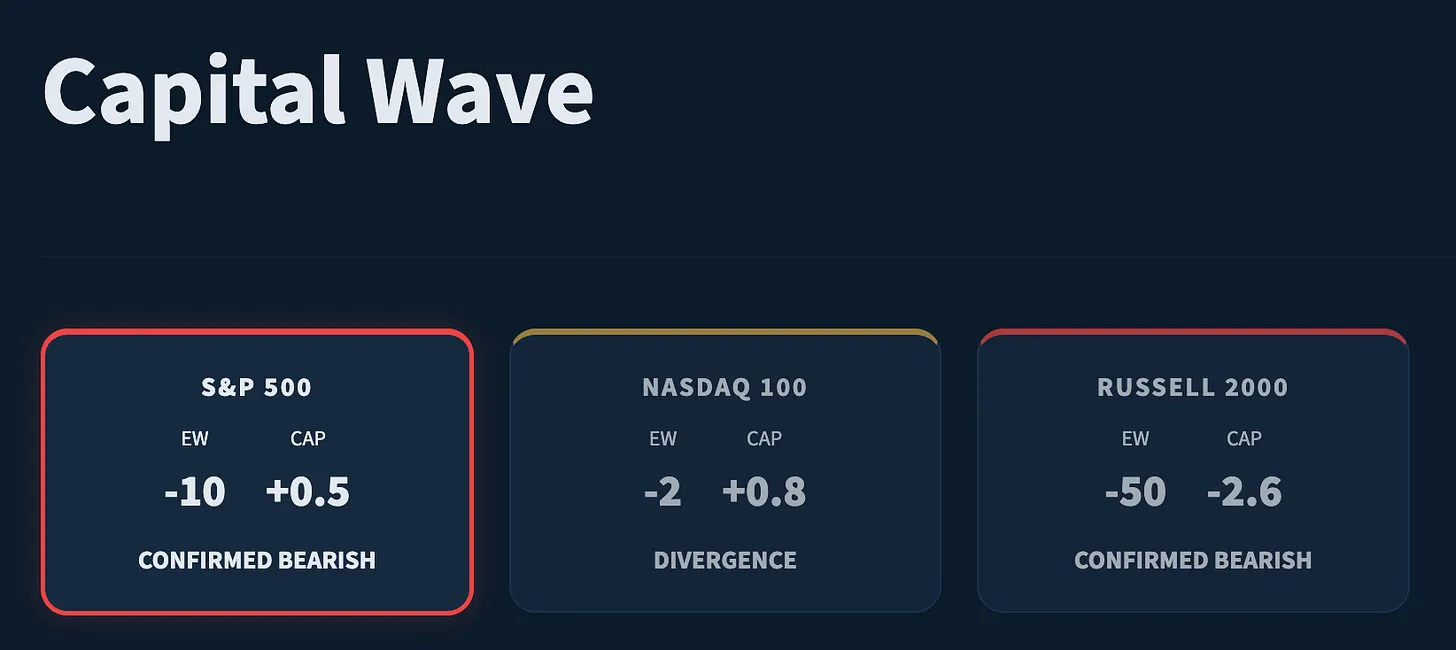
Heading into the end of the day, we found the market being dragged higher by just a handful of names.
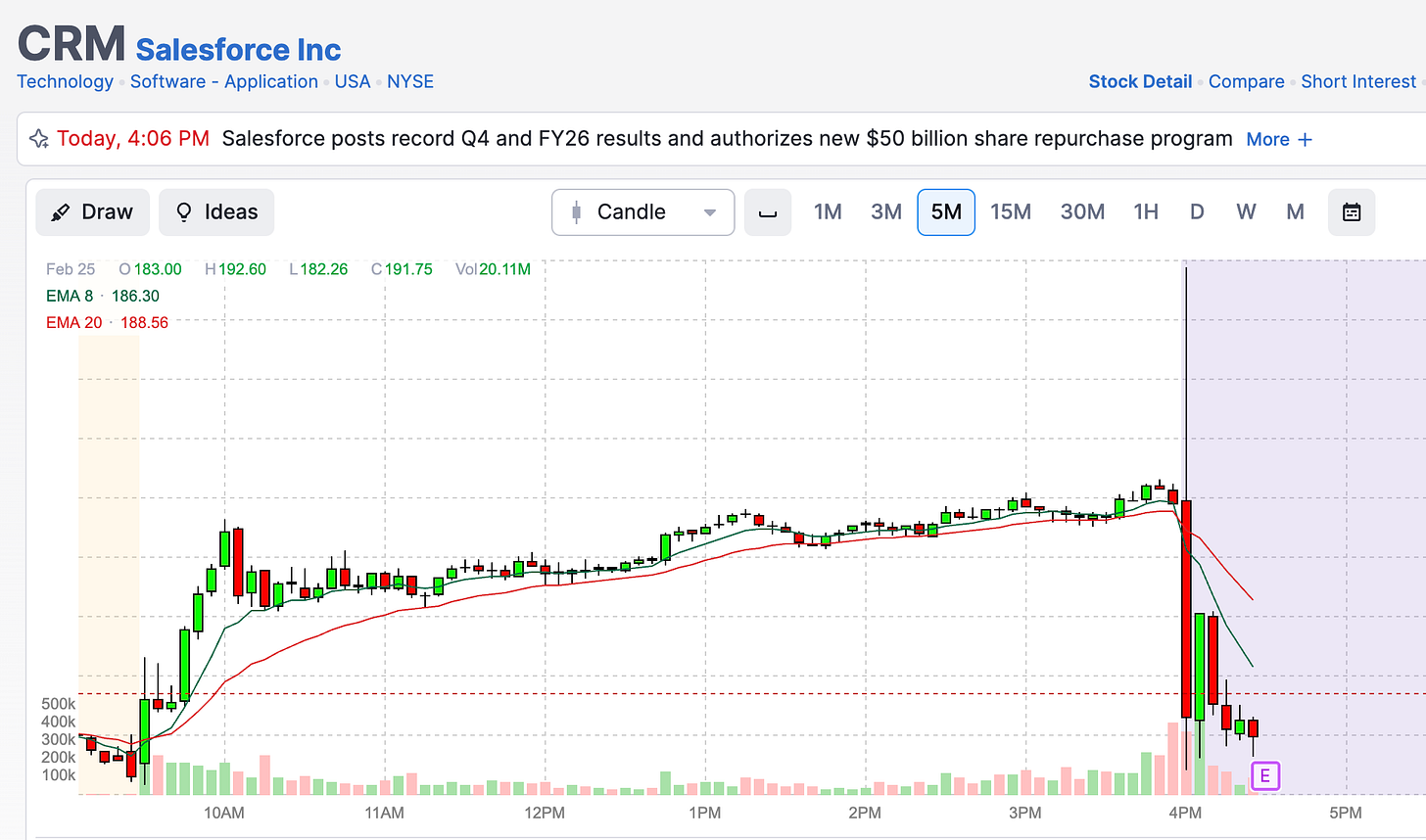
We’re still under pressure… Salesforce (CRM) reported earnings first after the bell. They had a record fourth quarter on profits and revenue… and announced a $50 billion buyback…
And still got punched in the face… Expect them to say “Claude” on that call about 5,683 times today…
Now, let’s get to the main event…
NVIDIA (NVDA) Earnings Report and Outlook
The Good
NVIDIA just posted $68.1 billion in fourth-quarter revenue, a 73% increase year over year, alongside $1.32 in adjusted earnings per share. (When I say “adjusted,” I mean the number that strips out one-time charges and stock compensation so you can see how the core business is actually performing.)
For the full fiscal year, revenue reached $215.9 billion, up 65% from $130.5 billion the year before.
Two years ago, this was a $27 billion-a-year company.
Have a Mellow Corn, and read that again if you need to.

The free cash flow numbers are staggering.
NVIDIA generated $34.9 billion in the fourth quarter and $96.6 billion for the full year.
The company returned $41.1 billion to shareholders in fiscal 2026 through buybacks and dividends, and the board just authorized another $50 billion in share repurchases on top of that.
They’re doing pretty well.
Maybe someone should write about them more often. Right?
The balance sheet is extremely strong.
The company is sitting on roughly $62.6 billion in cash and marketable securities.
Total assets nearly doubled to $206.8 billion, and shareholders’ equity doubled to $157.3 billion.
Even though this company is spending like it’s got a deadline only Jensen can see, the financial position has never been stronger.
The Meh (Not Even Bad)
Wait, They’re Still in Gaming
People really don’t care about gaming like they used to.
Gaming revenue fell 13% from the previous quarter to $3.7 billion. NVIDIA blamed post-holiday channel inventory normalization and flagged that supply constraints will be a headwind into the first quarter of fiscal 2027. Gaming was once the heart of this company, but now accounts for only about 5% of quarterly revenue.
There’s chatter they’re just gonna skip some developments here… so, whatever.
Margin Pressure
The fourth-quarter margins actually recovered nicely, with adjusted gross margin rising to 75.2%, up from 73.6% in the third quarter.
But the full-year picture tells a different story.
The adjusted gross margin for fiscal 2026 was 71.3%, down from 75.5% the year before, a drop of more than 4 percentage points.
The Blackwell product ramp carried real costs throughout the year, even though the worst appears to be behind them. The forward guidance implies margins staying in the low 70s for the first quarter, so this will remain a point of scrutiny.
Operating Costs
I’ve flagged this in the past, and it still stands out.
Reported operating expenses rose 45% compared to a year ago in the fourth quarter, and adjusted operating expenses were up 51%.
The company is investing heavily in engineering talent, computing infrastructure, and research and development, all of which are necessary to maintain its lead.
But the pace is intense.
If revenue growth ever moderates to something like 30% to 40%, which would still be incredible by any normal standard, the expense base doesn’t moderate at the same pace.
Operating leverage works both ways.
The Inventory and Receivables Tightrope
This is my only real criticism… and it’s still an issue.
Inventory has more than doubled to $21.4 billion.
Total purchase and supply commitments reached $95.2 billion.
Accounts receivable, which is the money customers owe NVIDIA for products already delivered, grew from $23.1 billion to $38.5 billion. That is a 67% increase that slightly outpaces revenue growth.
I want to be clear that this is not a crisis. You’ll hear Jensen say demand is off the charts, and he’s probably right. When you’re selling more than $60 billion in hardware per quarter, you need massive inventory, and your customers are going to owe you a lot of money. That’s just how the math works at this scale.
But it’s worth being eyes-wide-open about what’s embedded in these numbers.
This is $95 billion in supply commitments is a bet that AI infrastructure spending stays at this level or grows. That’s the bet. That’s the leverage.
This is almost like the MBA Cap-Simulation coming to life, where you’re selling products, and you have to go chaotically leveraged in inventory and debt to win…
If even one or two of the major cloud companies hit a wall on capital spending or slow their buildout, NVIDIA is sitting on a lot of silicon. Like the GDP of Jamaica…
The accounts receivable growing slightly faster than revenue is also worth watching.
It’s not alarming yet, but it tells you the credit exposure is real and growing.
It’s a tightrope, not a crisis. But it’s a tightrope over a very deep canyon.
Customer Concentration
It’s not like they’re trying to sell their business… and they’re some small business down in Tennessee with just a handful of customers. But it matters enormously.
NVIDIA says the big cloud companies represent “slightly more than 50%” of its data center revenue. That means three to five companies, think Microsoft (MSFT), Google (GOOGL), Amazon, Meta (META), and maybe Oracle (ORCL), are responsible for more than $30 billion per quarter.
If any one of them shifts strategy, pulls back on spending, or accelerates its own custom chip roadmap, the impact on NVIDIA would be enormous. It’s the latter element… custom roadmap that might be the real threat…
All of them are building their own AI chips. Google has its TPUs. Amazon has Trainium. Microsoft has Maia. Meta is developing custom silicon.
These are NVIDIA’s biggest customers and biggest future competitors, all at the same time.
Today, demand for AI computing power is so intense that those custom chips serve as a complement rather than a replacement for NVIDIA’s products.
But over time, that is the REAL question for this stock.
Stock Compensation Accounting Change
Other people brought this up (CNBC talked about it more than I’d expect…)
But at the start of fiscal 2027, NVIDIA will include the cost of stock-based compensation in its adjusted earnings.
Stock-based compensation is the value of shares the company gives to employees as part of their pay.
It’s been running at roughly $1.9 billion per quarter and growing, so including it will make future headline earnings comparisons messier. Not make or break… but just one of those things that make me have to write (adjusted before the company decided to..)
COME ON MAN… I’m trying to write fast!!
It’s the right move for transparency, but the timing is notable.
Growth rates would compress off a larger base, and at the same time, the headline numbers would look less flattering because of this accounting change.
Just be aware of it… Or else we’ll be going back and having to talk about this again…
The Whoa!!!
Okay… just holy cow…
Networking Revenue: Up 263% From a Year Ago
Most people are going to miss this one, but networking revenue jumped from $3.0 billion to $11.0 billion in a single quarter, a 263% increase.
As AI computing clusters scale from thousands to hundreds of thousands of GPUs, the networking layer, which includes high-speed connections such as NVLink, InfiniBand, and Ethernet, becomes just as critical as the computing power itself. NVIDIA is capturing that value, and this number will keep growing.
These are the little numbers that lead to what comes next…
First-Quarter Fiscal 2027 Guidance: $78 Billion
This is a spit-out-your-coffee number… NVIDIA guided first-quarter revenue for fiscal 2027 to approximately $78 billion, a $10 billion jump from the quarter that just ended.
What makes this even more remarkable is that the guidance assumes zero data center computing revenue from China. That is a new record guidance number with one of the world’s biggest AI infrastructure markets completely zeroed out.
The bull case is obvious… if export restrictions ever narrow, this number gets even bigger.
But the other side matters too.
Every quarter that NVIDIA is locked out of China, Huawei’s Ascend chips get stronger, and domestic alternatives become more entrenched. I
f the restrictions become permanent, and they probably will, that’s not just lost revenue. It’s a market that's permanently ceded to someone else.
The Groq Acquisition: $13 Billion in Cash
Buried in the cash flow statement, NVIDIA paid $13 billion in cash to acquire Groq, a chip competitor, during the fourth quarter.
The deal added $15.6 billion in goodwill to the balance sheet.
Instead of competing with a rival, they just swallowed it whole. NVIDIA is now building inference-optimized silicon, which is hardware specifically designed to run AI models quickly and cheaply, right alongside its GPU platform.
Here’s the question from that note…
If Blackwell delivers an “order-of-magnitude lower cost per token” for running AI models, as Jensen claims, then why pay $13 billion for a startup whose entire thesis was that GPUs aren’t efficient enough for that exact job?
Either NVIDIA sees something in Groq’s architecture that Blackwell can’t replicate, or it took the threat seriously enough to remove it from the board entirely.
Both of those answers are interesting, and neither is as simple as calling it empire-building. So… maybe it gets addressed tonight…
Strategic Investments: $17.5 Billion Deployed
NVIDIA’s portfolio of private company investments jumped from $3.4 billion to $22.3 billion over the course of the year.
The company spent $17.5 billion on strategic investments in fiscal 2026, taking positions in cloud infrastructure partners, AI startups, and platform companies.
They’re not just selling the picks and shovels anymore.
They’re buying stakes in the miners. This company is actively shaping the ecosystem it profits from.
Full-Year Net Income: $120 Billion
I mean… $120.1 billion in net income in a single fiscal year?
That is more profit than most Fortune 500 companies generate in a decade.
It’s more than the GDP of over 100 countries.
Two years ago, NVIDIA had $27 billion in revenue.
The scale and velocity of this transformation are without historical precedent in the technology sector. This is the chokepoint of the world now…
If you own NVIDIA, this report gives you nothing to panic about and everything to feel validated by. If you don’t own it, this is the part where you stare at the screen and wonder how much higher this thing can actually go.
The honest answer is that as long as every major company on Earth is racing to build AI infrastructure, NVIDIA sits at the center of the spending.
That hasn’t changed.
The best way to think about NVIDIA right now is this…
The engine is running at full throttle, the fuel tank is overflowing, and the road ahead looks clear.
But someone should probably keep an eye on the gauges. That’s all of our jobs…



Comments
Log in or sign up to join the conversation.