

One sure way the banks will be able to withstand a deep downturn is for the regulators to reduce required capital reserves. In March, the Canadian financial regulators, Office of the Superintendent of Financial Institutions (OSFI), reduced the capital buffer from 1.25% to 1.00% of total risk-weighted assets. Regulators require banks to hold sufficient capital as a buffer against unforeseen losses as part of their risk-management policies.The OSFI decision provided the banks with an additional lending capacity of $300 billion.
At the same time, vulnerabilities in the financial system remain quite elevated, especially since it is nearly impossible to gauge the pace of economic recovery. The pandemic has added pressure on highly indebted households. The Canadian banks have adopted a policy of providing some temporary relief, for example, in the form of mortgage interest forbearance in the short-term. Nonetheless, the five largest Canadian banks have set aside an additional C$10.43 billion for loss provisions, more than four times the amount set aside a year ago. These loss provisions resulted in the banks reporting earnings drops of 50% or more on a comparable yearly basis.
(Click on image to enlarge)
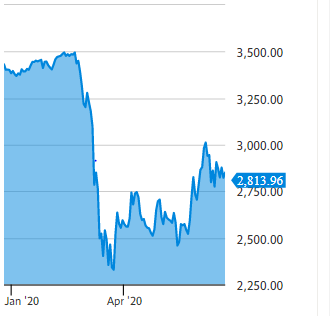
Figure 1 TSX Bank Index
The Canadian banks insisted that dividends not be cut in the face of such losses. In the case of the CIBC this is a highly questionable decision given that the bank had to take C$0.50/share out of capital to maintain its $C 1.46/share dividend. With the Canadian bank stocks trading at 20% below the January high-water mark, dividends remain attractive at 6-7%. However, to many analysts this could be interpreted as a value trap at a time when the Canadian 10 year bond is yielding less than 1%. In the case of the CIBC, it is not at all clear that it can continue to dip into capital to satisfy its shareholders.
This bank performance takes place against the Canadian backdrop in which national output declined by nearly 10% in the first quarter. For the second quarter, when the lock down was fully in place, analysts expect a much further drop in output. Government statistical data show that about a third of the workforce is either unemployed or under-unemployed, a sign of how damaging the pandemic has been so far.
Now, the banks have had their bank reserves requirement cut back, the real question is whether the banks will lend more to support an economic recovery. Putting more money in the hands of the banks does not necessary result in greater lending. The banks need to believe that individuals and business represent good risks--- the jury is still deliberating.



Comments
Log in or sign up to join the conversation.