

The Martian is one of my favourite books, and I enjoyed the movie just as much. Matt Damon plays Mark Watney, who finds himself stranded on Mars after his crew leaves him behind, thinking he’s dead. Help from Earth is going to take a while, and his food is only going to last so long. So he takes stock of what he has and figures out how to grow potatoes on Mars. The engineer in me loves that part. The second he gets something to grow, he’s already giving himself credit for colonizing the planet. I’d probably have done the same.
As someone who’s been investing in biotech since the early 2010s, I see a bit of Watney in the people who spend years trying to develop a drug for patients who have few treatment options. It takes some imagination to come up with the idea in the first place, and a fair bit of stubbornness to keep working on it when a trial doesn’t go your way. The ingenuity and determination it takes to find cures and solve some of the biggest mysteries of the human body remind me of how astrophysicists tackle the mysteries of the physical universe. That’s what gets me excited about investing in truly transformational companies.
Of course, those of us investing in the biotech sector know a thing or two about patience as well (pull up a five-year chart of XBI and you’ll see what I mean). One company I started investing in a while back is BridgeBio Pharma (BBIO). What drew me in was its remarkable CEO and the company’s determination to bring transformative drugs to market.
BridgeBio is a biotech company that specializes in rare genetic diseases, with most of its work in cardiology, endocrinology, neuromuscular disease, and skeletal disorders. It has several approved drugs and a pipeline targeting rare diseases with multibillion-dollar addressable markets.
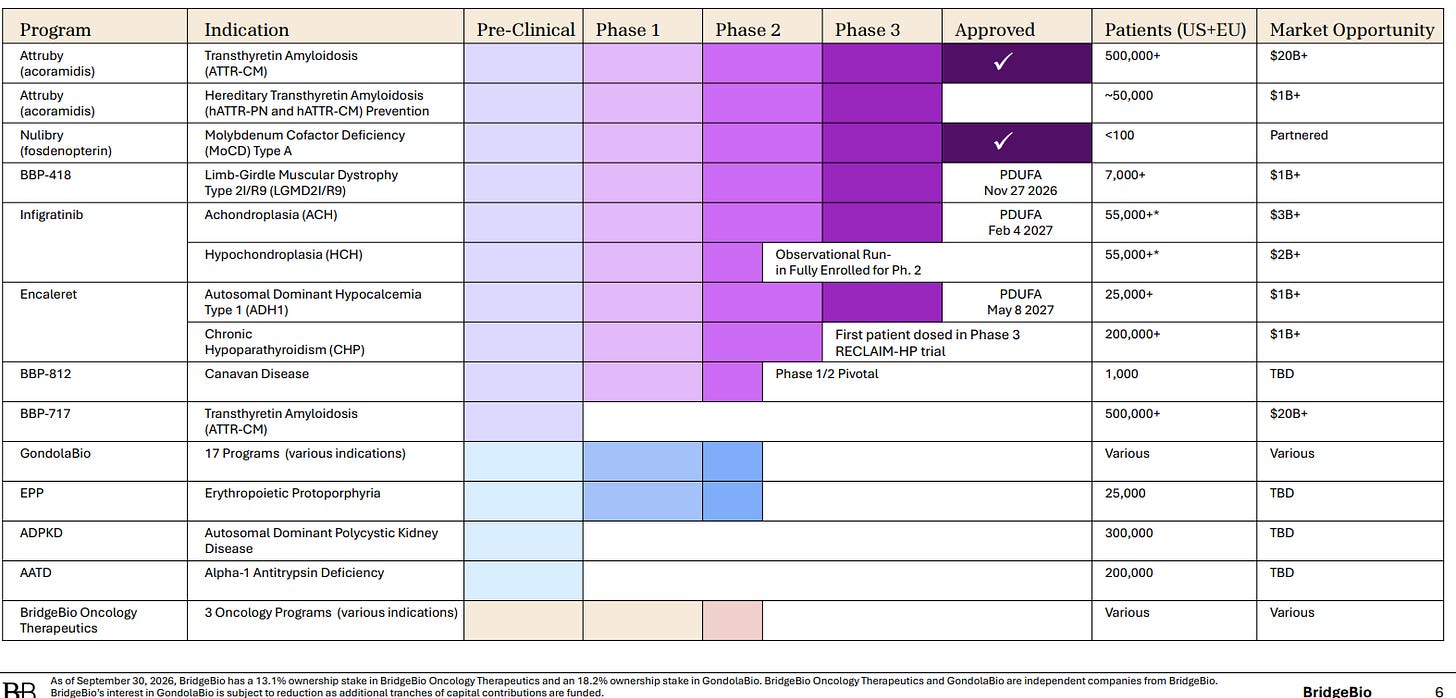
My original investment thesis centered on Attruby (acoramidis), BridgeBio’s drug for ATTR-CM (transthyretin amyloid cardiomyopathy). Beyond Attruby, there are three drugs I think deserve more attention: BBP-418, infigratinib, and encaleret.
In this article, I will give a quick overview of BridgeBio, get into what I’m watching for with each drug over the next few months, and dig into the financials. The question I keep coming back to is this. Can BridgeBio build a business around more than one blockbuster?
Business Overview and the Crown Jewel
BridgeBio Pharma was founded in 2015 by a group that included Neil Kumar and cancer researcher Frank McCormick to tackle a frustrating problem in biotech. The company went public at $17 per share and began trading on Nasdaq under the ticker BBIO on June 27, 2019.
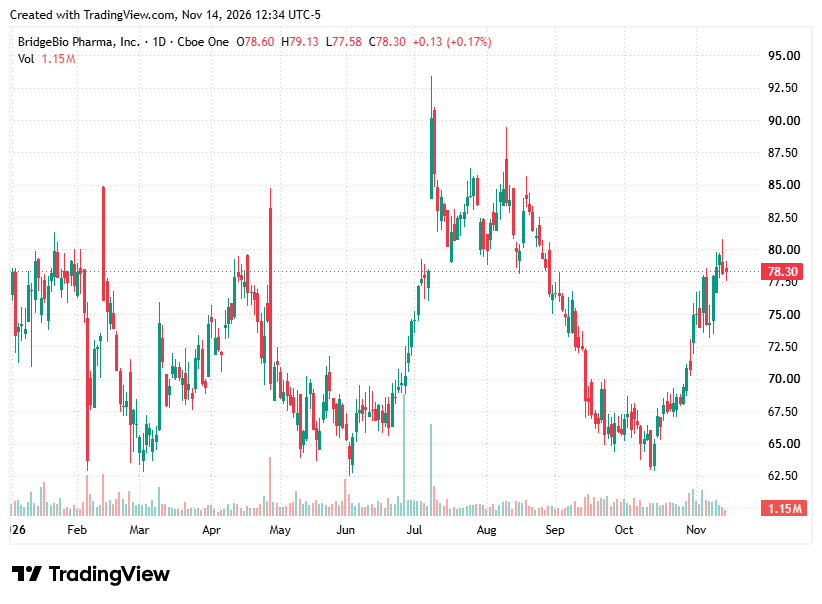
As I write this, BBIO is trading at $78.30 per share, giving it a market cap of about $15.23 billion and approximately 194.8 million of outstanding common shares. Although the company has more than quadrupled from its initial trading days, it has been relatively flat in terms for share price growth year-to-date.
The main driver of BridgeBio’s current market value is Attruby, its treatment for ATTR-CM. The drug hit the market in November 2024, and sales have continued to grow at double-digit rates. Beyond Attruby, BridgeBio has a deep pipeline with several drugs in development and a number of FDA decisions on the horizon.
In its latest earnings update, BridgeBio reported strong results for its main growth driver, Attruby, marketed as Beyonttra in Europe and Japan. The drug recorded $253.2 million in U.S. sales in Q3, and management continues to expect $4 billion in peak annual sales. Annualizing the Q3 figures puts U.S. sales just above $1 billion. That means Attruby has now reached a blockbuster sales run rate, something many investors, including myself, believed it could achieve.
BridgeBio’s total revenue for the quarter was $353.2 million, including $20.5 million in royalties, primarily from Beyonttra sales in Europe and Japan, where the company licensed the rights to Bayer and Alexion, respectively. Alexion is now part of AstraZeneca. The total also included a one-time $75 million sales milestone payment from Bayer. That payment gave the quarter a meaningful boost, so I would separate it from recurring revenue when looking at the company’s growth.
Management has set a high bar for Attruby, and I personally see it as the crown jewel of the company. They believe it can capture 65% of the ATTR-CM market, where it competes with Pfizer's (PFE) tafamidis and Alnylam’s vutrisiran. Vutrisiran works differently. It’s a TTR silencer, while Attruby and tafamidis are both TTR stabilizers. Studies have shown varying degrees of patient benefit with both approaches, and stabilizers are often used as a first-line treatment for patients with earlier-stage or more stable disease. As far as I’m aware, there are no completed or planned head-to-head trials designed to show whether a TTR silencer is superior to a TTR stabilizer.
So, What’s BridgeBio’s Next Act? - BBP-418
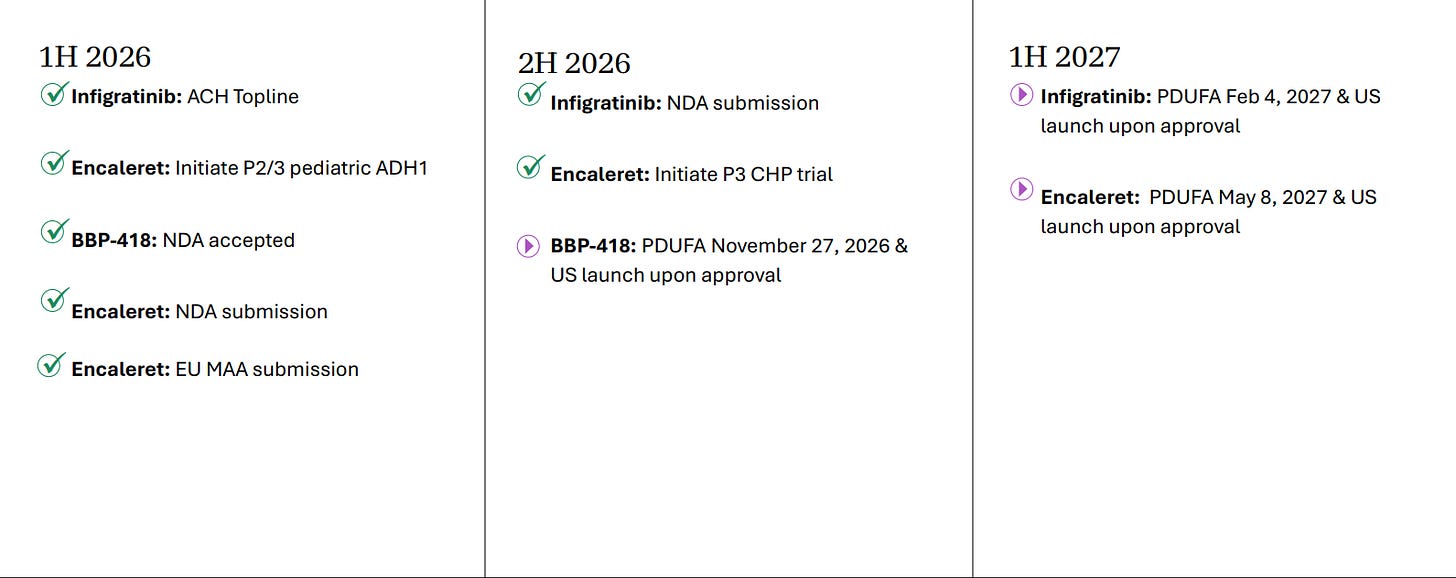
Management gave an update on upcoming catalysts, and the big one for the rest of the year is the FDA’s PDUFA date for BBP-418, a treatment for limb-girdle muscular dystrophy type 2I/R9 (LGMD2I/R9). It’s a rare inherited disease that causes progressive muscle weakness and can lead to breathing problems and heart complications. I put the odds of approval at 85%. If approved, BBP-418 could become the first drug approved specifically for this disease.
The reason for my bullishness on approval rests on its Phase 3 (FORTIFY) results, with muscle protein glycosylation showing 1.8X improvement and creatine kinase, a blood marker of muscle damage, falling 82% from baseline at 12 months. There was also significant improvement in walking and pulmonary function; both had p-values of <.0001 and .0071, respectively.
The drug was also safely tolerated, with the majority of side effects related to diarrhea and procedural pain. The safety data reinforce my favorable view of BBP-418's November 27, 2026 PDUFA prospects. Based on publicly disclosed results, there is no obvious major safety signal that would independently suggest a high risk of rejection. However, as seen many times before, the FDA can still reject the drug or extend the PDUFA date, which could provide downward pressure on the share price and create uncertainty.
Infigratinib - Oral FGFR Inhibitor
Infigratinib is another program I’m watching closely. It is a once-daily oral treatment being developed for children with achondroplasia, targeting the overactive FGFR3 pathway that affects bone growth. The PDUFA date is set for February 4, 2027, and the company is preparing to launch shortly afterwards if approved. There are already competing therapies on the market, including BioMarin’s Voxzogo and Ascendis’s Yuviwel. The main differentiator for infigratinib is its oral dosing, compared with daily injections for Voxzogo and weekly injections for Yuviwel. For children who could spend years on treatment, avoiding injections is a selling point I wouldn’t overlook.
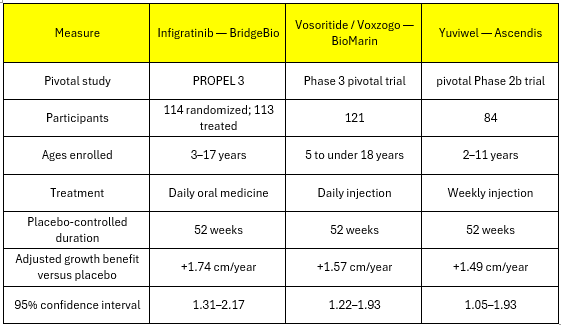
In the Phase 3 PROPEL 3 study, the primary analysis showed an additional 1.74 centimetres of annualized growth versus placebo over 52 weeks. That was numerically higher than the results reported by its competitors, although separate trials cannot establish that one drug is better than another. The drug was generally well tolerated, with no treatment-related serious adverse events or treatment-related discontinuations. Three children out of 74 experienced elevated blood phosphate, but those cases were mild, temporary, and required no dose changes. These results are encouraging, although I still want to see how the safety profile holds up over longer periods of treatment.
BridgeBio estimates a potential global market of more than $5 billion across achondroplasia and other FGFR-driven skeletal conditions. That is the broader opportunity, rather than sales we can assume infigratinib will capture. The competition is already building its business. Voxzogo generated $245 million in Q3 2026 sales, putting its annualized sales run rate close to $1 billion. Yuviwel generated €15.64 million in the quarter, bringing its revenue for the first nine months of 2026 to €23.22 million.
Infigratinib will have its work cut out for it, competing against drugs that are already available. Still, watching BridgeBio take on Pfizer and Alnylam in the cardiology space gives me confidence in management’s ability to compete. If approved (according to my estimate, a 90% chance of approval), I think infigratinib could become a substantial revenue contributor and give investors another reason to re-rate the company.
Encaleret — Oral Calcium-Sensing Receptor Antagonist
Another drug facing an FDA decision next year (May 8, 2027) is encaleret, an oral calcium-sensing receptor antagonist being developed for autosomal dominant hypocalcemia type 1, or ADH1. This is a rare genetic condition in which an overactive calcium-sensing receptor disrupts the body’s calcium balance. The company has high hopes for encaleret after its pivotal trial showed that 76% of participants receiving the drug achieved the target ranges for both blood and urine calcium at Week 24, compared with 4.4% of those same patients while previously receiving conventional therapy.
The safety results were encouraging, although there are some details worth watching. Elevated blood calcium occurred in 10 of the 45 encaleret-treated participants, or 22%, while low blood calcium occurred in three, or around 7%. One participant had a serious adverse event considered treatment-related. No adverse events led to encaleret or study discontinuation.
BridgeBio describes ADH1 as a potential blockbuster opportunity, but finding and diagnosing patients will be crucial to turning that opportunity into sales. The company said that they have identified more than 600 genetically confirmed patients and has deployed its U.S. field team ahead of a potential launch.
If approved (according to my estimate, a 90% chance of approval), encaleret would become the first therapy specifically indicated for ADH1. However, that doesn’t mean it would have the field to itself. Ascendis’s Yorvipath is already approved for adults with hypoparathyroidism, and its label does not explicitly exclude ADH1. Yorvipath generated approximately €739.6 million in revenue during the first nine months of 2026, with Q3 sales putting it above a billion-euro annualized run rate. Those sales cover the broader hypoparathyroidism market, rather than ADH1 alone, but they show the commercial potential in this field.
For me, an ADH1-specific approval and a solid launch could put encaleret in a strong position to become the market leader in this smaller patient population. The trial results give me a reason to be optimistic. Now management needs to turn that potential into patients treated and revenue.
Financial Metrics and Risks
BridgeBio reported $353.2 million in revenue for the quarter, including Attruby sales, Beyontra royalties, and a one-time $75 million milestone payment from Bayer. The company reported an operating loss of $11.6 million. Back out the milestone payment and the quarterly operating loss would have been about $86.6 million, all else equal. What stood out to me was Attruby’s gross margin of roughly 95%. If management can keep growing sales at double-digit rates, I think we’ll see more of that growth turn into cash over the next few years.
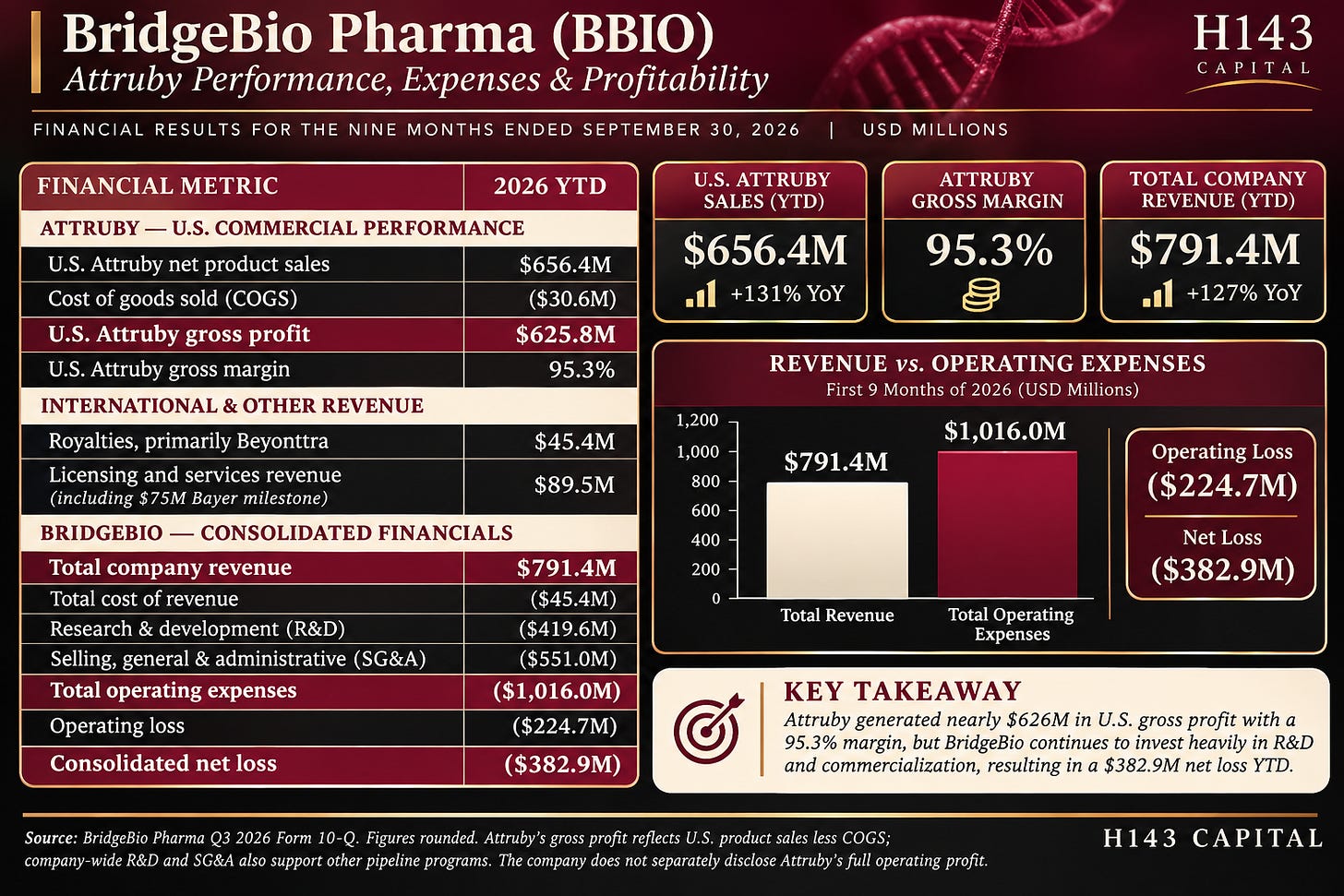
I think concerns about BridgeBio’s debt have weighed on the stock lately. I remember when I started building my position in 2024, there was a lot of chatter about whether the company was even “investable” given how much debt it carried. I think management has handled it well so far. BridgeBio has about $2.5 billion in outstanding convertible notes, with the first $550 million due in March 2027. It entered the fourth quarter with about $1.54 billion in cash and marketable securities. That gives the company some breathing room, though it’s still burning cash and could have three more launches to fund.
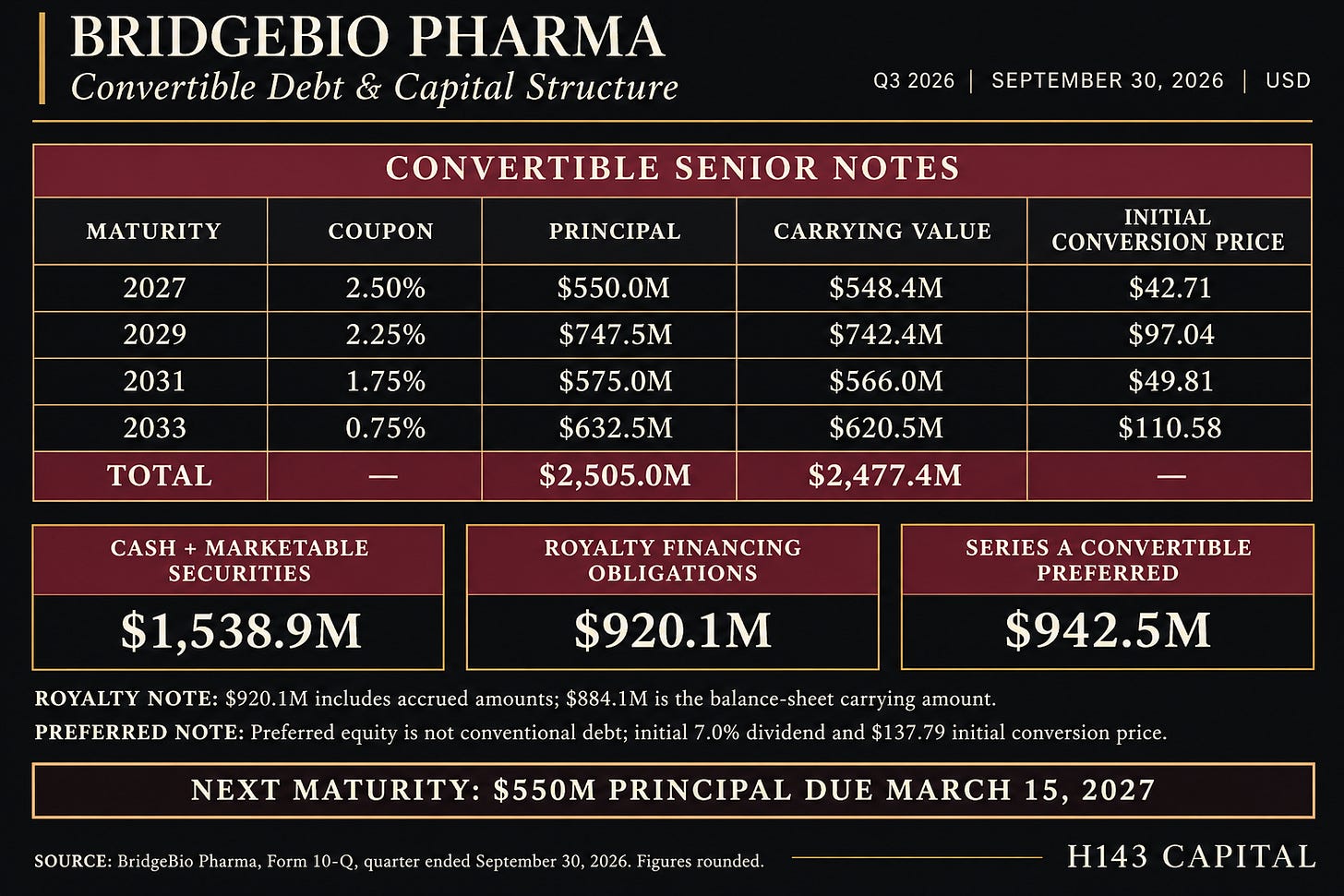
I think concerns about BridgeBio’s debt have weighed on the stock lately. I remember when I started building my position in 2024, there was a lot of chatter about whether the company was even “investable” given how much debt it carried. I think management has handled it well so far. BridgeBio has about $2.5 billion in outstanding convertible notes, with the first $550 million due in March 2027. The 2027 notes have a conversion price of about $42.71 per share. At $78.30, the $550 million in principal translates to roughly $1 billion in conversion value. BridgeBio spent $49.3 million on a hedge when it issued the notes, and under the original terms that hedge would be worth about $250 million at today’s share price. If BridgeBio pays the principal in cash, the hedge could reduce the net dilution on the remaining payment from the equivalent of about 5.9 million shares to 2.7 million. I’m still watching what management does with the principal, but the hedge makes the potential dilution a lot easier to stomach.
For me, the question is how management handles the debt while still funding the next set of launches. If Attruby keeps growing and generates enough cash to help pay for them, I’ll worry less about the balance sheet. But an FDA setback for any of the three drugs could put real pressure on the stock, especially with short interest already at about 12.5% of the float.
Technical Breakdown
As with any company I follow, I like to look at the chart to see how the stock is trading and where it might go next. BBIO closed at $78.30 on November 13 after bouncing from around $63 in October. It’s now above all three daily simple moving averages I track. The 20-day is at $73.10, the 50-day is at $69.98 and the 200-day is at $72.69.
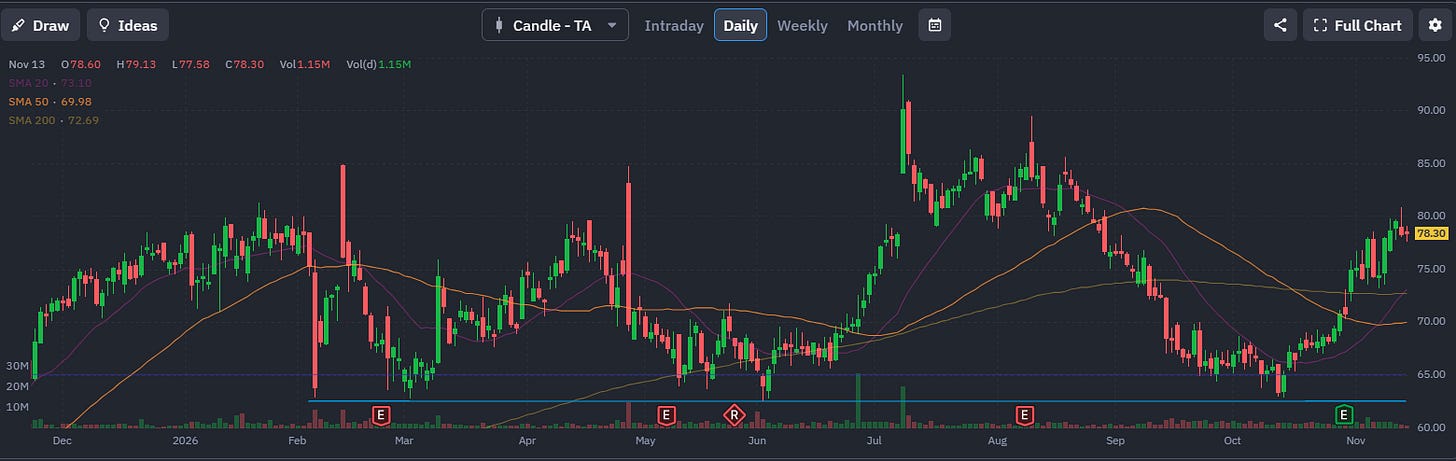
The first level I’m watching is $81, where the recent rally stalled. A close above that level on stronger volume would put the August high near $86 back in play, followed by the July high of $93.42. On a pullback, I’d like to see $73–$75 hold, with the 20-day and 200-day averages both near $73. If that range gives way, I’m watching the 50-day near $70.
That dip into the low $60s felt like a bit of a gift for anyone who bought it. I don’t expect BBIO to go back there, but if the FDA hands BBP-418 a setback this month, I wouldn’t be surprised to see the stock break below $70 and revisit its lows for the year.
Conclusion
BridgeBio is a special company to a lot of people. It’s bringing treatments to patients with rare genetic diseases who’ve had few options, if any. Attruby keeps gaining share in ATTR-CM, and if you annualize the latest quarter’s sales, it’s already running at a blockbuster pace. With three more potential launches ahead, I can see why BridgeBio is getting more attention. I think the debt still tempers some of that enthusiasm, though. The market wants to see more revenue before it gives the company a higher valuation. At $78, I see at least 30% upside if BridgeBio can execute on those launches.
I started this article with Matt Damon growing potatoes on Mars, so I might as well end with him trying to get home to Ithaca. When Neil Kumar brought up The Odyssey, I thought it was a fitting reference for a company I bought when people were still asking whether it was investable. Attruby has gone a long way toward answering that question for me. What I’m watching now is whether BridgeBio can do it again with BBP-418, infigratinib or encaleret. That’s the part of the story I’m still here for.



Comments
Log in or sign up to join the conversation.