

In the summer of 1944, with the war in Europe not yet won, the United States convened 44 nations at a resort hotel in Bretton Woods, New Hampshire, and wrote the rules of the postwar world. The dollar would be the world's reserve currency. The International Monetary Fund would manage imbalances. The World Bank would finance reconstruction. And the United States Navy underwrote the safety of global trade. For eighty years, it worked.
Today the promises of Bretton Woods are fracturing on every front simultaneously.
The US Navy cannot guarantee the Strait of Hormuz. US Treasuries, the foundational safe asset of the entire global financial architecture, now come with an asterisk. Whether Washington will honor that guarantee depends, it turns out, on whether it approves of your foreign policy. And the president of the United States, referring to the Strait of Hormuz, recently described America as acting like pirates, no questions asked, and meant it as a compliment.
And China, for generations largely beneath our notice, frankly, has spent fifteen years building an industrial and energy base specifically designed to function without American permission. And as we will see, their “90%” policy endangers not only the US manufacturing base but the world’s.
Our Strategic Investment Conference ended three weeks ago. I called this the Global Restructuring before the conference began, and everything I heard confirmed it.
But your humble analyst is reconsidering the term. The horse and buggy did not restructure into a car. The candlemaker did not restructure into an electrician. I grew up in a print shop setting hand type and still have ink in my blood. I don’t even recognize print shops today.
The restructuring is probably the right frame. But like Treasuries, it comes with an asterisk.
The old world ended. A different one began. That is what our speakers were describing. Not a correction. Something more permanent than that. We are inside one of those moments now.
(I had some readers the past few weeks that took exception to some of the things I wrote. I would point out that nearly all of them were me reporting what the speakers at SIC said, not necessarily that I agreed with them. That will be the case today. I had thought that we could conclude our coverage of the SIC this week, but we still have a lot of work left on the editing table. So, one more week.)
The Asterisk
My friend Louis Gave of Gavekal Research has been saying for years that a shift like this was coming. At SIC, his point was sharper: in some important ways, it has already shifted.
When the 2004 tsunami hit Thailand, they sold Treasuries to buy food. When Fukushima forced Japan to shut down its nuclear plants, Japan sold Treasuries to buy oil and gas. Treasuries equaled commodities. That was the deal.
For decades, foreign governments held US Treasuries because they were more than just bonds. They were claims on the American-led system itself. Then Russia invaded Ukraine, and the United States froze Russia's dollar reserves.
Whatever you think of that decision morally or strategically, every finance ministry in the world noticed the precedent. Treasuries still equal commodities, but now with an asterisk. Only if Washington approves of your foreign policy.
It was not only the US. Europe and other allies as well enacted the same policy. It is one thing to sanction Iran. Russia is a different game. It wasn’t that I disapproved, but I and others pointed out at the time that this policy would have unintended consequences. Perception matters.
Louis, who has been right about this longer than most people have been paying attention, framed it simply:
"If you're a foreigner, why would you want to buy US Treasuries when the head of the United States tells you, 'We'll just grab your stuff, no questions asked'?"
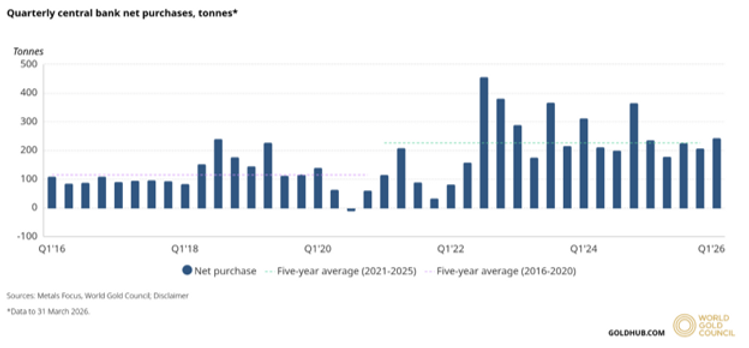
Foreign central banks appear to have reached the same conclusion. They are not selling Treasuries. Yet. But they are buying gold.
Gold buying accelerated dramatically after 2022 and has not stopped. The World Gold Council recently reported central bank demand of 244 tonnes in Q1 2026, up seventeen percent from the prior quarter and well above the five-year average.
Poland, Uzbekistan, China, Kazakhstan, the buyers are not random. Whether every finance minister would say it out loud is another question. But the timing is hard to ignore. Just saying…
Then came the second data point.
Iran closed the Strait of Hormuz, and the US Navy could not simply reopen it. As Louis noted, the Red Sea had already been closed. Two massive choke points.
“The reason you bought US Treasuries is you could count on the US Navy delivering you the food, the weapons, the oil that you needed. And now we've had two events in the past five years where this very assumption has proven to be untrue."
The US Navy controls the world's sea lanes, until it doesn't. Korea, Japan, Taiwan, countries that recycled their trade surpluses into US Treasuries and US weapons, are now discovering what happens when the oil stops flowing and the guarantor cannot reopen the strait.
This was the same point that René Aninao and David Bahnsen made in their presentation. They connected the power the U.S. Navy to the value of US treasuries. It is not an obvious connection, but everyone knows it is there.
George Friedman
Longtime readers know that George Friedman, one of the world's foremost geopolitical analysts, and I are very close friends. He does not panic and he does not moralize. He looks at what is actually happening and tells you what he believes it to mean. And he has a track record of being predominantly right. It pays to listen to what he says.
During the conference he was characteristically blunt about Iran. The US and Israel struck Iran with the goal of eliminating its nuclear capability. The assumption was that taking out the civilian leadership would collapse the regime and end the threat. It was a reasonable theory. It was wrong.
The IRGC — the Islamic Revolutionary Guard Corps — is the actual power structure. The civilian government attends meetings. The IRGC fights. And the IRGC was ready to resist. Now the United States is trying to find a path out while still getting control of Iran's nuclear capability. What the military originally expected to wrap up in weeks or months now looks like it can be a great deal longer.
Russia, meanwhile, is in deeper trouble than Western coverage suggests, which matters because a weakened Russia changes the calculus for every other actor in this letter. Putin canceled the May 9th Victory Day large parade/celebrations for the first time. That is the geopolitical equivalent of canceling fireworks on July 4th.
Ukrainian drones are attacking Russian oil facilities deep in Russia. On the battlefield, Ukrainian small drones are devastating the supply lines and soldiers well behind the front lines. The Russians have made no real advance for years. On the other side, Ukrainians have made very few advances well after the initial push back in 2022/23. Millions of young Russians have left for other countries. They have labor shortages in important businesses as well as defense contractors and for the Army.
But George was not finished. He pulled back further than any other speaker at SIC, past Iran, past Russia, past the bilateral relationships, to ask what this moment means in the sweep of history.
When Europeans learned to reliably navigate oceans, an entirely new geopolitical dimension opened. The countries that mastered it reshaped the world for five centuries. This is not unlike the moment Columbus proved the oceans were navigable, a new geopolitical dimension opening that most people alive at the time did not fully register. George's argument is that we are at a comparable inflection point. But the new ocean is space.
"In the same way as being able to navigate oceans created a new geopolitics, now the new dimension is space, particularly low earth orbit."
Think about what has happened to low earth orbit in just the last decade. There are roughly 15,200 functioning objects in orbit today. A decade ago that number was closer to 1,000. Starlink alone accounts for most of the difference. Here is what the race to fill low earth orbit looks like since 1960:
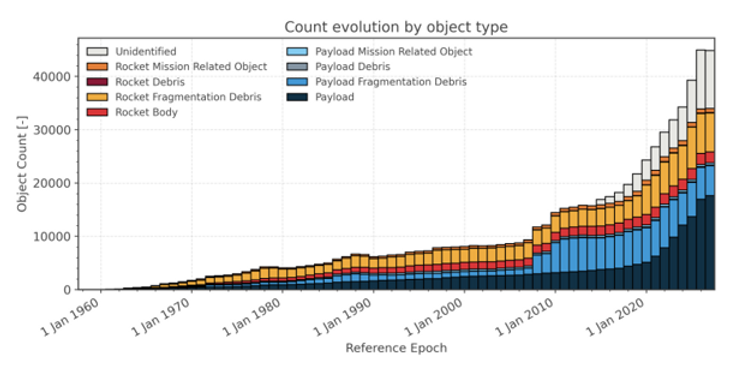
This is the new ocean. The race to control it has already begun. It is military reality playing out right now.
Drones closing the Strait of Hormuz from a thousand miles away have already demonstrated the corollary: you cannot clear a strait by landing Marines if your opponent has satellite intelligence and autonomous systems that reinfest it within hours. Satellites have given the Ukrainians clear images of points of attack and what is going on deep behind the front lines. Of course, satellites also give targeting information to Russia as they attacked Ukraine.
We all know there are scores, if not hundreds of companies building drones for the military and private use. For what it’s worth, Anduril is very close to having an unmanned sea vessel that can remove mines. I know of at least four other companies that are building unmanned naval vessels for various operations. It seems the US military is finally moving out to the edge in terms of research rather than letting a few old bureaucratic companies design multibillion-dollar programs that don’t really change the battlefront anymore.
This is not going to open the Strait this summer, but next year? War and the instruments of war are evolving before our eyes.
The Chinese 90% Model
Dr. Ram Charan has spent thirty years advising the CEOs of the world's largest companies, including many in China. His book is called China's 90% Model: China Has America by the Throat and Here's How to Fight Back and Win. Based on what he presented at SIC, it should be on your reading list. (We paired Charan with Lyric Hughes Hale, who is fluent in Chinese and has been involved there for over 40 years. The conversation was one of the most fascinating at the conference.)
The thesis is this: Ram Charan documented that select Chinese companies and industries are mandated to build production capacity equal to ninety percent of estimated world demand. Not China's demand. The world's.
First Chairman Hu in 2009 and then Xi Jinping identified industries, ten in the first term, ten in the second, ten more now, thirty in total. Then they flood the market at marginal cost, grab market share even at a loss, devalue the currency, and collect the trade surplus.
Ram Charan put the numbers plainly:
"Last year China collected $1.25 trillion. This year I'm predicting $1.8 trillion surplus in hard cash — dollars, yen, euros, wons. And that money is used for buying technology, building ships, military hardware so nobody can compete in those industries."
The results are measurable. LiDARs, the sensors that enable autonomous vehicles, cost fifty thousand dollars five years ago. Chinese manufacturer Hesai (HSAI) now produces them for three hundred dollars. A 99.5% cost reduction in five years!
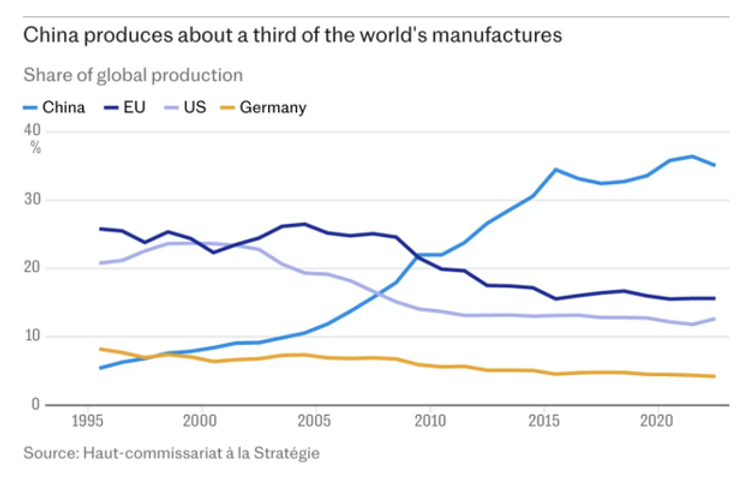
It appears to be working. Ambrose Evans-Pritchard, writing in The Telegraph (H/T Rod Martin), reports that France's own national planning agency has concluded that China now produces roughly a third of all manufactured goods on earth.
Here is what that trajectory looks like against the EU, the US, and Germany since 1995:
Ram Charan did not sugarcoat it:
"When you have ninety percent capacity, your costs are down because of hyperscale. You sell at the lowest cost, you grab market share even at a loss, and your opponent cannot build that industry. Nobody will put money in it. You don't just win. You permanently close the door behind you."
But Charan is optimistic that the West can counter this:
“… I'm not going to buy any argument that we [the West] cannot rebuild. It is a matter of scope and size. If [you add] America, Japan, South Korea, Australia, Europe, UK, it's a $70 trillion economy. It can grow faster... And as you build, you must block Chinese inputs and negotiate with the presidency that their 90% model has to phase out. Otherwise, we have to do some other things.”
Further along:
“…this is a great question. First, good news. There is a former CEO of Siemens (SIEGY), Barbara Humpton. She reports to the Secretary of Treasury. She's the CEO of this whole effort of minerals. She has a board, she has a fund. She's buying these places. I met the people who funded her work, buying companies, building all these plants. We are doing it…
“But she's on it, it's moving. I have met outside investors who are funding her. So, it's going to get done. She's a fantastic leader, and it is moving very fast the way she's doing it. Various countries are creating arrangements. People who have the knowledge of how to process. These people are alive and available.”
Lyric Hughes Hale: “What you're saying is we have the brain trust that allows us to do it.”
Dr. Ram Charan: “We have experienced people. I don't buy that argument at all because I know where they are. They are available. They're patriotic. They will do that. I see a lot of talent in Japan in my work.”
Frankly, the question is whether Washington can organize a response with the same strategic intentionality Xi Jinping has shown for twenty years. Admittedly, that is a high bar.
Who Gets Left Behind
Jacob Shapiro was mentored under George Friedman at Stratfor and Geopolitical Futures. Chase Taylor spent seventeen years in Air Force geospatial intelligence before turning that lens on macro investing. Together at SIC they brought an angle to the conversation I was not expecting. They focused on everyone else.
"Roughly four billion people today rely on modern and synthetic fertilizers in order to eat. So, if you take fertilizer off the plate, we're going to have incredibly high food price spikes."
The thing is, it is not that fertilizer makes food cheaper. It is that without synthetic nitrogen, the earth cannot support its current population at all.

Jacob connects food prices to geopolitical instability:
"If you go back to almost every single major war or revolution, you will find rising food prices there at the beginning." (I might push back on the words “almost every…” but his point remains.)
Jacob was also direct about who comes out ahead in this reorganization, the societies with cheap energy, demographic tailwinds, and control of the commanding heights of the tech economy. China. The United States. Parts of South America.
That leaves a very long list of countries on the other side of that sentence. The ones that spent thirty years building their entire development model around cheap labor and access to Western markets. I should note that many of these economies have made remarkable strides over the last thirty years. That is precisely what makes their current position so precarious.
Think Bangladesh. Think Vietnam. Think the dozens of countries across Southeast Asia and sub-Saharan Africa whose entire premise was that globalization would keep expanding. They are not losing market share. They are losing the premise on which their economies were built.
The Civil War in Sudan may be the worst humanitarian catastrophe of this decade. Nobody is covering it because there is no viral video driving attention to it. Sigh.
China has given loans to 162 countries. Those loans also came with asterisks, coercion dressed as investment. The Belt and Road was not infrastructure. It was leverage acquisition. The countries that took the money without reading the terms are now discovering what the terms actually are.
"Competitiveness in manufacturing is national security on a level that is difficult to describe."
Chase Taylor said that at SIC. I think it is the sentence that ties this entire section together. It is not just about the United States. Chase thinks it is about every country that outsourced its industrial base and called it efficiency, and every country that never had one to begin with.
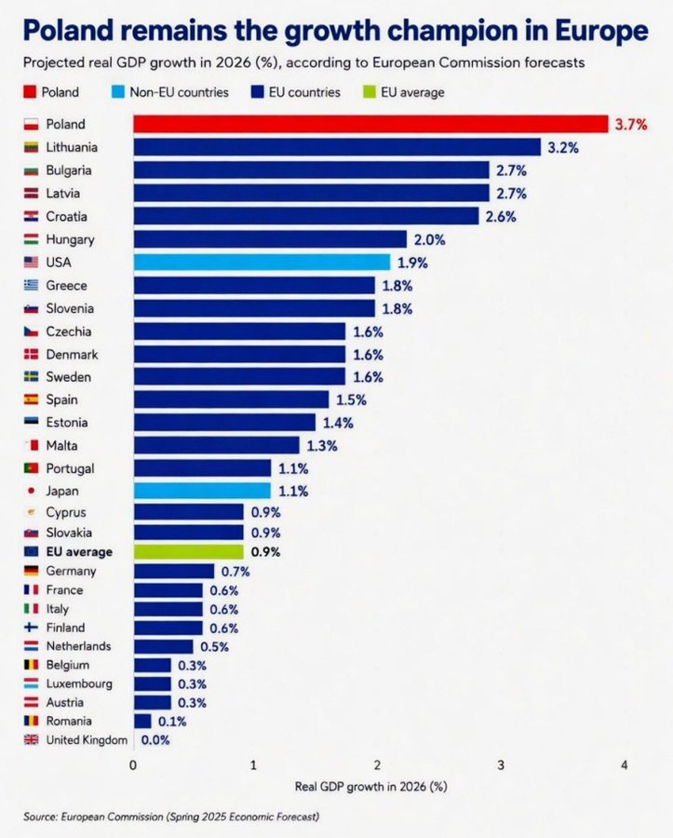
But it is particularly severe for countries that have seen their growth rates slow precipitously, “Old Europe” in particular. The US is growing at roughly 2% a year (1.9% in these projections for 2026) but many would note that half of that was AI or we would be in that same lower bracket. But I would point out that AI is doing what other technologies have always done, leading growth. And while Starlink in space have yet to really impact GDP in and of themselves, their importance is being felt in scores of industries, not just military.
(I know the chart below highlights Poland, but it is a good measure of the relative growth rates of the Western world.)
The Long View
Every speaker at SIC 2026 was describing the same world from a different angle. And the world they described is genuinely more dangerous and uncertain than the one we navigated for the last eighty years. I am not going to pretend otherwise. That said, energy abundance, industrial capacity, institutional foundations, the societies that get those three things right will navigate this reorganization. The ones that do not will not. Call it Muddle Through for the world, just not for the United States.
Each time the world has reorganized, the pessimists were right about the disruption and wrong about the direction. I remain, as always, an optimist about where this ends up. Just not necessarily about how we get there. As I’ve said many times, I am intellectually and viscerally long humanity but short government.
The world is not ending. It is restructuring. But restructuring, as I noted at the outset, comes with an asterisk. What is really happening is a replacement, of assumptions, of guarantees, of the architecture that held everything together for eighty years.
And replacements, for those positioned correctly, are not only threats. They are opportunities.

Comments
Log in or sign up to join the conversation.