
This week’s vote from the Federal Reserve FOMC committee is going to have implications for quite some time. I think most of the pundits who are writing about this have their analysis wrong. This was not just a vote to not raise rates. I think there was a lot more going on behind the scenes.
But first, today marks the beginning of the 27th year of my writing Thoughts from the Frontline. It started out as a way for me to collect my own thoughts and write about what interested me the most that week. Most competing letters focus on one particular topic or subject matter. After a while, there’s only so much you can say about gold or interest rates. Serendipitously, because I wrote about anything and everything, I ended up with a much larger audience. It helped that the letter was and still is free, plus there were not a lot of competitors back in 2000. Today? I haven’t done a survey, but it seems like there are more letters and websites than I have subscribers. And we all compete for your attention.
So let me offer my sincere appreciation that you have allowed me to come into your inbox/home. The most valuable thing we have in our life is our attention and time, and I do my best to deserve both. Quick pitch: if you like this letter, forward it to a few friends and suggest they try me for a few weeks.
Finally, I am going to make one change to this letter going forward. Originally, there was no length per se, I just wrote the letter. It started to get pretty long. We can see from the click-throughs that over time people began to prefer shorter letters. The target number of words today is 3000. I’m going to reduce it to 2500 or less as I want the letter to be something you can read in under five minutes. That will mean more concise editing and wordsmithing, but that is the feedback from the readers. Again, thank you and I look forward to many more years of our conversation.
Who’s Got the Votes?
Of course, we all know that the Federal Reserve elected to hold the Fed funds rates on a 9-3 vote, with three dissenters wanting higher rates. The markets did not react well. Long rates as characterized by the 30-year bonds went up, short rates went down in what is a classic bear steepener. The stock market threw up but then settled down. But why? Looking at the bond futures market, there was not really an expectation of a rate hike.
But the reaction of the market suggested that at least the most significant players who actually move things were expecting or at least wanting a rate hike. They wanted to see a Fed that was serious about inflation. And Warsh had been talking a good inflation fighting game.
Warsh has come under heavy criticism in the last two days for two main points: there are those who wanted him to be a hawk and raise rates. And the second criticism was part of his rope-a-dope press conference where he really said nothing. The second group kept asking for the equivalent of forward guidance, which Warsh has said he does not want to do.
His reasoning is that he wants the markets to pay attention to the game (what he called the ball) and not the referee. More than a few commentators said back to him, “You don’t understand, you are the ball.” And for 20 or more years the chairman of the Fed has been. That is what KW is trying to end.
Warsh actually wants the markets to function without having to be spoon-fed by the Fed (pun intended). What he wants is called price discovery. And the markets in price discovery should be every bit as important as other data points to the Federal Reserve. If the market is reacting to forward guidance, whatever information can be gleaned from market pricing is reduced because they are reacting to the forward guidance and not to market conditions.
WWWD?
I believe that Chairman Warsh would have liked to raise rates. Everything he has written in the past decades and recently gives me the indication that he is hell on inflation. As I wrote over the last two weeks, I think he needed to make a statement that says he thinks of inflation as job one.
Paraphrasing Gov. Waller from last week, you simply can’t angrily stare at inflation and expect it to go away. You have to do something (although Waller voted to hold rates where they are).
The stock market basically yawned after some initial significant fluctuation. As I write this Friday morning, the S&P is basically flat since the Fed meeting, and the Dow Jones 30 is down by only 0.6%. And even that, you can’t attribute to the bond market.
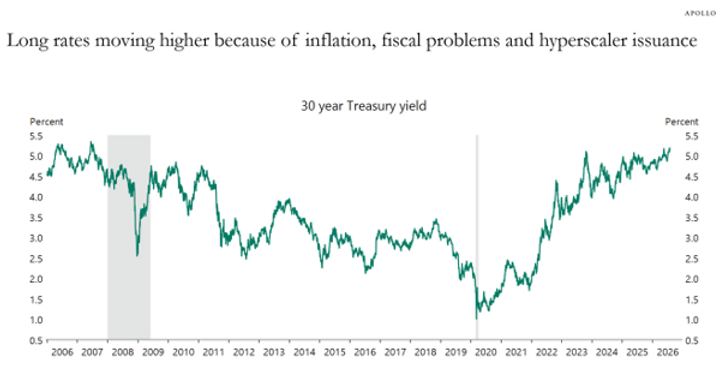
But the bond market? Not happy. The 30-year bond is close to a 20-year high. It is 19 basis points higher since the Federal Reserve announcement day. And then yields in the short end, as seen in the two-year bond, have dropped.
The human mind likes to have things nice and neat. So, a lot of analysts blame the Fed. One data point equals one result. They ignore all the things happening around the event.
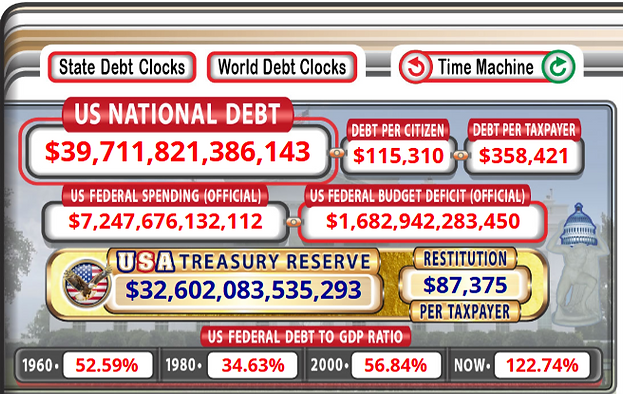
But the context is that we will have a $40 trillion debt by the fourth quarter. Interest on the debt ($1.1 trillion) is over 20% of total revenues. The deficit is $1.7 trillion on our way to $50 trillion of debt. We have a Congress that seemingly has no interest in bringing down the deficit. Where is the Tea Party when you need them? Let’s look at the three charts below. The first shows the actual debt and interest paid. The second looks back at the 30-year bond rate over 20 years and you can see that we are close to a twenty-year high. The last shows the 30-year bonds over the last year and you can see the spike upwards at the end after the Fed meeting.
Source: USDebtClock.org
Source: Apollo
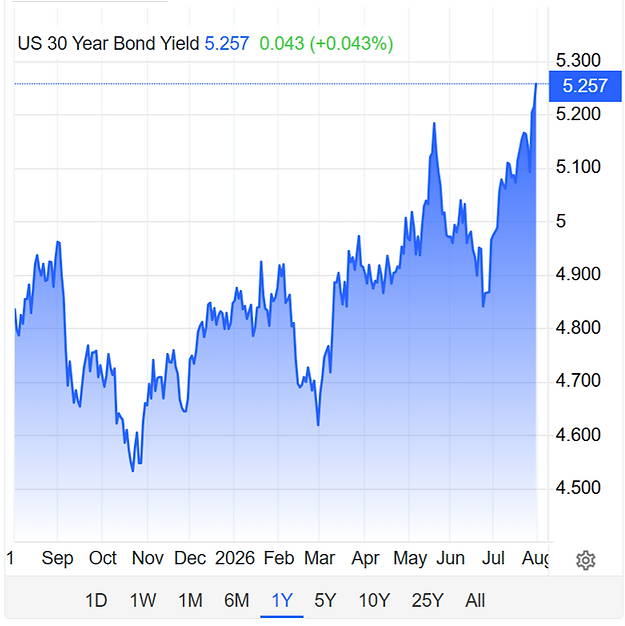
Source: Trading Economics
My belief is that if they had raised rates, the 30-year bond yield would have dropped. Two-year rates would have moved up somewhat and we would have what is roughly called a bull flattener.
Now? The bond market in specific and the rest of the world in general is focused on inflation. Inflation has now become a problem in England and Europe and Japan, and also other developing countries. And rates are rising everywhere where the bond markets consider their central bank not sufficiently focused on inflation. And so, if you’re a long-term bond buyer, you want a sufficient cushion that will overcome inflation. And right now, your cushion is less than 2% in the US. That’s not a lot. If you don’t believe the Federal Reserve has inflation-fighting bona fides, you are going to want higher yields.
As I pointed out last week, if the Fed moved to raise rates this week, they would have to do less tightening in the future. Now they are in the opposite place. They are going to have to raise rates more and keep monetary policy tighter for longer.
So why didn’t Warsh move?
He didn’t have the votes.
That’s it, pure and simple. Sure, he could vote to raise rates, and Powell would have gone along with him, as he pledged to vote with the chairman. Maybe you get two or three more votes for raising in that case.
The problem is, you cannot be seen doing something as consequential as raising rates in this political environment on a vote of 7-5 or 8-4. That shows the chairman doesn’t have control of the majority of the board, so in one sense it would be a sign of weakness.
I had a friend ask me why didn’t he just go ahead and vote to raise rates to establish where he was. The problem was he would then be seen as a chairman that couldn’t lead. He was in a no-win situation. Allowing the vote to go to 9-3 to maintain rates was his best option. I will bet you a dollar to 47 doughnuts that Chairman Warsh is not happy.
The next Fed meeting is September 15 and 16. They will have two CPI reports and one PCE report between now and then. Most of us expect the next CPI report to be “hotter” because energy prices are going back up. What circumstances will change?
My guess is that the FOMC members who did not vote to raise rates wanted to see those two more data points before they acted. And, it should be noted that we are going to be very close to the midterms in September. I think it is even tougher to raise rates then, even if they need to.
The worst outcome would be that Warsh does not get a clear consensus and the market comes to believe that nothing has changed from Bernanke/Yellen/Powell. Meet the new Fed, same as the old Fed. That is not a formula for benign long-term rates.
Yes, I know, the problem is mostly fiscal now. But if the Fed is seen as aiding and abetting that fiscal profligacy, it will get a lot messier.
But this is what happens as we stumble forward toward a funding crisis. It was never going to be smooth or easy. Note that all of the governors voted to keep rates steady. Stay tuned.
I should note that even with the weak GDP number, the economy is still growing and there is a lot to be positive about.
The next real opportunity for Warsh to make a point will be at his annual Jackson Hole presentation at the end of the month. Looking back over time, I would say that most Jackson Hole presentations are fairly formulaic. Most don’t have much meaning over time. There are exceptions, of course, and they are important. Warsh has the opportunity to make this Jackson Hole speech one of those exceptional speeches, and frankly, I think it needs to be.
My point here is not that they should simply raise rates with no context. They need to be in the business of maintaining price stability and that’s it. That has to be the emphasis in his speech. I should also point out that the task forces that he has appointed will make public the results early next year. They will be looking at different data sources in the future, different communication methods and more. Changing the culture at the Federal Reserve is going to take more than one or two meetings, and obviously some of the governors seem to be resisting a change. It needs to happen. It was never going to be easy.
If this waffling continues, it is only going to make the crisis worse. The Fed needs to put the ball back into the hands of Congress where it belongs. That is what the Chairman is trying to do. Congress can bring down long-term rates simply by lowering the deficits and moving towards a balanced budget, not unlike what happened between Clinton and Gingrich in the 1990s.
Comments
Log in or sign up to join the conversation.