

Bond Rout
The market spent most of the week dancing on the roof of a burning building before finally noticing the smoke coming through the floorboards. What began as another momentum-fueled AI melt-up slowly morphed into a stress test for every crowded trade on the board as bond yields ripped higher, oil kept climbing, and the Trump-Xi summit delivered little more than diplomatic wallpaper. By Friday, the mood had shifted from euphoric to uneasy. The AI generals that had carried the entire equity army uphill for months suddenly looked exhausted, and once the semis rolled over, the rest of the tape followed like loose cargo sliding across a storm-tossed ship deck. The S&P 500 (SPY) finally blinked after tagging fresh highs, the Nasdaq (QQQ) cracked under the weight of its own gravity, and underneath the surface, the broader market looked far weaker than the headline indices suggested. The S&P may have finished marginally green on the week, but the S&P 494 quietly slipped into the red while the Magnificent Seven continued doing all the heavy lifting like overworked engines trying to pull a freight train up a mountain grade.
What really changed this week was not equities themselves but the atmosphere surrounding them. The bond market started behaving like a creditor walking into a casino and demanding to see the books. Treasury yields surged across the curve as inflation fears collided with stronger-than-expected growth data and a renewed oil shock stemming from the Middle East. The 10-year Treasury yield is pushing toward 4.60%, and the 30-year is moving back above 5% felt less like a normal repricing and more like the market openly questioning whether central banks have lost the luxury of patience. Every hotter inflation print, every resilient manufacturing survey, every upside surprise in industrial production acted like another gust of wind feeding the inflation fire. The New York manufacturing data came in scorching hot: industrial production posted its biggest gain in over a year, and suddenly the entire soft-landing narrative started looking less like a smooth descent and more like a plane trying to land with one engine on fire.
The problem for equities is that this is not the kind of inflation investors can easily dismiss with the usual “look through the shock” playbook. This is not just energy anymore. Import prices tied to technology components and computer peripherals have been accelerating as the AI infrastructure boom collides with supply chain friction and higher commodity costs. The market is slowly realizing that the same AI revolution driving equity valuations higher may also be contributing to inflationary pressures that are forcing yields upward. That creates a dangerous circular loop. The very capex cycle fueling the boom may eventually become the mechanism that tightens financial conditions enough to choke it.
Oil remains the central accelerant in this story. The closure of the Strait of Hormuz has turned the energy market into a pressure cooker with the safety valve welded shut. Brent (BNO) above $109 and WTI (USO) back over $100 are no longer temporary panic spikes. Physical crude markets continue tightening, inventories are draining at an aggressive pace, and tanker flows through the Gulf remain negligible. Traders went into the Trump-Xi meeting hoping for at least symbolic progress on energy flows or some indication that Beijing might pressure Tehran toward a stabilization framework. Instead, they got diplomatic theatre with no tangible breakthrough. The market interpreted the silence exactly how one would expect in a supply-constrained environment. Oil bids higher almost immediately because when policymakers refuse to address the bottleneck directly, traders assume the bottleneck will remain in place.
That is where the broader macro tension now lives. The consumer is still spending, corporate earnings remain resilient, and the AI capex machine continues to print liquidity and optimism into global equities. Yet at the same time, gasoline prices are climbing, inflation expectations are drifting higher again, and the bond market is starting to behave as if it no longer trusts central banks to keep the inflation genie in the bottle. The Fed suddenly looks trapped between two moving trains. On one side sits a still-resilient economy with sticky inflationary pressures. On the other side sits a market addicted to easing expectations and low discount rates. This week, the market began aggressively repricing the possibility that the Fed may not just abandon cuts but could even be forced into discussing hikes again in 2026. Once traders started whispering about that scenario, yields accelerated higher like a dam finally giving way.
The global nature of the bond selloff made things even more uncomfortable. Japanese yields surged again, UK gilts were hit by political chaos surrounding Keir Starmer’s weakening position, and sovereign debt markets everywhere started repricing fiscal stress at the same time. This was classic global bear-steepening behaviour, in which investors collectively decided that government borrowing costs were simply too cheap for the world being described. The chatter about bond vigilantes testing incoming Fed Chair Kevin Warsh only added another layer of tension. Every new Fed chair eventually gets stress tested by the market, and this week felt like the opening warning shot. Bond volatility is waking up again, and once that genie escapes the bottle equity traders tend to lose their nerve quickly.
What fascinates me about this tape is that the AI boom still refuses to fully crack even as the bond market keeps firing warning flares into the sky. Normally, a move in yields of this velocity would have already caused a far uglier equity unwind, yet the AI trade continues absorbing capital like a black hole feeding on every dip. That tells me positioning remains incredibly concentrated and momentum-driven. Investors are still selling losers and buying winners in almost a mechanical fashion. But concentration cuts both ways. When leadership narrows this aggressively, markets become less like diversified ecosystems and more like suspension bridges hanging from a handful of cables. As long as the cables hold, everything looks stable. Once they begin snapping, the entire structure can wobble violently.
The semiconductor complex showed the first real signs of instability this week. NVIDIA (NVDA) finally rolled over after becoming the poster child for the AI revolution, Micron (MU) gave back a chunk of its spectacular gains, and South Korea’s Kospi (EWY) suffered a brutal reversal after briefly crossing the psychologically important 8000 level. That reversal mattered because Korea has become one of the purest external expressions of global AI optimism through the chip cycle. When the Kospi suddenly drops 6% after hitting record highs, traders pay attention because it feels like the market briefly looked over the cliff's edge before stepping back.
Meanwhile, the broader internals continue deteriorating. Small caps were hit hard as higher yields squeezed the most rate-sensitive corners of the market. Consumer discretionary stocks struggled as lower-income consumers continue to show signs of fatigue, even while AI leaders levitate higher into the stratosphere. The divergence is becoming increasingly surreal. On one side of the economy sits an elite AI-driven capital-spending boom with virtually unlimited access to funding. On the other side sits a consumer increasingly squeezed by energy costs, tariffs, and financing pressures. It is beginning to resemble a two-speed economy where Wall Street is partying under neon lights while Main Street quietly checks its credit card balances in the parking lot outside.
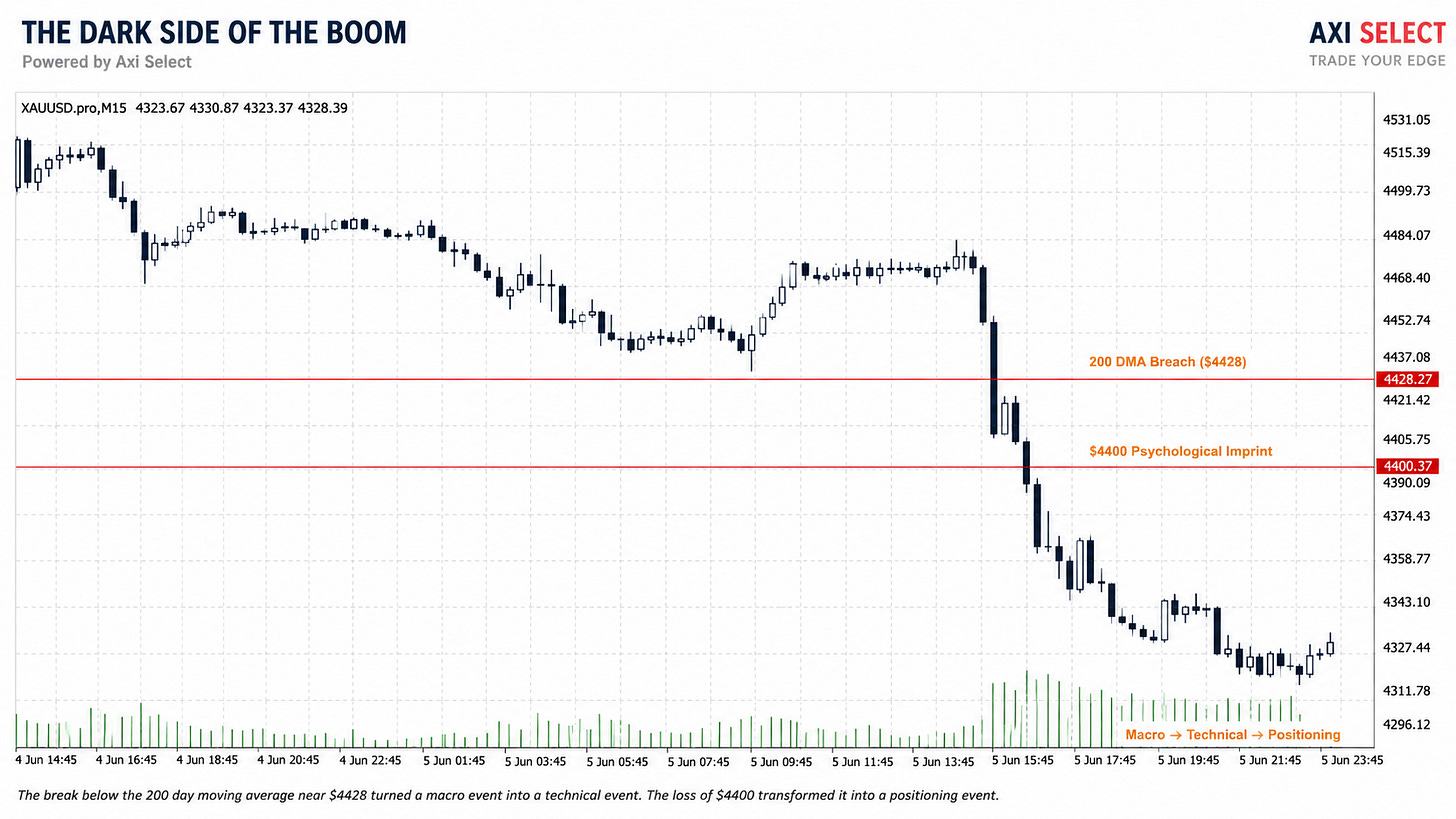
The dollar only amplified the pressure. The greenback exploded higher this week as yields surged and global investors scrambled back toward US assets. The yen weakened back toward 160 despite previous intervention efforts, sterling came under pressure amid UK political instability, and the stronger dollar became another hammer crushing gold (GLD), silver (SLV), and crypto. Gold’s plunge back toward $4500 felt particularly violent because bullion had become one of the market’s favourite geopolitical hedges. Bitcoin (BTC.X) (IBIT) behaved similarly, whipping traders around in a highly kinetic fashion before rolling over sharply into the weekend. The message from macro markets was brutally clear. When real yields surge and the dollar catches fire, speculative assets suddenly lose their oxygen supply.
The key battle now feels incredibly simple beneath all the noise. Bonds versus the AI boom. Everything keeps circling back to rates. As long as yields stabilize, the equity melt-up can probably continue limping higher because liquidity conditions outside rates remain loose and the AI spending cycle still has enormous momentum. But if bond volatility keeps accelerating, history suggests equities rarely digest such an environment smoothly. The market has spent months pretending the bond market was background scenery. This week it started realizing the bond market may actually be the main character again.

Comments
Log in or sign up to join the conversation.