
Washington punts CLARITY to September, BIP-110 tests Bitcoin governance, Wall Street starts funding Bitcoin’s defenses, and AI bots quietly become the majority of the internet. | |
Bitcoin has always had an interesting relationship with authority. Governments want to regulate it, companies want to build around it, developers want to improve it, miners want to protect their economics, and users mostly want everyone to leave it alone. This week, all of those forces collided. Washington pushed its crypto market-structure battle into September, BIP-110 reached a critical stage with very little miner support, a serious COLDCARD vulnerability raised uncomfortable questions about self-custody, and some of the largest financial institutions on Earth started putting real money behind Bitcoin security. The common thread is governance. As Bitcoin becomes more important, more powerful institutions have an incentive to influence its future, yet Bitcoin remains remarkably difficult for any one of them to control. | |
CLARITY Survives to SeptemberThe Senate left Washington for its August recess without completing work on the CLARITY Act, but Majority Leader John Thune filed for a key procedural vote when lawmakers return in mid-September. That keeps the legislation alive and brings us closer to an answer to one of the industry’s longest-running questions: when is a digital asset a security, when is it a commodity, and who regulates it? I still believe America eventually gets comprehensive crypto market-structure legislation. The problem is the calendar. With the midterms approaching and legislative priorities piling up, every delay makes passage more difficult.
| |
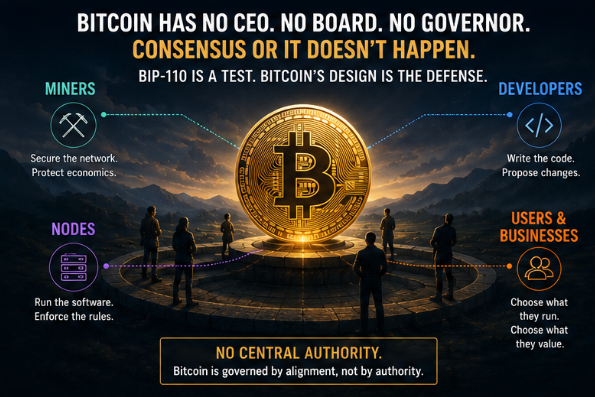 | |
BIP-110 Meets Bitcoin GovernanceBIP-110 proposes temporarily restricting certain forms of arbitrary data stored inside Bitcoin transactions. Supporters believe Bitcoin’s blockchain should primarily serve censorship-resistant money rather than permanent storage for images and other non-financial data, while opponents argue that if a transaction follows Bitcoin’s rules and pays the required fee, nobody should decide that its purpose is unacceptable. The proposal has struggled to attract meaningful miner support, making this less of a theoretical debate and more of a live governance experiment. Bitcoin has no executive committee capable of ordering a protocol change: developers can write code, miners can signal, nodes can choose what to run, businesses can choose what to support, and users ultimately decide what they value.
| |
COLDCARD’S Nightmare ScenarioOne of Bitcoin’s most trusted hardware wallets just suffered the kind of failure that self-custody is supposed to protect against. A serious vulnerability was discovered in certain COLDCARD wallets that could have weakened the process used to create users’ private keys, potentially leaving Bitcoin less secure than its owners believed. The really uncomfortable part is that updating the device may not be enough. If an affected wallet created a compromised seed in the past, the problem could already be baked into the keys themselves, meaning some users may need to create an entirely new wallet and move their Bitcoin. Coinkite has published guidance explaining which devices and users may be affected.
| |
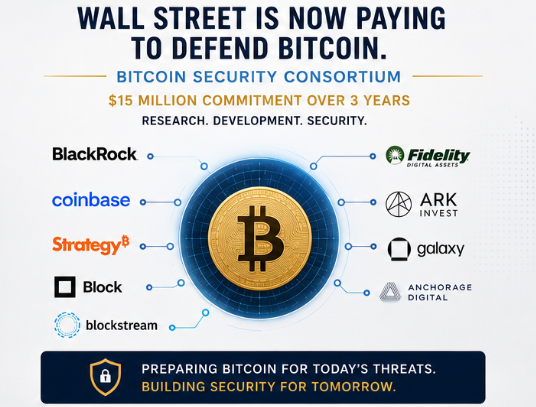 | |
And Now Wall Street Is Helping Defend BitcoinWhich brings us to the strange irony of the week. Just as COLDCARD reminded us how difficult it is to secure Bitcoin properly, some of the biggest names on Wall Street are stepping forward to help fund that security. BlackRock, Fidelity Digital Assets, Strategy, Coinbase and five other major Bitcoin companies have formed the Bitcoin Security Consortium, pledging a combined $15 million over three years to support developers and researchers working on Bitcoin’s long-term security. That includes preparing for threats such as quantum computing, even though sufficiently powerful quantum computers don’t exist today. There is something wonderfully strange about this. Bitcoin was created as an alternative to a financial system dominated by large institutions, and now some of those same institutions have accumulated enough exposure to Bitcoin that protecting the network has become part of their own economic interest.
| |
 | |
Korra AI: The Ghost Economy Is HereWhile Bitcoin wrestles with governance and security, another transformation is happening quietly across the internet. Cloudflare recently reported that automated bots have overtaken humans online, generating roughly 57% of all web requests. Korra AI explored what that means this week in its new video, “The Ghost Economy”. For decades, technology companies have been valued using metrics designed around human attention: monthly active users, page views, clicks, engagement and conversions. But an AI agent might consume information, compare products, call APIs, conduct research or execute transactions, meaning one economically productive agent could potentially be worth more to a network than thousands of passive human visitors. That creates a fascinating valuation problem. A useless crawler and an autonomous AI agent conducting real economic activity may both appear under the broad heading of “bot traffic,” even though their economic value couldn’t be more different. This broader shift toward an agent-driven economy is explored in this AI discussion.
| |
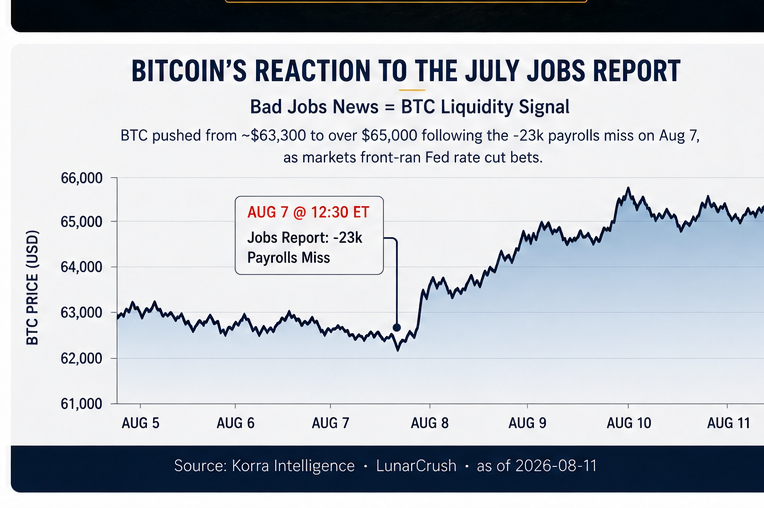 | |
Liquidity Is Back in the Driver’s SeatThe July U.S. jobs report delivered a genuine surprise, with payrolls falling by 23,000 and markets quickly reconsidering the path of Federal Reserve policy. Bitcoin subsequently climbed from roughly $63,300 around the release to above $65,000, reinforcing the idea that while Bitcoin may be decentralized money, its price still lives inside the global liquidity machine. The next Employment Situation report arrives on September 4, followed less than two weeks later by the Fed’s September 15–16 FOMC meeting. That makes September particularly interesting: another weak labor print could strengthen expectations for easier monetary conditions just as Washington returns to the CLARITY fight.
| |
The Quantum ViewTaken together, these stories show how quickly the digital economy is maturing. Washington is trying to establish rules around digital assets, Bitcoin participants are debating the rules inside Bitcoin, Wall Street is beginning to directly fund its security, and AI agents are becoming an increasingly important part of internet activity. Bitcoin is no longer a niche experiment run by cryptographers and cypherpunks. Nation-states care about it, Wall Street owns it, public companies hold it and industrial miners secure it, yet individual users can still download software and independently decide which rules they accept. Bitcoin never promised efficient governance; it offered something much harder: governance without a governor. At the same time, the internet itself is changing. Bitcoin gave the internet digitally native scarce value, while AI is giving machines increasingly autonomous economic agency. We are still figuring out what happens when those trends collide, but the participants are changing quickly and the metrics we use to understand them will have to change too. |
Bitcoin’s Governance Test Just Got Real

Bitcoin faces a critical governance test as Washington delays crypto legislation and BIP-110 struggles for miner consensus.
Disclaimer:
This content is for information and educational purposes only and should not be considered investment advice or an investment recommendation. Past performance is not an indication of future results. All trading carries risk. Only risk capital you're prepared to lose.


Comments
Log in or sign up to join the conversation.