


Brent crude is trading near $97 to $98 a barrel on September 8, with Goldman Sachs warning the benchmark could surge to $120 if attacks on Middle Eastern shipping continue to broaden and intensify. Risk that has also put Iran crypto activity under fresh scrutiny as sanctions pressure mounts.
That conditional forecast, delivered by Daan Struyven, Goldman Sachs’s co-head of global commodities research, sits alongside a separate and less-tested claim: that annual blockchain transaction value across the Middle East and North Africa has reached roughly $350 billion, according to a Bitcoin (BTC.X) Policy Institute report. The two data points describe different phenomena: one is a live oil-market risk, the other a regional crypto adoption trend.
The central question for investors is whether they are converging or simply coinciding.
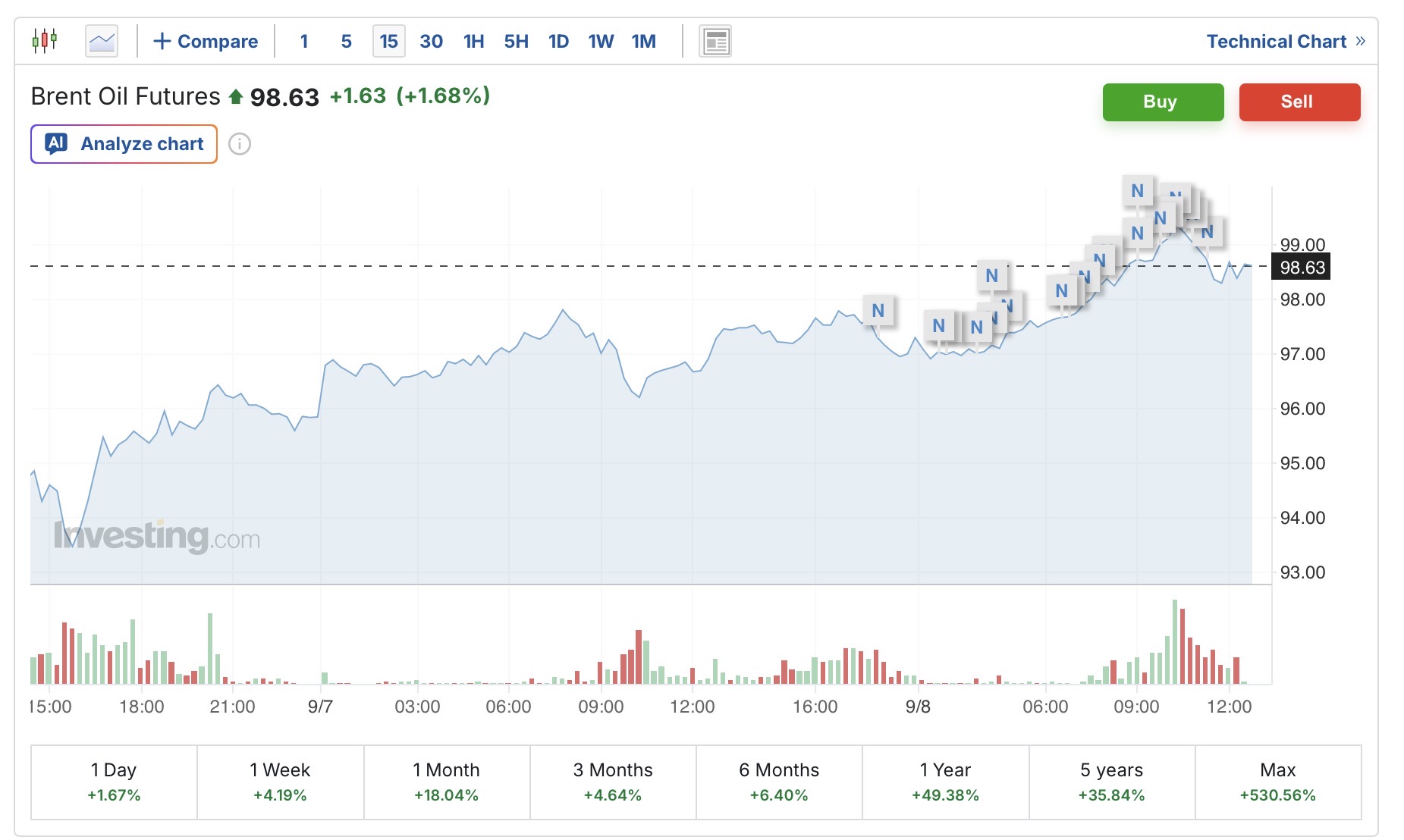
Brent Crude Oil Investing
Oil Shock and the Collapse of Diplomacy
President Trump has abandoned negotiation with Iran in favor of military strikes, sanctions, and a blockade halting Iranian imports and exports. Trump described the country’s prior ceasefire commitments as worthless, according to CNN reporting referenced in the same coverage, a rhetorical shift that has hardened into policy.
Brent rose toward $98 on Monday, its highest level since late July, after weekend US strikes hit three Iranian tankers. A separate attack struck Saudi Aramco’s Jizan facility the same day.
Energy Aspects, an oil market research firm, estimates that inventories outside China have fallen by more than 400 million barrels since the war began, a drawdown that is turning commodity funds increasingly bullish, as detailed in reporting on how sanctions and Brent crude pressure are feeding into broader risk markets.
Diesel is now trading more than $100 a barrel above crude in the US, a gap analysts describe as evidence the supply crunch has already arrived. Iran and Oman are separately negotiating a temporary shipping route tied to the Strait of Hormuz corridor talks that briefly cooled prices last month, though whether Washington accepts any such arrangement remains unresolved.
Iran Crypto Network: Bitcoin as Regional Financial Infrastructure
Set against that oil-market backdrop, the Bitcoin Policy Institute’s estimate of $350 billion in annual MENA blockchain transaction value – more than triple the roughly $100 billion recorded in 2022 – points to a structural shift in how capital moves through sanctioned and unstable economies.
Rather than fleeing the region entirely, a growing share of capital has shifted into digital assets during the conflict.
That figure is a regional aggregate spanning multiple countries, not an Iran-specific measure, and it does not establish that the underlying activity is predominantly Bitcoin-denominated or illicit. Still, the report identifies Egypt, Turkey, Lebanon, and Iran specifically as economies where currency depreciation has pushed residents toward Bitcoin and dollar-pegged stablecoins to preserve purchasing power. That pattern of crypto adoption under duress has precedent: exchange flows tied to sanctioned Iranian entities have drawn regulatory scrutiny before, as covered in reporting on offshore exchanges used by Iranian actors and in separate coverage of sanctions-evasion concerns tied to Binance-linked activity.
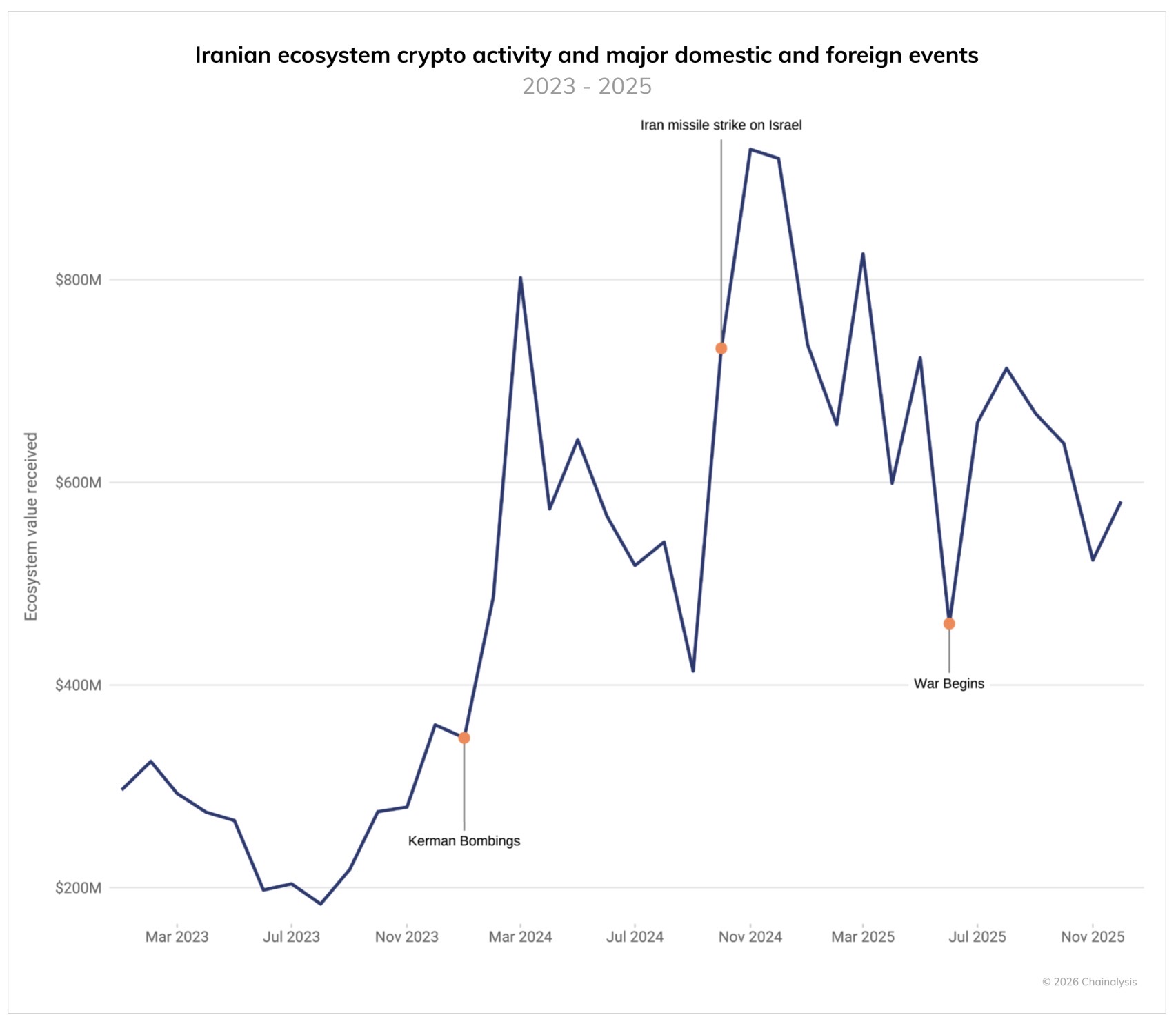
Iran Crypto Activity Chainanalysis
Risk Asset by Day, Emergency Rail by Night
The safe-haven framing has an important caveat. The Bitcoin Policy Institute’s own data shows Bitcoin initially fell alongside global equities when fighting broke out, trading as a risk asset rather than an immediate hedge.
Its share of total crypto market capitalization later climbed to a one-month high of 64.8% as capital rotated out of altcoins, but that consolidation reflects risk-off positioning within crypto, not a decoupling from broader macro conditions.
On the geopolitics of the conflict itself, Hamidreza Azizi, an Iran analyst at the International Crisis Group, said Tehran likely wants calibrated escalation rather than full-scale war. He warned that miscalculation, not intent, is now the biggest risk of a wider conflict – a caution that applies equally to oil traders and to anyone extrapolating a durable Bitcoin correlation from a fast-moving war.
Iran’s Supreme National Security Council chief Mohsen Rezaei has floated a new exclusion zone spanning the Persian Gulf and Gulf of Oman, a move that, if enacted, would widen shipping disruption well beyond the strait itself.
The primary-market variables remain squarely in oil: shipping disruption, inventory drawdown, and the risk of miscalculation around the Strait of Hormuz. Goldman Sachs’s $120 figure is a conditional scenario tied explicitly to intensifying attacks, not a base case, and the bank has separately noted Brent could fall to $80 if regional exports normalize.


Comments
Log in or sign up to join the conversation.