

Beyond Meat's (BYND) stock has delivered spectacular returns for investors over a short period of time. From an IPO price of $25 in May of this year, the stock ended its first trading day at $65.75, and it is now trading at around $163 per share as of the time of this writing. Understandably, these impressive gains are attracting a lot of attention among investors in the search for high growth stocks with superior potential.
However, past performance does not guarantee future returns, and Beyond Meat is valued at aggressively demanding levels right now. The stock is priced for perfection, and the odds are against the bulls going forward.
High Growth And An Uncertain Future
Beyond Meat is clearly growing at full speed. Revenue during the quarter ended in June amounted to $67.25 million, a breathtaking increase of 287%. The company is doing well across the board, with retail sales growing 192% and restaurant and foodservice revenue increasing 483% year over year.
This performance is due to multiple growth engines: expansion in the number of retail and foodservice points of distribution, new strategic customers, international customers, and greater demand from the company's existing customers.
During the earnings call, management quoted statistics from the NPD Group saying that 95% of the people who are purchasing plant-based burgers are also consumers of beef burgers. This is indicating that the potential target market for plant-based meat substitute is rapidly expanding beyond vegans, which bodes well in terms of evaluating Beyond Meat's growth opportunities over the long term.
On the other hand, there are some serious questions regarding the health implications of plant-based meats. These products are highly processed foods that include considerable amounts of sodium and saturated fat. In fact, many dietitians consider that plant-based meats are not necessarily healthier than real red meat.
There is a clear trend towards healthier nutrition, especially among younger generations. Such a trend is arguably here to stay, but it's hard to say to what degree plant-based meats are going to be a big part of such a trend over the long term. It will be important to watch how demand evolves once plant-based meats are no longer a novelty for consumers.
Besides, even if demand remains vibrant, Beyond Meat will be facing increased competition from all kinds of players. This includes other plant-based protein makers such as Boca Foods, Field Roast Grain Meat Co., Gardein, Impossible Foods, Lightlife, Morningstar Farms, and Tofurky. In addition to this, traditional meat companies like Cargill, Hormel Foods (NYSE: HRL), JBS (JBSAY), and Tyson Foods (TSN) are potential competitors to keep in mind.
Beyond Meat has a lot to prove going forward. The company needs to show what kind of revenue growth it can sustain in the long term and what levels of profitability it can produce. Besides, competitive pressure will be a key risk factor for the company over the years ahead.
Aggressive Valuation
Beyond Meat is losing money and producing negative cash flows at this stage, so we need to rely on valuation metrics focused on revenue or book value to assess the stock.
This has some limitations. Beyond Meat is a fairly unique company and comparisons are not very straightforward. However, the numbers can provide some perspective on how demanding valuation is for Beyond Meat right now. The stock is priced at a massive premium versus other players in the sector.
(Click on image to enlarge)

Source: Seeking Alpha Essential
Valuation should always be analyzed in its due context. A company with vigorous revenue growth and strong profit margins obviously deserves higher valuation ratios than a business with declining revenue and mediocre profitability. However, it can be challenging to incorporate the different factors into a single quantitative metric.
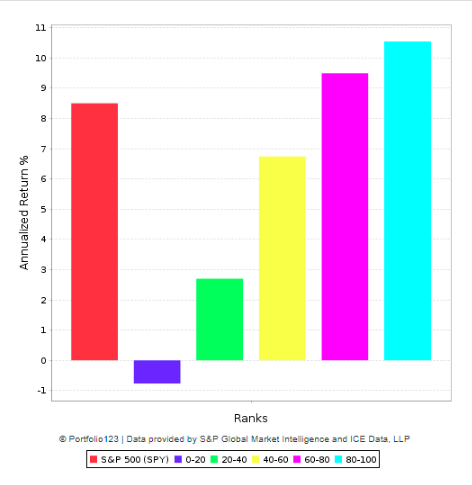
The PowerFactors system is a quantitative algorithm that ranks companies in a particular universe based on a combination of factors: financial quality, valuation, fundamental momentum, and relative strength.
In simple terms, the PowerFactors system is looking to buy good businesses (quality) for a reasonable price (valuation) when the company is doing well (fundamental momentum) and the stock is outperforming (relative strength).
Data from S&P Global via Portfolio123
The backtested performance data shows that there is a direct relationship between the PowerFactors ranking and subsequent returns; the higher the ranking the higher the returns, and vice-versa.
In the case of Beyond Meat, the company has a PowerFactors ranking below 25, meaning that the stock is in the lowest quintile of stocks in the US stock markets when considering the quantitative return drivers combined.
In other words, it's not just that Beyond Meat is too expensive when looking at the valuation ratios in isolation, the stock looks downright overvalued when considering different quantitative drivers such as value, growth, and profitability together.
The Numbers Don't Make Sense
Anything can happen in investing, and it is entirely possible that Beyond Meat stock could deliver attractive gains in the short term. High growth stocks trade based on expectations as much as fundamentals, as long as the company continues delivering rapid revenue growth as well as expanding its presence in different channels and product categories, it would not be much of a surprise to see the stock price performing well in the near term.
On the other hand, the valuation is too expensive from a long-term perspective. In order to justify current valuation figures, Beyond Meat would need to sustain exceptional performance for years to come. A high bar is hard to beat, and Beyond Meat does not have a long track record to evaluate, so it's hard to tell if the company can live up to expectations in the future.
If the demand for vegan meat substitutes continues growing rapidly, it makes sense to expect increased competition in the space. In this context, Beyond Meat's ability to fend off the competition still remains to be seen. Needless to say, a slowdown in industry demand would be an even worse scenario for Beyond Meet, since the company needs vigorous growth to justify the valuation levels for the stock.
In order to deliver solid returns from current valuation levels, Beyond Meet would need to produce sustained revenue growth and expanding profit margins for years to come, which would also mean that demand for vegan meat substitutes keeps booming and the company remains the global leader in the space in spite of rising competitive pressure.
I am not saying that this scenario can't happen, but betting on it doesn't sound like a good idea in terms of risk versus potential reward. At current prices, there are too many things that could derail the bullish investment thesis in Beyond Meat.



Comments
Log in or sign up to join the conversation.