

Ignore the initial reaction. Focus on the framework.
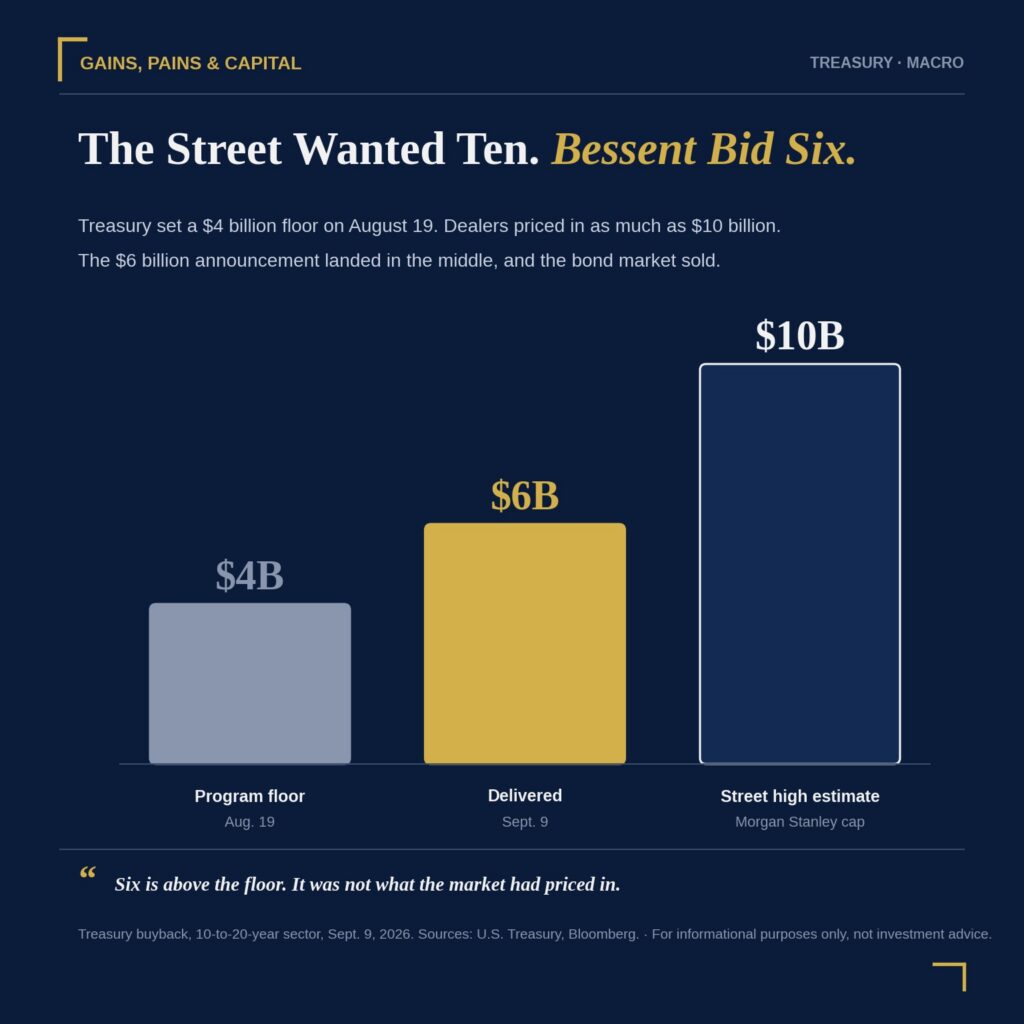
At 11 a.m. yesterday, the U.S. Treasury announced it would buy back $6 billion of 10-to-20-year U.S. debt. Dealers had been floating figures as high as $10 billion. Six is above the $4 billion floor Treasury set on August 19, so technically Bessent expanded the program as promised. But the market had priced in something closer to the top of the range, and when it got the middle, it sold.
The yield on the 10-year jumped to 4.85%, its highest level since November 2023. The yield on the 30-year hit 5.30%. The long bond future dropped 21 ticks in about half an hour, which is a major move for that market. Even the yield on the 2-year rose to 4.43%. That last one matters because 2-year notes are barely affected by a buyback aimed at 10-to-20-year paper. When the short end sells off too, the market is no longer reacting to one operation. It is reacting to what the operation revealed about Treasury’s plan.

I understand this is getting quite technical if you don’t track the bond market, so let me put this in very simple terms.
The U.S. government borrows money by selling bonds at auction. The interest rate it pays is the yield. When investors want more yield to hold a bond, the bond’s price falls and the government’s borrowing cost rises.
Over the summer, yields on long-dated bonds climbed to their highest levels in nearly two decades. That raises the cost of everything from mortgages to the interest on the national debt. With $40 trillion in public debt outstanding, of which ~$9 trillion needs to be rolled over in the next 12 months, higher yields can be a major problem.
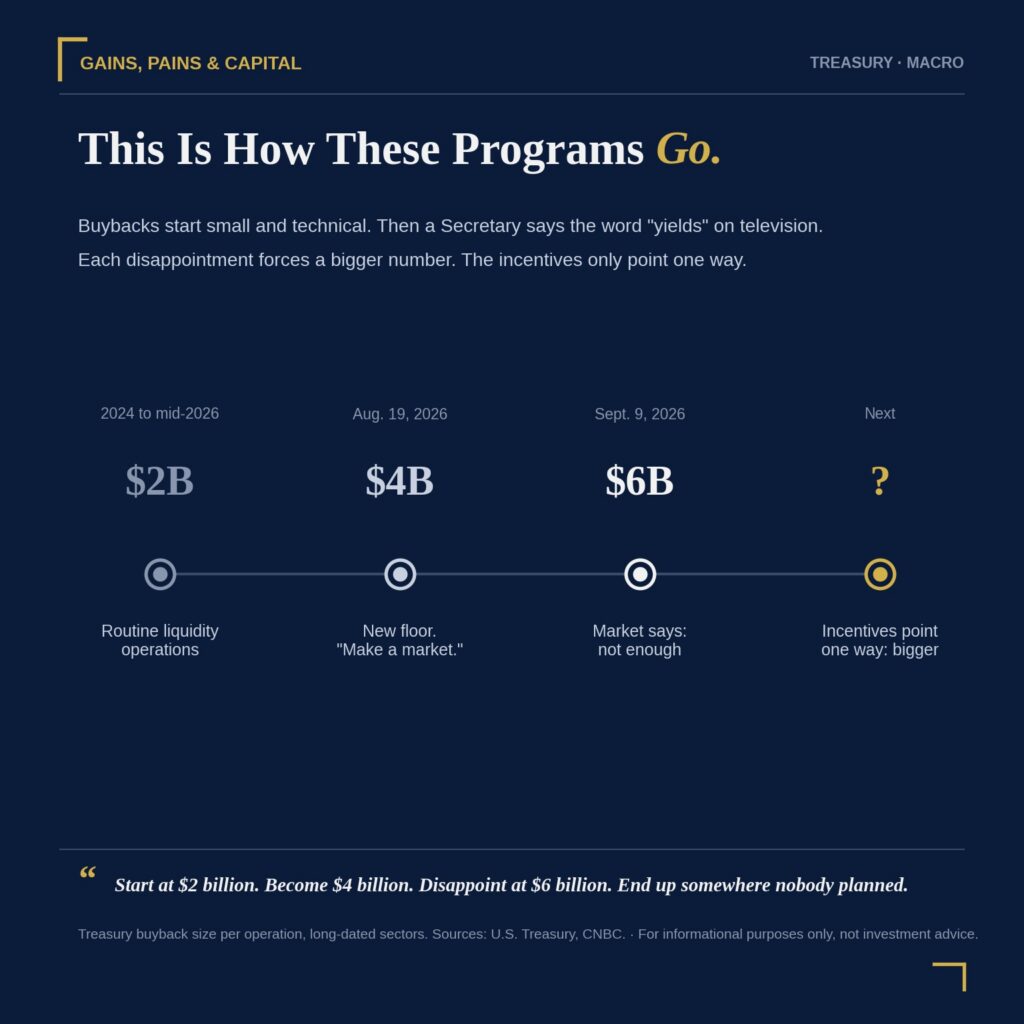
A buyback is Treasury going into the market and repurchasing bonds it already sold. Treasury has done this routinely for two years to keep older bonds trading smoothly. Those operations were small, $2 billion each, and nobody paid attention. Then on August 19, Bessent said Treasury would at least double them to $4 billion per operation, with $4 billion as the minimum rather than the maximum.
Each operation targets one slice of the market, and long-dated slices get an operation roughly every two weeks through November 4. Yesterday’s announcement set the size of the first operation under the new program, which Treasury executes today.
Bessent did not frame this as a technical adjustment. He went on CNBC and said Treasury would “make a market” in long bonds, that operations could run well past $4 billion, and that current yields did not reflect fundamentals. Officials then floated Treasury’s near $950 billion cash balance as a possible funding source. Put together, the message was that Treasury was prepared to commit real money to pulling long-term yields down.
Wall Street took Bessent at his word and started sizing the intervention.
Yesterday he showed up with $6 billion against a market that trades hundreds of billions of dollars a day, and the market decided the toolkit is smaller than advertised.
To be clear, none of this is a crisis. A 4.85% 10-year is not a broken market. It is the market repricing what Treasury intervention is actually worth, which turns out to be less than three weeks of headlines suggested. This afternoon’s 30-year auction will tell us more. If it goes badly, meaning investors demand a higher yield than the market expected before the sale, the buyback conversation gets louder and the numbers get bigger. If it goes fine, Bessent gets breathing room and yesterday’s move fades.
Either way, the direction of travel is set.
Treasury has committed itself to managing the long end of the bond market. Yesterday revealed it will have to spend more to do it than it hoped. That is how these programs go. They start at $2 billion, become $4 billion, disappoint at $6 billion, and end up somewhere the original announcement never contemplated. I am not predicting a specific number. I am telling you incentives only point one way, and that is more money spent on buybacks.
Now, the bigger picture, because this is not really a story about one buyback.
A tectonic shift is underway in the financial system, and it is repricing assets according to a simple rule: what Washington prizes goes up, and what Washington needs to control goes down.
Look at the two sides of the ledger. On one side sit Treasuries, the paper Washington has to sell in ever larger amounts to fund deficits running above 6% of GDP in peacetime. Roughly $9 trillion of existing debt, about a third of everything held by the public, matures in the next year and has to be refinanced, much of it at rates far above what it was issued at. Every basis point of yield on that paper is real money. So, Treasury has now committed itself to pushing the price of its own debt higher and its yield lower, and yesterday it learned that commitment costs more than it hoped. The direction is set. Treasuries are an asset the government is actively trying to make cheaper to issue, which is another way of saying the government is on the other side of your trade.
On the other side sit critical minerals. Copper, uranium, rare earths, antimony, tungsten, the inputs the defense and energy sectors cannot function without. Washington has told you exactly how it views these. It has taken equity stakes in producers, guaranteed prices, fast-tracked permits, and written them into national security policy. These are assets the government wants higher. It is not trying to suppress them. It is trying to build them, and it is willing to pay up to do it.
That is the tell.
When a government spends its cash balance trying to hold down the price of the paper it issues, while spending policy and capital to push up the price of the physical things it needs, it is telling you where it perceives “value”. The repricing is already underway.
None of this happens overnight and none of it requires a crisis. It requires exactly what we saw yesterday: a government that has shown its hand, a bond market that has tested it and found it short, and a set of hard assets that Washington has decided it cannot afford to let fail.
I laid out the framework on Wednesday. Yesterday the market gave us the first data point. Bessent told you where his pain threshold is. The bond market just told him what it costs to defend it. Position for the shift, not the headline.

Comments
Log in or sign up to join the conversation.