

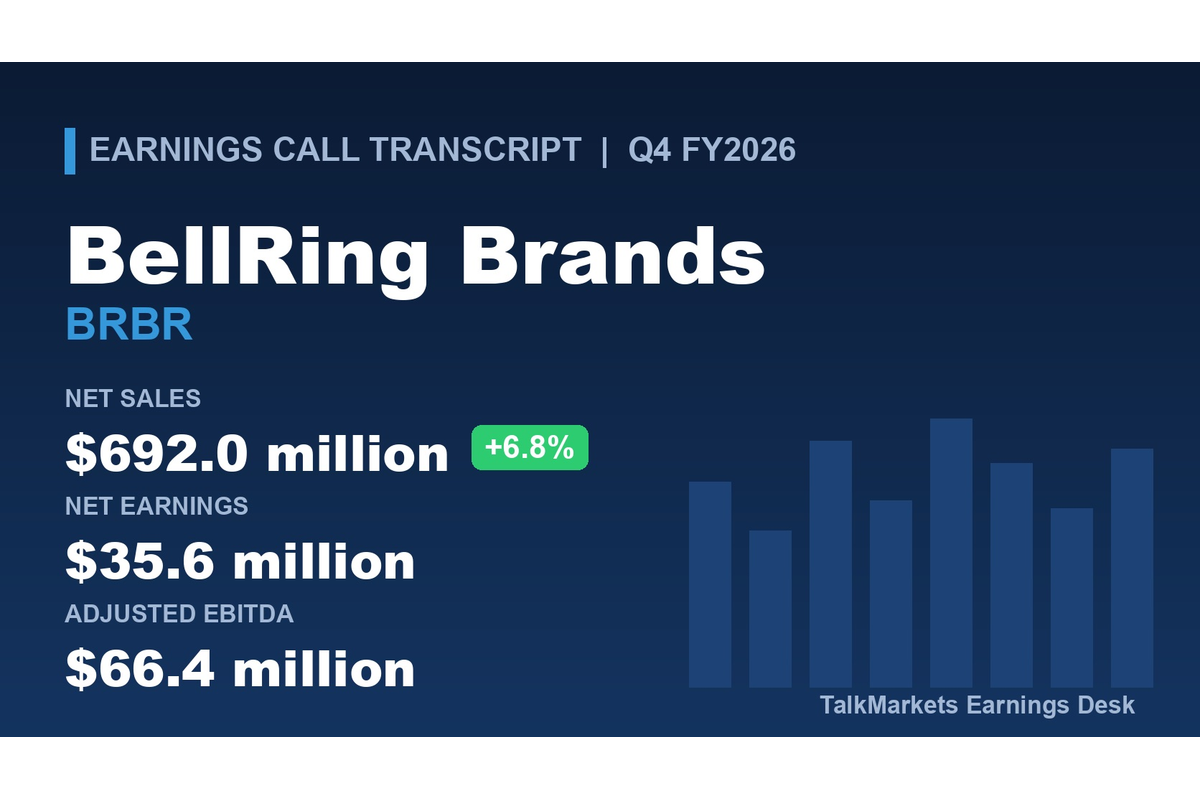
BellRing Brands' Q4 fiscal 2026 net sales rose 6.8% to $692.0 million on higher volume, while net earnings fell to $35.6 million from $59.6 million, including a $16 million inventory-related headwind.
Ticker: BRBR
BellRing Brands, Inc. (BRBR) reported results on 18 November 2026 for its fourth fiscal quarter and fiscal year ended 30 September 2026. Sales grew on a 14.9% increase in volume, partly offset by an 8.1% decrease in price/mix, but profit fell on input cost inflation including tariffs, incremental trade investment, higher freight and inventory-related actions.
The key numbers (fourth quarter fiscal 2026)
Metric | This year | Last year | Change |
|---|---|---|---|
Net sales | $692.0 million | $648.2 million | +6.8% |
Gross profit | $152.3 million | $187.4 million | |
Operating profit | $67.8 million | $102.2 million | |
Net earnings | $35.6 million | $59.6 million | |
Diluted EPS | $0.31 | $0.48 | |
Adjusted EBITDA | $66.4 million | $117.4 million | |
Adjusted diluted EPS | $0.22 | $0.51 |
Gross margin was 22.0% of net sales, compared with 28.9% a year earlier. The approximately $16 million of inventory-related headwinds included about $8 million of incremental reserves for slow-moving inventory and about $8 million mainly of targeted trade spend to clear excess RTD shake bottle inventory.
Sales by brand
Premier Protein: net sales up 7.1%, on a 16.0% increase in volume and an 8.9% decrease in price/mix.
Premier Protein RTD shakes and other beverages: net sales up 7.9%.
Dymatize: net sales up 3.6%, as an 18.2% increase in price/mix outweighed a 14.6% decrease in volume.
Dollar consumption of Premier Protein RTD shakes and other beverages increased 8.8% in the 13-week period ended 27 September 2026, while Premier Protein powder products decreased 1.8% and Dymatize products increased 12.1%.
President and CEO Michael Axelrod said fourth quarter Premier Protein ready-to-drink consumption was the strongest of the year, with consumption and sales growth ahead of guidance and profitability in line with expectations.
Full fiscal year 2026
For fiscal year 2026, net sales rose 3.5% to $2,398.4 million. Operating profit was $277.7 million, net earnings were $147.4 million and Adjusted EBITDA was $288.8 million, each including an unfavourable $37 million pre-tax headwind from inventory-related actions. BellRing generated $126.0 million in cash from operations.
Source: SEC Form 8-K Exhibit 99.1
Full call transcript
Operator:
Ladies and gentlemen, thank you for standing by. Welcome to the BellRing Brands fourth quarter fiscal year 2026 earnings conference call. At this time, all participants are in a listen-only mode. After the speaker's presentation, there will be a question-and-answer session. To ask a question during the session, you would need to press star 11 on your telephone, and you will then hear an automated message advising your hand is raised. And to withdraw your question, please press star 11 again. Please be advised that today's conference is being recorded.
I would like now to turn the conference over to Jennifer Meyer in Investor Relations for BellRing Brands. Please go ahead.
Jennifer Meyer (Investor Relations):
Good morning. Thank you for joining us today for BellRing Brands fourth quarter fiscal 2026 earnings call. With me today are Mike Axelrod, our president and CEO, and Paul Rode, CFO. Mike and Paul will begin with prepared remarks, and afterwards, we'll have a brief question-and-answer session. The press-related supplemental slide presentation that supports these remarks are posted on our website in both the investor relations and the ST filing sections of bellring.com. In addition, the relations slides are available on the STT's website.
Before we continue, I would like to remind you that this call will contain forward-looking statements, which are subject to risks and uncertainties that should be carefully considered by investors, as actual results could differ materially from these statements. These forward-looking statements occur as of the date of this call, and management undertakes new obligations at these statements. As a reminder, this call is being recorded, and an audio replay will be available on our website. And finally, this call will discuss certain non-GAAP measures.
For reconciliation of these non-GAAP measures to the nearest GAAP measure, see our press release issue this morning and post it on our website. With that, I will turn the call over to Mike.
Mike Axelrod (President and CEO):
Thank you, Jennifer, and good morning, everyone. Thank you for joining our fourth quarter earnings fall. Let me begin with a brief recap of the fourth quarter before sharing my initial assessment and priorities for the business. Fourth quarter net sales growth of 7% exceeded our expectations with both Premier protein and Dymatize contributing to the upside. Premier shake dollar consumption grew 9% with low teens volume growth while continuing to add households. This growth exceeded our expectations driven by stronger than planned volumes in the important back-to-school selling period.
Promotional discounts levels were in line with our plans. While the category promotional environment remained elevated, intensity moderated somewhat in Q4 relative to Q2. Adjusted EBITDA was 66 million within our guidance range and included additional inventory related charges from our year end inventory review. Underline profitability was modestly better than expected, but remains well below the levels we believe the business can achieve. Before discussing our plans for 2027, I'd like to share 2 important conclusions from my first 100 days.
First, BellRing has an exceptional foundation, strong brands, attractive category dynamics, loyal consumers, and meaningful scale. Second, we have opportunities to translate those advantages into stronger competitive performance and profitability. We need to become more agile, more cost competitive, and more disciplined in how we invest and execute. Those changes are already underway. I'll start with the strengths that give me confidence in our long term potential before turning to where I believe we need to raise the bar.
We operate in a healthy category supported by attractive consumer health and wellness trends. The Premier shake category grew 11% in fiscal 2026, supported by double digit volume growth and continues to stand out as one of the few food and beverage categories delivering meaningful volume growth. We expect the category to deliver high single digit dollar growth in 2027 with considerable long term growth opportunity as household penetration remains below that of mature CPG categories.
Within this attractive category, Premier Protein has established a leading position and strong consumer foundation. At approximately 23% in growing, the brand leads the category in household penetration. This demonstrates meaningful consumer awareness and adoption while leaving room to reach new households and support future growth. Importantly, Premier's case ratings are among the best in the category and it maintains the highest repeat purchase rate in RTDs. These are compelling indicators of the strength of our consumer proposition and the loyalty we've built.
As a category leader, we play an essential role in helping our retail and supply partners capitalize on category growth, creating a strong foundation for collaboration and shared success. Premier has established a powerful presence across channels, including the categories largest and fastest growing. We hold leading positions in club and mass, the 2 largest channels by volume, as well as the number 1 position on the leading ecommerce platform, a key driver of category growth.
Our scale extends to our supply chain where we are one of the categories largest purchasers of protein ingredients and co-manufacturing capacity, which gives us strategic relevance and opportunity to work closely with our partners to drive efficiencies. While these strengths reinforce my confidence in our long term potential, I see clear areas of opportunity. We have talented people and strong brands, but our capabilities and ways of working have not always kept pace with the growth and complexity of the business. I've identified 3 clear opportunities to improve performance.
First, strengthen our commercial execution through better consumer insights, more effective marketing and innovation, and deeper partnerships with our retail and partners. Second, leverage our scale to structurally improve our cost position. And third, increase the speed, agility, and accountability with which we operate. Improved insights and analytic capabilities will help us develop more targeted, impactful product innovation that drives household penetration and purchase frequency and improves returns on promotional and marketing spending. Equally important is elevating business planning with our retail partners to unlock opportunities and drive shared growth.
Beyond strengthening our commercial capabilities, we must fully capture our scale and category leadership advantage and our cost structure. We are advancing a strategic supply chain optimization program targeting at least $100 million in growth savings over the next 3 years. These opportunities span manufacturing, procurement, packaging, and logistics. We expect to begin realizing benefits in fiscal 2027 with savings building over time. These structural improvements will provide greater flexibility to reinvest in our brands, offset inflation, and strengthen profitability.
And finally, we must establish clear ownership to enable faster decision making while better leveraging our existing tools and systems and making targeted investments where needed. As part of this effort, we will be enhancing integrated business planning and financial visibility to enable stronger execution and more consistent performance. We are taking action now to capitalize on these opportunities while advancing a broader strategic review to shape the next phase of our long-term growth.
This review is focused on strengthening our competitive position, improving profitability, and establishing a more sustainable growth model. As part of this process, we believe it's appropriate to withdraw our previous long-term algorithm issued last November. We intend to share our refreshed strategy in updating long-term financial outlook with our second quarter earnings call in May 2027. We recognize the importance of a clear, long-term target for investors and look forward to sharing the results of our work.
Turning to 2027, we expect 2027 to be a year of foundational progress as we build operational capabilities and deliver margin expansion while absorbing modest near-term top line pressure. The fiscal 2027 outlook should not be viewed as indicative of our long-term financial potential in our business. We expect premier RTD consumption to grow in mid-single digits, below expected category growth, and are focused on narrowing that gap through execution. We expect bell-ring net sales of up 1% to down 3% with premier trip sales trailing consumption growth.
This reflects two dynamics, a moderation in distribution growth this year as we outsize prior year comparisons and modest retailer inventory adjustments associated with our pricing actions. We view these factors as largely 2027 transitional impacts. Our focus is on proving velocities across existing distribution, expanding and under-penetrated channels, and delivering innovation that drives incremental consumption and sustainable growth. Our sales guidance reflects a proven approach that includes a range of outcomes for several key variables.
We expect price increase related to elasticity impacts greater than 1, continued competitive pressure in the club channel, and benefits from innovation. As a result of our Q1 price increase, promotional planning with certain FDN retail partners remains ongoing. We expect to secure merchandising opportunities as plans are finalized and have incorporated a range of outcomes into our guidance. We expect to make progress on adjusted EBITDA in 2027 with benefits of pricing, cost-saving initiatives, and lapping 2026 inventory items somewhat offset by continued commodity and freight inflation.
Overall, while we expect our low double-digit price increases on shakes to create some near-term headwinds, we believe it is necessary to restore profitability in light of significant inflationary pressures across key commodities. To deliver our financial plan, we are focused on four operating priorities in 2027. One, reducing the cost of our core shakes. Two, strengthening market share through improved club performance and targeted distribution expansion. Three, increasing our effectiveness of our marketing and innovation investments. And four, building the operational capabilities and accountability needed to execute consistently.
With respect to our first priority, our historical focus was to ensure we had sufficient supply to support rapid growth in demand against the backdrop of tight industry capacity. With industry capacity constraints easing, we are now implementing structural cost reductions and expect to deliver approximately 25 million of our three-year cost savings program in 2027. These savings will be driven by optimizing our co-manufacturing network, improving procurement economics, and reducing distribution and packaging costs.
Second, we intend to approve our share trends over time by regaining momentum in our core channels while continuing to expand distribution and improving our promotional effectiveness. Club remains a critical channel for premier in the category, and we recognize that sustaining leadership requires continuous innovation and strong customer partnerships. As a result of our improved joint business planning, we expect to recover a previously lost everyday assortment item late in the first quarter.
Additionally, we are pleased with how our innovation tasks in club performed this year and are planning for additional test opportunities in fiscal 27 grounded in the needs of club members. This month, we began shipping Premier Ultimate 42-gram shakes for a regional club test. Alongside our efforts to strengthen performance in our largest channel, we remain focused on expanding distribution across other channels.
In 2027, we expect to grow premier distribution through meaningful gains in grocery, where our portfolio continues to be under shelved relative to its potential, as well as entering DSD. We are executing a regional expansion strategy in DSD in parallel with ongoing efforts to secure a national partnership. Our regional strategy is a disciplined, targeted strategy for both core 30-gram and ultimate protein shakes. We have superior contracts with over 25 distributors, reaching 10 states, are in active discussions with several distributors to further expand our coverage in 2027.
We are also pleased to announce that we have secured distribution with several national sea stores, retail chains, and have activation in marketing plans to ensure strong velocities in this channel. Volume is shipping this quarter with consumption following Q2, and we expect DSD to contribute approximately one point to bell ring revenue in 2027. Across channels, we are undertaking a broader assessment of our informational strategy to ensure our trade investments are delivering the greatest impact.
We've identified targeted opportunities to enhance return on investment in 2027 and applied these learning store programs for this year. Overall, our focus is on strengthening our competitive position across channels while laying the foundation for a return to growth in club over time. Third, we are taking a more focused and disciplined approach to marketing and innovation to maximize the impact and returns of our investments. We are increasing advertising support while refining our marketing strategy to strengthen consumer engagement and maximize the effectiveness of our spending.
Our 2026 campaign delivered lifts in awareness, purchase intent, and brand favorability, but did not achieve our return on investment goals. The 2027 marketing plan is designed to engage consumers across the full path to purchase with refresh creative, more precise audience targeting, and a greater emphasis on driving conversion. Our objective is to recruit new households, increase purchase frequency among existing consumers, and improve the return on our marketing investment.
We are launching our New Year, New You campaign earlier this - earlier with refresh, go get 'em creative beginning in December to build awareness and purchase intent ahead of January. Looking ahead, we plan to introduce a new brand campaign, granted in rigorous testing for the fourth quarter back to school promotion season with stronger differentiation and a focus on consumer acquisition and loyalty. We also have new partnerships with leading media and shopper agencies.
These partners will help us improve audience targeting, optimize our media, strengthen demand generation, and engage consumers closer to the point of purchase, including through retail media. We will measure success by strong conversion and improve returns, not spending alone. Our 2027 agenda is focused on discipline - is focused on discipline, prioritizing opportunities that begin to address differentiation on our core 30-gram shakes and new products that create incremental category growth and expand occasions. We intend to evaluate innovation against clear consumer and financial milestones.
For our core portfolio, we are advancing cleaner formulations, differentiated packaging and consumer communications, and continuing our successful LTO strategy. On formulation this summer, we launched a carrageenan-free formula at a key retailer, Club Retailer, and broader formulation work is ongoing. We will share more - we will share more later this part as we - as part of our strategic review.
Our limited time offerings continue to perform well with pumpkin spice in the top turtle, and we will build on that momentum with a unique new seasonal shake flavor launching in our second quarter. Last, as part of our core portfolio work, we are also making targeted investments to update Dymatize's positioning. We will focus on packaging and messaging improvements to more clearly communicate the consumer benefits of Dymatize's best-in-class formula and high-quality ingredients.
This year, our new product efforts are focused on fewer opportunities with the potential to expand occasions and deliver meaningful incremental growth. Our priorities include building momentum behind the Premier Ultimate 42-gram and increasing consumer awareness, trial, and repeat purchase for sparkling soda, both of which were launched in late fiscal 2026. We're also expanding our successful coffee house line. In closing, BellRing has strong brands, a leading market position, and significant opportunities ahead. Our responsibility now is to translate those advantages into stronger and more consistent performance.
Fiscal 2027 is a year of action. I am confident in the opportunities ahead, but equally clear that success requires urgency, focus, and accountability. We have the team, brands, and scale to compete more effectively, and we are committed to delivering the results that our shareholders expect. I look forward to updating you on our progress and sharing our long-term strategy later this year. Finally, I want to thank our team for their hard work, dedication, and commitment to our business.
We have important work ahead of us, and I appreciate the energy and focus our people are bringing to building a stronger company. Before turning the call to Paul, I want to briefly address the CFO transition that we announced today. First, I want to thank Paul for his leadership and contributions over the past decade. He played an instrumental role in BellRing's IPO and subsequent growth and has been a valued partner to me during my first few months as CEO. I appreciate his continued support through this transition.
I'm also excited to welcome Travis Leonard as our new CFO, effective December 1st. Travis brings extensive financial leadership experience, including serving as CFO of Hostess Brands in lockdown. His experience driving profitable growth, operational discipline, and capital allocation will be valuable as we execute our strategy. With that, I'll turn the call over to Paul.
Paul Rode (Chief Financial Officer):
Thank you, Mike, for the kind words, and good morning, everyone. It has been an honor to serve as BellRing's CFO since our IPO, and I am proud it will be built together. I've been fortunate to work with an amazing team at BellRing and at our former parent company, Post Holdings. I'm grateful to my colleagues for their partnership and support along the way.
I feel great about the opportunity ahead for BellRing, and I'll be working closely with Mike and Travis to make this transition as smooth as possible. Turning to our results and outlook. Category fundamentals remained healthy in the fourth quarter, with total wellness dollar sales up 8% and RTD shake dollar sales up 12% driven by strong volume growth. Promotional intensity remained elevated year over year. However, the percentage of sales sold on promotion moderated somewhat in Q4 relative to Q2.
Premier RTD consumption growth of 9% was ahead of our expectation of mid-single digits. We were encouraged by improving trends in this club channel, with consumption turning slightly positive. Consumption excluding club remained strong up 17% in the quarter, with each of the mass food and e-commerce channels delivering double digit growth. Net sales exceeded our expectations up 7% year over year. Premier protein brand sales grew 7%, with RTD net sales up 8%. RTD volume grew 17%, partially offset by a 9% decline in price mix.
The RTD outperformance versus our guidance was primarily driven by volume. As contemplated in our guidance, total BellRing net sales growth included a two-point benefit from the ultimate and sparkly innovation launches. Dymatize sales were up 4%, with strong price mix of 18% and a 14% volume decline. International sales were strong, while domestic volume declines were driven by elasticities related to inflation-driven price increases taken earlier this year. Compared to our expectations, Dymatize is outperformed in e-commerce and mass.
Adjusted gross profit was $139 million, with adjusted gross margin of 20.1% compared to 29.7% a year ago. The year-over-year decline was driven by significant protein and freight cost inflation, including tariffs and incremental trade investment. Additionally, we recorded $16 million in inventory-related headwinds, which had an unfavorable 230 basis point impact on gross margin. SG&A expenses were $80 million, or 11.6% of net sales, including a $3 million advertising increase. The quarter also benefited from lower-incident compensation and modest savings from our organizational realignment earlier this year.
Adjusted EBITDA was $66 million at a margin of 9.6%. This included the $16 million of inventory actions that I discussed earlier, which had an unfavorable impact of 230 basis points. Turning to our fiscal 2027 outlook, we expect bell-ring net sales of $2.32 to $2.42 billion, representing a range of 1% growth to down 3% versus prior year. This is inclusive of an approximately 100 basis point headwind for powders and Dymatize's, with premier shakes expected to be up 2% to down 2%.
As a result of the trade inventory dynamics that Mike discussed, we expect shipment growth to trail consumption growth, creating a mid-single digit headwind to net sales growth. Our outlook incorporates a price increase of low double digits on shakes, along with additional price increases on powders, both effective at the beginning of fiscal 2027. From a brand perspective, we expect mid-single digit premier shake consumption growth.
Premier net sales are expected to decline 1% at the midpoint and line with the overall company, inclusive of an approximate 100 basis point headwind for powders. Meaningful price growth should be offset by volume declines from consumer elasticities and trade inventory headwinds. In addition, we expect volume headwinds as we lap a year of strong distribution gains and retailers modestly adjust their inventory as a result of our price increase. We expect Dymatize's and all other to decline low single digits at the midpoint, driven by consumer elasticities.
Moving to fiscal 2027 adjusted EBITDA, we expect adjusted EBITDA of $310 to $350 million were approximately at 14% margin at the midpoint versus at 12% margin in 2026. The approximate 200 basis point of margin improvement will be driven by meaningful gross margin expansion of nearly 400 points. This improvement will be partially offset by 100 basis points of incremental AMP investment and higher SG&A resulting from a return to normalized incentive compensation levels and capability investments.
Adjusted gross margin expansion largely reflects the benefits of low double digit pricing, cost savings of approximately $25 million and favorable comparisons to 2026 inventory related items. This is partially offset by high single digit commodity inflation inclusive of tariffs. As Mike discussed, our full year sales guidance range reflects several meaningful variables and these will primarily play out after the first quarter. I'll now walk through those factors and how they influence our first quarter versus balance of year outlook.
Our price increase was actioned at the beginning of our fiscal year with retailer implementation on shelf continuing to phase in. As a result, retailer inventory adjustments are beginning to impact the first quarter while more meaningful consumer elasticity impacts remain ahead of us. The new year, new year and back to school seasons which are typically more competitive and promotional are still ahead of us in our second and fourth quarters.
Ongoing FD and promotional discussions that primarily impact consumption in Q2 have an unfavorable year over year impact on shipments in the first quarter. And last, distribution and innovation comparisons are tougher as we move through the year. With that context, we anticipate Premier RTD consumption growth to be low to mid teens in the first quarter and bell ring net sales growth to be up low single digits. Premier is expected to be in line with the overall company, inclusive of an approximate hard basis point headwind from powers.
Price mix is expected to increase double digits reflecting our price increase, which will be mostly offset by volume declines. Dymatize and all other sales are expected to be relatively in line with the overall company. The meaningful gap between consumption shipments for Premier Protein RTDs in the first quarter is driven by several factors. These include lapping, prior year shipment bills associated with a mass promotion and new products.
The timing lag between our price increase and shelf changes is favorable to consumer consumption while we expect some headwinds to shipments from retailer inventory adjustments. We expect Q1 adjusted EBITDA margin to be just under 17% at the midpoint with gross margin expansion largely offset by the timing of incremental advertising spend. Note that the timing shift in our new year programming will put some advertising spend forward into the quarter. Additionally, we are lapping our lowest quarterly advertising spend quarter from the prior year.
We expect gross margin expansion in each quarter of the year, although the cadence of year over year improvement will be influenced by the comparison against inventory related charges in the second, third, and fourth quarters of fiscal 2026. Our cost savings outlook is evenly phased across the year. At current prices, year over year inflation is expected to be highest in the first quarter and moderating throughout the year while protein inflation compared to prior year is expected to remain relatively consistent through the year.
With respect to SG&A, incremental advertising investments are expected to be more heavily weighted to the first and fourth quarters, while incentive compensation headwinds are more meaningful post the first quarter. As a result of all of these factors, we expect higher year over year adjusted EBITDA margin expansion in the second half versus the first half. Absent the fiscal 2026 inventory related comparisons, adjusted EBITDA margin expansion is relatively even between the first and second halves of fiscal 2027.
Turning to our balance sheet and capital allocation priorities, our business generated strong cash flow in 2026 with operating cash flow of $126 million, inclusive of the $90 million litigation settlement payment this year. Fourth quarter cash flow is stronger than expected, resulting in a year in that leverage ratio of 3.6 times lower than anticipated. Looking ahead, we expect strong cash conversion in fiscal 2027, which combined with our adjusted EBITDA growth, positions us to reduce leverage below three times.
We remain committed to a balanced capital allocation strategy that includes returning cash to shareholders and conservatively managing leverage. In summary, we remain confident in the long term opportunity for BellRing. The steps we are taking to improve profitability together with our strong cash flow profile position the company well to both invest in growth opportunities and to deliver shareholder value. I will now turn it over to the operator for questions.
Operator:
As a reminder to ask a question, please press 11 on your telephone and wait for your name to be announced. And to withdraw your question, please press 11 again. The first question will come from Andrew Lazar with Barclays. Your line is open.
Andrew Lazar (Barclays):
Great. Thanks so much. Good morning, everybody. Thanks, Paul. Thanks for all of your help. I guess I wanted to talk a little bit more about the promotional environment in RTDs. You mentioned that RTD volume sold on promotion in the fourth quarter was up five points year over year, but down a point versus the second quarter. I want to get a better understanding of, I guess, what more specifically I'm meant to take away from that.
Is it that promotion is up year over year, but you think has peaked going into 27? Or is it too early to sort of suggest that? And then what are you seeing with respect to pricing from a competitive perspective, given all the pricing you're taking? Is that fairly consistent with what you're seeing across the category, or is there some disparity there that we should be sort of attending to as well? Thank you.
Company Executive:
Yeah, so I think promotions remain an important part of competing in the category. And I don't believe the answer is just more promotions. I think the focus needs to be on the effectiveness and getting the right return from those events. You know, we've already adjusted our 27 programs based on what we learned in 2026, and we learned a lot. We learned a lot about depth. We learned a lot about how wide, what periods of time.
I think longer term, the opportunities really to improve the ROI continue to attract incremental household and build sustainable consumption, rather than just increasing our frequency or depth. It's part of our strategy review. We're going to go a little deeper here. But I would, I would also say we're doing a much better job in identifying and implementing quality promotion opportunities. I mean, we've, as we've expanded in FDM.
We've gotten much better at learning how to, you know, where to place our displays, what to place in the displays, what pricing works, etc. And so we'll continue to expand that and continue to expand those learnings. In CLUB, I think our plans are broadly consistent with 26, but I think, you know, as we're, again, as we're learning, we're going to take a deeper look at frequency timing and effectiveness as part of the review.
Company Executive:
And Andrew, I think from a category perspective, I think the call out there is just, we did see it, you know, pretty intense. Competitive promotional activity in Q2, that moderated some in Q4. I think it's a totally to tell how that plays out in fiscal 27. We've, you know, considered a number of outcomes in our, in our guidance for that. But I think that was the call out really was just the Q4 headwind was not quite what we saw on Q2.
Andrew Lazar:
And then just the competitive pricing arena as well. I thought there's basically been essentially keeping pace with what you're putting implementing in the marketplace or there's some disparities we should be aware of. Thank you.
Company Executive:
Yeah, I mean, we've seen, as we call that before, I mean, some of our larger competitors took pricing earlier this year. We have seen some additional pricing actions taken in the category more recently. So, again, we'll, you know, more to come. But we have seen some pricing just with the level of inflation out, that's out there. I think it's, it's logical that you'd see, you know, a lot of competitors, even it's not, it's logical to see some of that pricing offsetting the inflation.
Operator:
Thank you, and our next question is going to come from Tom Palmer with JPMorgan. Your line is open.
Tom Palmer (JPMorgan):
Good morning. Thanks for the question. Paul, it's been great working with you over the years. I appreciate your regular availability and insights. Mike, I, a lot of detail in the prepared remarks. I wanted to make sure I understood messaging on this promotional activity on club and mass. There was reference to regaining in club this. So, should we be thinking about there were promotional events that you've been running the last couple of years, like these month long promotions at club?
That will not be run that you're not sure if you're going to run. I know there was also the new promotional event last year that was added in a couple of spots. I just like what promotion is still kind of to be determined versus what is secured at this point.
Company Executive:
Yeah, I can start. So, thank you for the kind word. So, from a club perspective, we expect the promotional cadence and we expect to be similar year over year. So, there's no significant change in the club dynamics from a promotional calendar perspective. So, no change. What we were calling out in our prepared remarks is that there are still some of our merchandising and promotional programs within FDM that are still being discussed. So, some of those are not fully locked in at this point.
So, for guidance purposes, we've explored a range or we have a range of outcomes within our guidance to reflect potential outcomes there. The other piece in your question is that within club, we called out on the last call that we expected a headwind in 27 from losing a pallet position in one of our key club customers. That now has been, we now are regaining that. So, in the prepared remarks, we talked about regaining that. So, that becomes less of a headwind.
There's still a little bit of a headwind in Q1 because it was off for a little bit. Now it's back, but that was way to call out. So, from a club perspective, pretty similar distribution versus a year ago with some gap there in Q1 and then similar promotional dynamics from a cadence and timing perspective for club. Great, thank you.
Operator:
And our next question will come from David Palmer with Evercore. Your line is open.
David Palmer (Evercore):
Good morning, and thank you, Paul. My question for you on just distribution comparisons and inventory reductions that you mentioned. I know, on the other hand, there's a little bit of hope out there that you'll find some distribution wins, some ready-to-drink convenience channel expansion. Could you talk about that as a priority for the company? And then sort of separately, perhaps relatedly, could you talk about innovation as sort of a priority relative to past years?
Could you talk about the performance of some of your recent innovation and how innovation will play into your 2027 plans? Thank you.
Company Executive:
So, first, I think in terms of the distribution TDPs, I think we continue to grow TDPs, although we're lapping a pretty significant gain in 2026. And I believe that there are meaningful opportunities ahead. I think as we scale beyond 2 billion in revenue, the impact of those distribution gains will naturally moderate. But I see meaningful opportunity here. I think grocery and convenience are particularly attractive. I think innovation and improved velocities can drive growth in more of these established channels.
And so I do see continued upside there. On the innovation side, you know, I think, you know, I think in terms of the solutions that we have, I think they're really promising. I think Ultimate Sparkling and Coffee House, which we introduced this year, are addressing really different consumer needs and occasions. I think Ultimate gives us an offering in the higher protein segment. And, you know, I'm pleased with the early reception by retailers and consumers.
And, you know, it's going to be one of our key products that we're going to be expanding in the convenience store channel. You may have seen the announcement we made earlier this week about a large convenience store where Ultimate is going to be a key product for us. I think Sparkling adds refreshment occasions and has the potential to be highly incremental to our product portfolio. But, you know, it's a sub category. It's a new category. And I think it's still in its earlier stage.
I think importantly, we do need a stronger, more consistent innovation pipeline. We are evaluating our insights, our consumer insights, and our innovation processes and speed the market so we can get the things, the right things to market quicker. You know, innovation takes time, but we are moving with a sense of urgency to build a more impactful pipeline, including evaluation of some of our formula optimization, which I mentioned in my prepared remarks around clean label and things of that nature.
And really renovating the core shake as well. Thank you.
Operator:
And the next question is going to come from Peter Grom with UBS. Your line is open.
Peter Grom (UBS):
Great. Thank you. Good morning, everyone. And Paul, thanks so much for all the help over the years as well. Mike, I wanted to get your perspective, just on kind of long term targets and I think we can all appreciate the decision to withdraw them this morning from what was outlined a year ago. But we're still operating in a pretty volatile and uncertain environment. The category dynamics continue to evolve. So just maybe some thoughts on how you're approaching building for these targets over the next few months.
What are you trying to learn? What are some of the key watch points? And then specifically, you know, why is it important to have long term targets at this stage?
Company Executive:
So, I think as we're, you know, at this point, we're continuing to undergo our strategic review. So, in terms of the longer term, I'll hold comments around what I think the long term potential of the business is. I think 27 is a year of in many ways of resetting expectations. We have a tremendous amount of potential in areas that, you know, quite frankly, are under our control. And so I see, you know, really significant improvements around, you know, the investments are making in promotions.
Again, learning and coming back with better ROI there, accelerating some more innovation, making decisions faster, and then structurally resetting our, you know, lowering our cost of our core shakes, which is, I think, a tremendous amount of opportunity there. So, until we're through the strategy planning process here, you know, I think the business has a tremendous potential. I just don't want to commit to anything until we've done our due diligence here.
Peter Grom:
Great. Thank you so much.
Operator:
And our next question is going to come from Alexia Howard with Bernstein. Your line is open.
Alexia Howard (Bernstein):
Good morning, everyone. And thank you so much to Paul. Appreciate all the help. Can I ask about what price elasticity assumptions you're making as you think about the forecast, obviously, on the sales line? It obviously looks as though you've got some headwinds from distribution and other inventory adjustments. But in terms of the core consumption trends, what are you assuming?
Company Executive:
So, we're monitoring modeling a range of elasticities that are all greater than one. And, you know, as our guidance would indicate, the high end of that is that the lowest elasticity, which is above one, and the midpoint and low ends would be higher underpinning that is we've used historical data. And made additional assumptions give the magnitude of the price increase, but I'd say that's, you know, in our ranges included our best estimate in those ranges that we just communicated.
Alexia Howard:
Thank you very much. I'll pass it on.
Company Executive:
Yeah.
Operator:
And our next question is going to come from Max Gunport with BMP. Your line is open.
Max Gumport (BNP Paribas):
Hey, thanks for the question. With regard to cost inflation, you gave your outlook for the year, but I was hoping you could give some color on how much of that is hedged already or covered. Just give a sense for how much variability there still could be in regard to cost inflation this fiscal year. Thanks very much.
Company Executive:
Yes, we're modeling high single digit commodity inflation and fiscal 27, which is covered by our pricing. You know, most of that is at the protein cost level. So, both whey powders, which is the input cost for our powder business, and also melt proteins, which is the primary cost for our shake, are significantly higher over the year.
To your point, we give a hedging program in place where we do have coverage, and that allows us to mitigate some of the volatility in those headwinds as we go into the year. So, from a coverage perspective, our proteins are about two-thirds covered. You may recall on freight, we had some volatility as well in 27 or in 26 on freight.
And so, we have changed our strategy to some degree on the spot by and moved some of that to contracts, which gives us kind of three to six month visibility. So, we have better visibility in the first half on freight. And if you look at the rest of our basket, our input basket, we have a pretty good line of sight. So, our coverage is pretty solid going into the year.
Obviously, more covered in the first half than perhaps in the latter parts of the year, but overall, we're pretty covered. And just overall, we've probably covered about 70% hedging on proteins at this point.
Operator:
And our next question will come from Jim Salera with Steve, and your line is open.
Jim Salera (Stephens):
Thanks, guys. Good morning. Thanks for taking our question. Paul, it's been a pleasure to work with you over the years. Appreciate all the help with understanding the business. Mike, I wanted to go back to an earlier question about the pallet position in one of your big club customers. Can you just give us any color on what led to the initial decision to have that come out and then maybe some details on what brought it back in?
Because it seems like a pretty quick reversal, and I'm wondering if there was a supply issue with the replacement pallet or the velocities didn't hold up. Anything you can give us, there would be helpful just to kind of understand how that might influence other retail decisions moving forward.
Company Executive:
Yeah, I think some of that comes back to ensuring that we have, as I've been in my first center days, you're really looking at lots of different areas of the organization. One of them is, are we organized across all of our functions to win? I think one of the areas that we've made, I think, significant improvements is on the sales side where we've really focused the sales organization on those direct to customer relationships. And, you know, club is a big part of that.
And I think as we've improved the relationships with our club buyers, we've done a much better job of articulating our value proposition, how we perform in the category. And that has enabled us to, I think, get back some of our momentum that we mitigated a bit over the last year, 18 months. And so that's an example of just the team being really focused and sharing great consumer insights that I mentioned, you know, we're using those in a much better way.
We've got shopper insights that are consumer, customer specific, and we're using that. And so, again, it's focusing your organization and then enabling them to go win. And so this is an example of them winning back something in club where, you know, we have a great value proposition. We have a great product and great taste. And so it was getting that back, and we did it. And so we're excited about that and excited to continue to focus on where the biggest opportunities are.
So, yeah, again, an example of the team, you know, just working really well and leveraging our insights and shopper work.
Operator:
And the next question is going to come from Robert Mosko with TDCo, and your line is open.
Robert Moskow (TD Cowen):
Hi, I have a question about the ongoing discussions you're having about your promotion plan with FDM customers and merchandising plan. I just want to make sure I understand what the key discussions are about. You know, you raised your list prices and you have one big customer that I believe you had some very aggressive merchandising activity with in fiscal 26. So is the discussion about how high the promoted price point should go and whether there might be any like price clips you don't want to go over?
Because I imagine from a consumer standpoint, there's certain price points that really move the product. You know, as part of this price increase, is your promoted price point going to have to go up as well? Thank you.
Company Executive:
Hi, Rob. We have a very strong relationship with this customer supported by very healthy and strong consumption trends, which are really driving the category growth for them. It's delayed given the price increase. I mean, given the magnitude of the increase, certain promotional plans for Q2 have been slightly delayed. We believe and I believe we're positioned well to secure the merchandising program, but just given the discussions that are, you know, they continue to be ongoing.
We thought it'd be appropriate to include a range of scenarios for our guidance. So the guidance includes the timing of the promotion and the impact of the promotion in our guidance. So I feel like we're making great progress. It's just been a slight delay because of the price increase.
Robert Moskow:
Okay. Thank you.
Operator:
And the next question is going to come from Matt Smith with Stiefel. Your line is open.
Matt Smith (Stifel):
Hi, good morning. Thanks for taking the question. And Paul, it's been a pleasure to work with you. I want to follow up on the $100 million supply chain savings program. You've talked about supply constraints easing for the category. Can you give a little more detail as to the scope of the program beyond the $25 million in fiscal '27? And then relatedly or perhaps relatedly, what is the margin impact or the impact to inflation from lower volume through your existing supply chain contracts this year?
Was that concrete headwind that abates or is that -- were you able to renegotiate those contracts coming into this year? Thank you.
Company Executive:
Yeah, so thanks for your question. You know, I think at least $100 million of cost savings are coming out of cost, and that's coming out of manufacturing, packaging, procurement, and logistics. They -- these are all gross margin initiatives. And, you know, as part of our full review that we're doing, we will include SG&A. But the biggest potential here is on COGS, where we can really leverage the scale of our brand.
And so I think that that, you know, the three years, I think it's about a 6% cost takeout, at least a 6% cost takeout in these COGS. And, you know, we have flexibility to use those savings in our brands, absorb inflation, and also drive profitability. So I think as we come out of the strategic review, we'll be more clear about how we see those dollars and where they're going to go.
Company Executive:
And then, Matt, on the second part of your question, you know, our guidance does reflect, you know, our current thinking on the potential -- any potential minimum volume commitments based on, you know, it's obviously a range from the high to the low. But we do contemplate any minimum volume commitments and that we would need to pay. And we're continuing to work those, as you said, to either minimize them or to potentially eliminate them. But those -- we have contemplated that for guidance.
Operator:
And the next question will come from Steven Powers with Deutsche Bank. Your line is open.
Steven Powers (Deutsche Bank):
Great. Thanks very much. Paul, my appreciation and well wishes as well. Thank you. It's been a pleasure working with you. Mike, I wanted to ask on that same $100 million of savings just from a different perspective, and you alluded to it in your answer just a second ago. But, you know, it's a big chunk of savings, especially as you think about incremental savings, you know, as we look at SG&A.
But you've also outlined a meaningful agenda of capability enhancements across consumer insights, marketing, innovation, retail planning, commercial execution, et cetera. So I guess just as you sit here looking at the longer term, just, you know, should we think about that savings pool as more just a gross funding pool to offset that reinvestment and some inflation? Just your confidence that a meaningful portion of it can ultimately flow through to structurally higher margins. Thanks.
Company Executive:
Yes. So I think we do continue to do the work to ensure, you know, where we think that the best ROI is going to be on the business. And there are a lot of -- there's a tremendous amount of initiatives going on across the business, and so we're organizing in order to execute with excellence. And I'll talk about that as we go through Q2 here in the future.
But, you know, I think a lot of that savings is, you know, we're going to unlock a lot of value also through being more effective on our promotions and the work we're doing to, you know, we're doing work to relaunch packaging and formulations that will come out later this year, fiscal year as well.
And so I think as we think through all of those different areas, a portion, you know, a portion of that, you know, at least 100 million over the next three years, a portion of that will go into profit, and a portion of that will continue to fund the business. I think at the end of the day, the core shake has -- we want to make sure we have the best value proposition in the market with that core shake, and that's the work we're undertaking.
And so I anticipate more color on that coming into Q2.
Steven Powers:
Okay. Appreciate it. Thank you.
Operator:
And our next question is going to come from Yasmeen Deswande with Bank of America. Your line's open.
Analyst (Bank of America):
Good morning, everyone. Thank you, Paul. Great working with you over the years. I know there's been a lot of discussion around CLUB on this call, and I just had another clarifying question. Premier Protein RTD Consumption and CLUB actually saw meaningful improvement in Q4 quarter over quarter at Flip Positive. I'm just trying to square that, you know, into thinking about next year with, you know, you're getting into pretty easy compares through the first three quarters of next year, you know, on CLUB consumption for RTD shakes.
So is, you know, is it that it will still be negative in the first quarter, or will it kind of be positive throughout the year as you're kind of lapping some of these easy compares?
Company Executive:
Yeah, I mean, our guidance, you know, includes obviously a range of outcomes, including by channel. We don't -- we haven't gone down, you know, disclosing our guidance on channel. We get a high level. We continue to expect, you know, strong growth in FDM and e-commerce, and we continue to expect that the competitive environment in CLUB will stay elevated.
As we talked about on this call, we're pursuing a number of opportunities to improve our trends, getting back the, you know, the incremental pilot, obviously, that we expected to lose was part of that. And some of these regional tests that we're doing also are parts of that.
You know, so again, there's a number of opportunities we're pursuing that we think can benefit the near term and long term, but ultimately, you know, we feel good about where we are with CLUB, but it's continued -- continue to work to improve the trends there and to get it, you know, get it to growth.
Operator:
And the next question will come from Robert Dickerson with BTIG. Your line is open.
Robert Dickerson (BTIG):
Great. Thanks so much, and thank you, Paul. I guess just a question on the DSD capability. I think you, you know, had a comment in the prepared remarks, how you look to leverage that, that would add some to the top line. I heard you make comment, too, on, you know, potentially, you know, signing recently new C-Store distribution contracts.
So just like as we think about, you know, the broader strategic review that's ongoing, where does DSD actually, you know, start to play, you know, an incremental kind of distribution opportunity piece of the business? And clearly, I assume that's all outsourced, right? You're not thinking, you know, actually building in-house capabilities. So I'm just trying to understand, you know, where DSD fits, how that changes over time, and does that just give you a bigger opportunity for kind of increased channel diversity? Thank you.
Company Executive:
Yeah, so I'll take this. Convenience, you know, represents, I think, an attractive opportunity for us as, you know, consumers expand, as we expand our consumption occasions and reach new households. It's a great way to get trial of our products, of the right products. And just in terms of the size of the channel, it's about 10% of $10 billion. So it's about a billion-dollar channel. And our priority is really to establish the right distribution economics, execution capabilities, and consumer proposition as we scale.
We do need to invest and have invested in building that capability internally because it does require resources that have the relevant experience in building that out. We have started with regional distribution partners and national convenience chains. And, you know, I think for 27, we expect a modest contribution of about 1% of sales growth with, you know, an opportunity to grow that over time.
It's a very exciting channel for growth, but we also have to, you know, grow and focus on leading and club mass and our e-commerce partners where there's also a tremendous amount of growth opportunity.
Robert Dickerson:
Okay, super. Thank you.
Operator:
And our next question is going to come from Glenn West with William Blair. Your line is open.
Glenn West (William Blair):
Hi, guys. This is Glenn on for John Anderson. Thanks for the question. Just a quick one at the end here. Over the course of the past year, you guys bought back quite a bit of stock, and I appreciate you're at 3.6 times leverage targeting below 3 by the end of the year. I guess I'm just curious, and Paul, you mentioned capital allocation includes returning cash shareholders. Do purchases, are they going to continue or resume before you reach that three times level or only after?
Or just how do you guys rank buybacks in with the debt paid out? Thanks.
Company Executive:
Yeah. Our immediate focus right now are priorities strengthening the business and reducing leverage. You know, we believe they're compelling opportunities to create value through just organic growth and improved profitability in the business. And as our balance sheet strength and share repurchases can be an attractive use of that capital, I think we'll continue to evaluate opportunities that create shareholder value. And that's what we'll focus on here.
Glenn West:
Thank you.
Operator:
And this does conclude the Q&A session. And this will also conclude today's conference call. We want to thank you for participating, and you may now disconnect.
Comments
Log in or sign up to join the conversation.