

Last week, I discussed how the large-cap Energy sector has soared, with State Street Energy Select Sector SPDR ETF (XLE) up 26.5% year-to-date at the time. I suggested that it could keep rallying, but that it is at risk of declining too. It is now up 29.1% year-to-date, with the 2% advance last week that was driven by gains in its three largest holdings, which each rose more than 3% as oil futures increased 8.9%.
A Look at the Market
I follow 84 ETFs very closely right now, and they cover stocks, bonds and precious metals and bitcoins. Their market caps range from $404 million to $858 billion. The average is $90.1 billion. In March, which is two weeks old now, the average ETF has returned -4.3%, with 5 up and 79 down in a range from -9.5% to +8.6%. Year-to-date, the average return has been +1.0%. with a range of -20.1% to +29.1%. The 84 ETS include 7 that are double-digit gainers, including XLE, the leader, as well as sector ETF XLU, three precious metals ETFs (GLD, IAU and SLV) and two other ETFs, iShares Semiconductor ETF (SOXX) and Schwab US Dividend ETF (SCHD).
SCHD is one of eight dividend-focused ETFs that I include on my ETF watchlist, and I initiated it it with a Sell rating at Seeking Alpha on 10/22, and it has gained 14% in price as the S&P 500 has declined by 1% in price since then. My article was an attempt to explain why SCHD was having such a bad 2025, and I pointed out that it was very low on Utilities. I liked that it was heavy on Energy then. At the time, SCHD was about unchanged year-to-date, greatly lagging the S&P 500.
I follow SCHD and 8 other dividend-focused ETFs, and 7 of those are up. Only Vanguard Dividend Appreciation Index Fund ETF (VIG) is down in 2026 (by 1.0%). At least I wrote negatively about VIG! I gave VIG a Strong Sell on 1/26, and it has declined since then. Here is how the 8 dividend-focused ETFs have performed since the end of 2022:
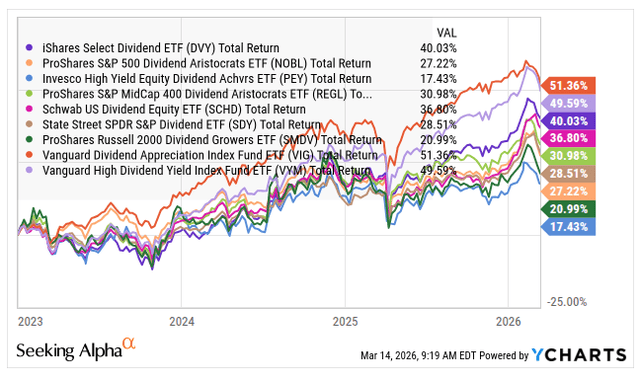
While SCHD is the best performer in 2026, it is in the middle of the pack since the end of 2022 with a total return of 36.8% compared to the S&P 500 total return of 80.2%. I really like the two bottom performing ETFs, Invesco High Yield Equity Dividend Achievers ETF (PEY) and ProShares Russell 2000 Dividend Growers ETF (SMDV), both of which are in my model portfolio (as well as in my wife's IRA).
I have written about both of these passive ETFs:
PEY Is Not As Bad As It Looks
SMDV: Why I Still Like It
I first wrote about SMDV in early November, and since then, it has returned 5.8%, while SCHD has rallied 16.3%. Today, I want to explain why SCHD is doing so well. First, it sure has attracted attention! The number of followers at Seeking Alpha has increased to 140K, up from 127K in late October. The size of the ETF, currently $83.7 billion, has increased by 20% since the article on SCHD, suggesting that the ETF, which is up 15% in price, has seen an increase in the number of shares.
SCHD, launched more than a decade ago, replicates the Dow Jones Dividend 100 Index. The index has some rules that it follows, including paying dividends for a minimum of 10 consecutive years, a market cap above $500 million and a certain minimum amount traded daily.
The ETF as of the end of February had a PE ratio of 20X, according to Schwab, with a Price to Book ratio of 3.7X. The ETF is down slightly in March. As of the end of 2025, it was very exposed to Energy:
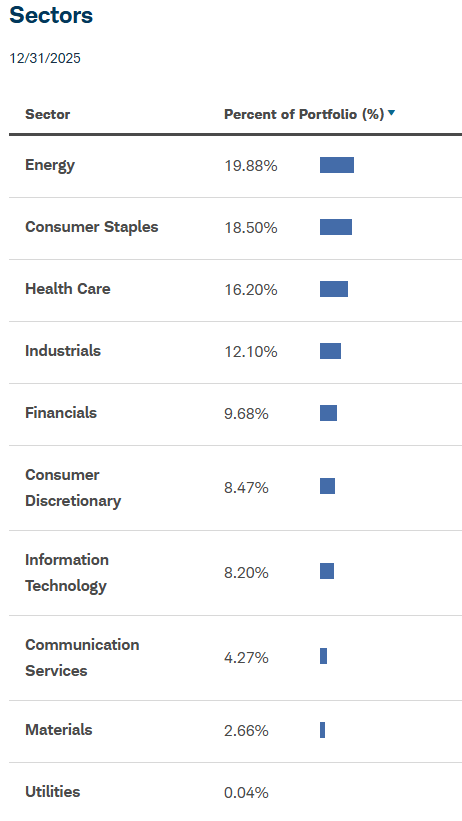
Notice the very low exposure to Information Technology (SPY had 34.4% at year-end). The Energy exposure was much higher than the 2.8% in the S&P 500. While these differences are not as extreme, SCHD was less exposed to Communication Services, Consumer Discretionary and Financials and more exposed to Consumer Staples, Health and Industrials. In 2026, what SCHD is overweight has done well, with Energy up 29.1%, Consumer Staples up 9.1%, Industrials up 6.1% and Health down 3.2% with the S&P 500 down 2.9%. What it owns less than the S&P 500 has done poorly, with Tech down 5.0%, Communication Services down 2.8%, Consumer Discretionary down 7.2% and Financials down 10.7%.
Here are the current Top 10 holdings:
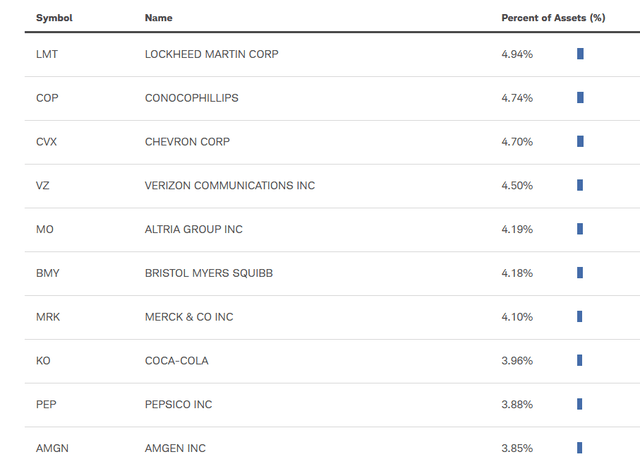
Notice that #2 and #3 are big Energy stocks that have soared in 2026, with Conoco Phillips (COP) up 31.2% and Chevron (CVX) ups 30.4%.
So, SCHD is outpacing the other dividend-focused index ETFs, but its index is different from the others. While the index does allow in small-caps, the weighted average market cap of SCHD as of 2/28 was $159 billion. Its sectors, dictated by the rules of the index, are very different from its peers. If you want to keep heavy in Energy, which has soared, and to be underweight Technology and some other sectors, stick with SCHD. I think that there are better ideas.
ETF Model Portfolio Update
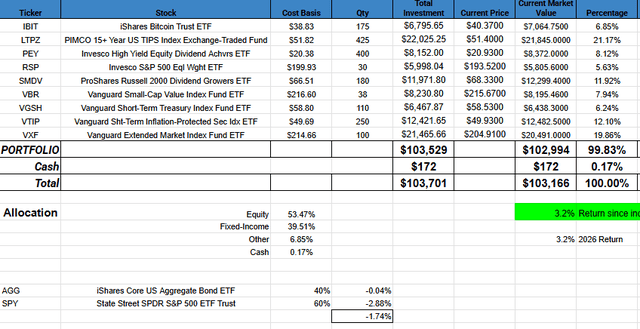
This ETF, which is measured against 60% SPY and 40% AGG, is up considerably relative to its benchmark. This week, I did two trades, all of which are published on my Seeking Alpha blog.
Going into the week, my equity exposure totaled just 49.7%, spread out across four ETFs. Here is what I did this week:
Wednesday: I extended TIPS exposure by reducing VTIP and increasing LTPZ, and I also reduced VGSH to boost SMDV.
Thursday: I returned VBR to the model portfolio, reducing VTIP and RSP.
Here is the current model portfolio, which now has 53.5% equity exposure in 5 ETFs and fixed income exposure in 3 ETFs that totals 39.5%. There is also 6.9% invested in an a 9th ETF that is considered "Other":
How Can I Help You?
I enjoy analyzing ETFs and stocks, and I like sharing my thinking in writing. I am working on starting a subscription service at Seeking Alpha. What things would you as an investor like to see offered?
If you are an investment professional, I would like to work with you as well. I can help educate financial consultants about the ETFs, and I can work with management at investment firms to help create model portfolios or potential ETF investments. Please let me know if your firm would be interested in this.
My ETF articles at Seeking Alpha, written under the alias The Intelligent ETF Investor, share a lot of my ideas.



Comments
Log in or sign up to join the conversation.