

Today's fuel prices are once again elevated for consumers as the latest result of a series of shocks in the underlying price of oil that have taken place since the 1973 Oil Crisis. How does today's average price of a gallon of gasoline at the pump compare to those earlier episodes?
To find out, we tapped the U.S. Energy Information Administration's data on the average retail price of a gallon of gasoline sold in the United States, which surprisingly only extends back to April 1993. That month marks when the EIA adopted its basic methodology for surveying retail gasoline prices across all the regions it monitors in the United States, which has been consistently collected and reported since.
We've taken that available nominal price data and presented it in the following chart from April 1993 through September 2026 as the red data series. We've also adjusted its price for the effects of inflation to be in terms of constant September 2026 U.S. dollars (blue). Here's the chart, which includes our annotations of the contributors to the major oil prices shocks that have taken place during this period:
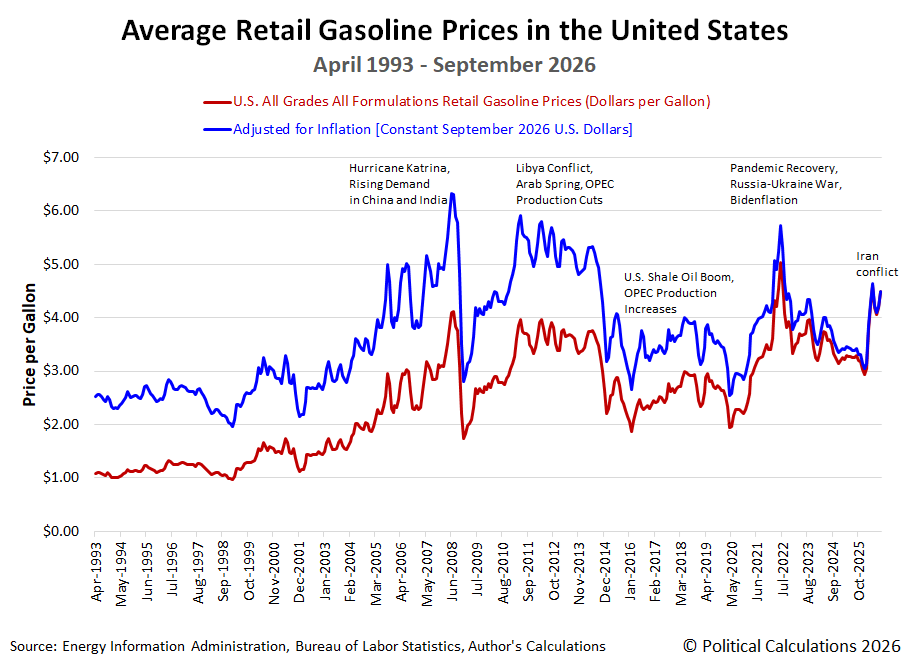
The current price shock ranks fourth out of the four major shocks covered in the chart after accounting for inflation. The period from 2005 to 2008 comes in first as the fuel prices rose after Hurricane Katrina and remained in short supply as China's and India's oil consumption grew sharply in this period until the onset of the 2008-09 Financial Crisis and Great Recession.
In second place, the escalation of prices resulting from the series of shocks diminishing the output of oil from Libya and from nations affected by the Arab Spring uprisings in the early 2010s, which lasted until the shale oil boom in the U.S. triggered OPEC to slash prices to try the stifle the new competetion.
Fuel prices at the pump then hit a low with the loss of demand in 2020's Coronavirus Pandemic, but quickly recovered in 2021 to the third-highest spike on the chart with the Biden administration's fiscal stimulus that also produced high inflation in the U.S. Combined with the geopolitical impact of Russia's February 2022 invasion of Ukraine, which reduced the supply of Russian produced oil because of economic sanctions, fuel prices went on to reach the third-highest peak in June 2022. Fuel prices then fell for several years as the Biden administration sought to undo the damage its policies created by draining the U.S. Strategic Petroleum Reserve.
The Iran conflict, which began on 28 February 2026, has resulted in the fourth highest spike on the chart.
Unlike the previous price spikes, the price of diesel fuel has risen relatively higher in the two most recent shock events because of diminished global refining capacity for producing diesel fuel in the period since the 2010s. The next chart shows how the average price per gallon for diesel in the U.S. has changed from April 1994 through September 2026, which covers the EIA's available data for this fuel.
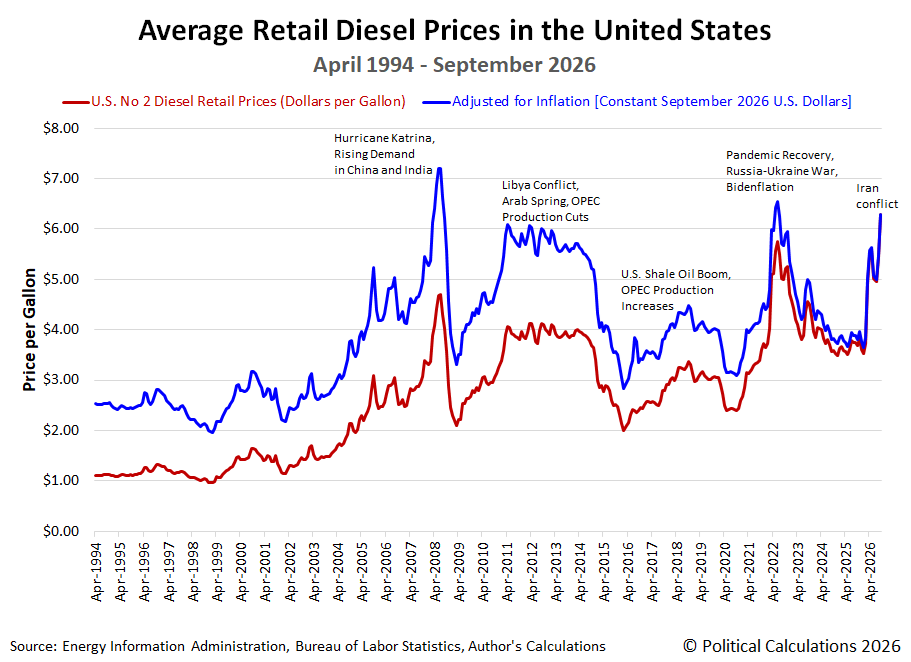
The latest price shock has been constrained in part by the U.S. supplying markets with oil from the Strategic Petroleum Reserve and by other nations' supplying oil from their strategic reserves.
The EIA's weekly price data for both gasoline and diesel points to a small decline in these prices during the first three weeks of October 2026.
References
U.S. Energy Information Administration. Petroleum & Other Liquids: U.S. All Grades All Formulations Retail Gasoline Prices (Dollars per Gallon), April 1993-September 2026. [Excel spreadsheet]. Accessed 25 October 2026.
U.S. Energy Information Administration. Petroleum & Other Liquids: U.S. No 2 Diesel Retail Prices (Dollars per Gallon), April 1994-September 2026. [Excel spreadsheet]. Accessed 25 October 2026.
U.S. Department of Labor. Bureau of Labor Statistics. Consumer Price Index, All Urban Consumers - (CPI-U), U.S. City Average, All Items, 1982-84=100[Online Database]. Accessed 25 October 2026. Data collection for October 2025 was omitted and is presented as the average of September and November 2025's index values.
Comments
Log in or sign up to join the conversation.