

For the first time since President Donald Trump announced his "Liberation Day" global tariff scheme on 2 April 2025, the combined value of goods exported from the U.S. to China and imported by the U.S. from China has exceeded its pre-tariff war level.
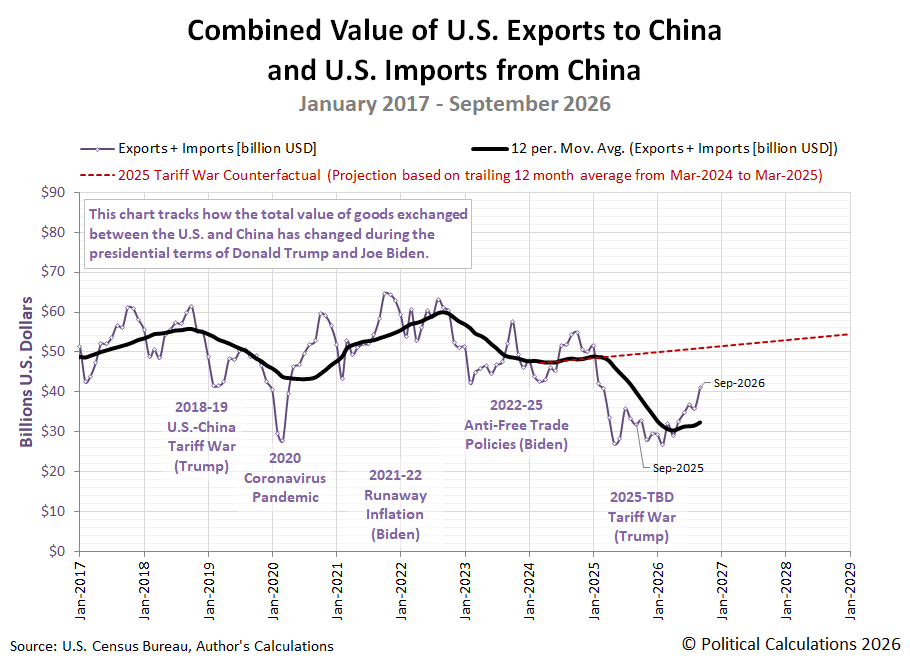
According to international trade data tracked by the U.S. Census Bureau, the total value of goods exchanged between the U.S. and China in September 2026 was $41.1 billion. That surpasses the nominal $40.8 billion figure recorded back in March 2025. It is important to recognize these are nominal data figures, with no adjustment for either inflation in the value of the specific goods being traded between the U.S. and China or seasonality in the data.
The following chart shows September 2026's combined trade value figure, which is 14.7% higher than what was recorded a year earlier, along with the trailing twelve month average for the combined US-China trade figures, which helps address the seasonality in the monthly data. The chart also presents a counterfactual projection for what trade between the U.S. and China would reasonably have looked like based on its pre-global tariff war trend.
Getting deeper into the import and export data, September 2026's trade data breaks down as follows:
U.S. Exports to China: $9.6 billion
U.S. Imports from China: $31.5 billion
Combined Value: $41.1 billion
Here's is the import and export value data from March 2025 (before the Liberation Day tariffs were announced):
U.S. Exports to China: $11.5 billion
U.S. Imports from China: $29.4 billion
Combined Value: $40.8 billion
The United States' trade deficit with China has increased since the Liberation Day tariff announcement. That's partly attributable to the difference in each nation's relative economic performance. China has experienced sluggish economic growth, characterized by weak domestic demand, which also lessens the economy's demand for imports. Economic growth in the U.S. during this period has been stronger, driven by the AI technology boom. That boom is responsible for much of the U.S.' increased imports from China, as U.S. domestic production of advanced information technology products is not able to support the increased demand by the economy's information technology sector.
At the same time, we estimate the combined value of trade between the U.S. and China is about 37% less than it would otherwise have been without the global tariff war between the U.S. and China. That estimate is based on the difference between the no-tariff war counterfactual and the trailing twelve month average of the value of goods exchanged between the U.S. and China.
What can we say? International trade is complicated.
References
U.S. Census Bureau. U.S. International Trade in Goods and Services (FT900). U.S. Trade in Goods with China, Not Seasonally Adjusted, Nominal Figures, Total Census Basis. [Online database]. Accessed 5 November 2026.

Comments
Log in or sign up to join the conversation.