

The outcome of the Trump-Xi meeting this weekend, if it takes place at all, could pave the way for either a trade deal or prolonged uncertainty, but we aren’t too optimistic. A lot of activity data and India's new budget are the other highlights of the week.

Trump-Xi trade talks – little hope
The word out of preparatory meetings by the US and Chinese trade representatives this week struck a positive chord about the Trump-Xi G20 meeting this weekend.
Amidst the uncertainty about if this meeting will take place at all, the advance rhetoric has been mixed, with talk about the dumping the tariffs on $300bn of Chinese goods followed by President Trump’s threat of even more tariffs. But China wants all tariffs to be removed before any further negotiations. This raises skepticism for any resolution of the trade dispute and prospects of an imminent trade deal between the US and China. Here is what our Greater China economist, Iris Pang, on what happens next.
Data-packed week – more weakness
Hopes rest on both the US and China coming to terms with the effects of the trade war on their respective economies. It's been more than a year since the trade war started, and recessionary fears are growing in the US, while the Chinese economy is already seeing a growth downturn. And the impact of all of this isn't just limited to China and there will be plenty of data to validate this next week.
China's manufacturing and service sector PMIs will reinforce the bipolar state of the economy – contracting manufacturing but a steady service sector. This de-coupling may not last for too long though, with services eventually following manufacturing into weakness. The PMIs from the rest of the region will reinforce the weak manufacturing trend.
Korea’s trade figures for June - the first trade numbers for the month from the region and probably the world, will be scrutinized for the trade war impact. The double whammy of the trade war and tech slump underpins the consensus of double-digit export contraction by over 13% year-on-year.
Moreover, the impact of the trade war isn’t limited to exports and manufacturing but is also now spreading out to domestic demand. The grim prospect ahead is that the trade war deters spending and drags inflation even lower. Consumer price inflation releases from Korea, Taiwan, Indonesia, the Philippines, and Thailand, as well as Hong Kong’s retail sales data, will be worth watching.
India's new budget – no restraint
India’s new finance minister, Nirmala Sitharaman, unveils her maiden budget on 5 July, but news of five-year GDP growth touching new lows (5.8% in 4Q FY19 ended in March), which happened despite the surge in election-related spending was a poor start for the Modi government’s second term - and the trade war with the US clouds prospects further.
More fiscal stimulus is probably on the way, with talk of hikes in income tax exemption limits, boosts to the housing sector, as well as recapitalization of public sector banks. While the budget deficit is likely to remain at 3.4% of GDP as planned in the pre-election interim budget, sticking to this target will be challenging as weak growth slows revenues and fiscal stimulus swells spending.
A rally in Indian government bonds since the start of May finally ended this week. Although this could be partly due to the escalation of US-Iran tensions pressuring oil higher, we think the market is considering the likely lack of future fiscal restraint, resulting in a greater supply overhang in the future.
Asia Economic Calendar
(Click on image to enlarge)
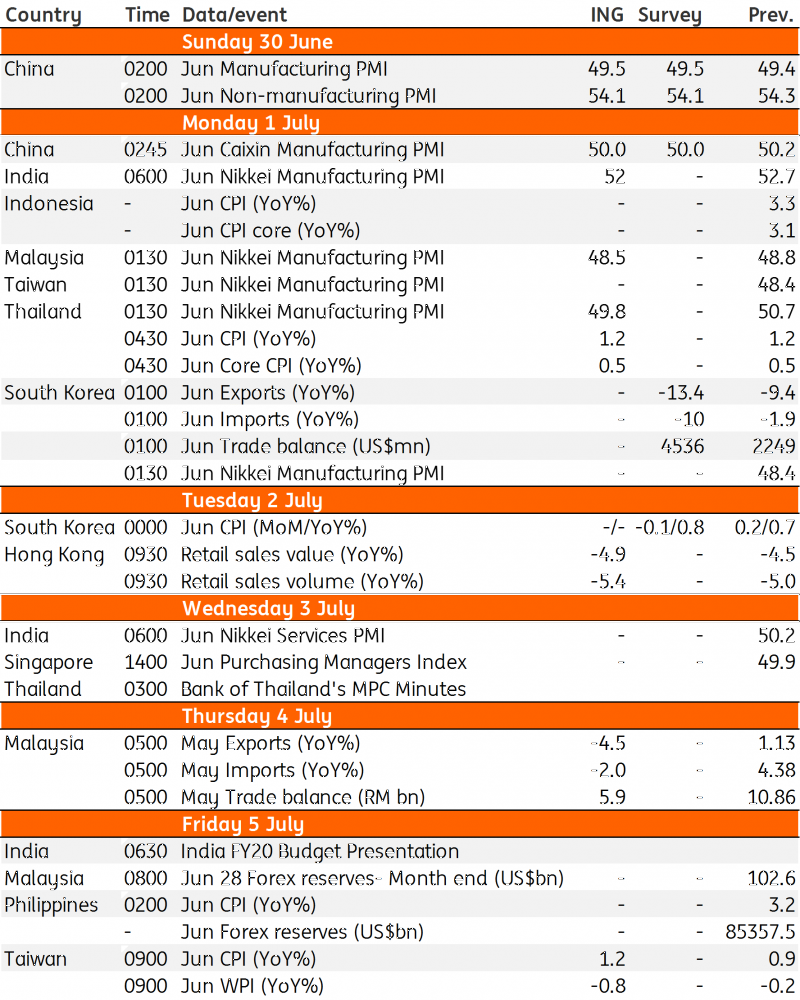
Source: ING, Bloomberg, *GMT



Comments
Log in or sign up to join the conversation.