


More RBI easing in the pipeline
The Reserve Bank of India (RBI) will deliberate monetary policy at a meeting next week with a decision scheduled for Friday, 4 October. There is no fresh consensus on this event available as of this writing. The last one by Bloomberg in late August, a bit stale in view of a raft of stimulus announcements over the past month, suggests no change to the RBI policy rate.
The previous move in early August was a bigger-than-usual 35 basis point cut to the key policy rate, putting it well ahead of Asian peers in the current easing cycle -- a total of 110bps of rate cuts this year. The economic news since the August meeting has not been good. The report of a continued slump in GDP growth had the government firing up stimulus on all cylinders. We don’t think the RBI is done with easing either, especially with Governor Shaktikanta Das recently hinting at more easing, which leaves little doubt about the RBI slashing rates again next week. The key question is whether it will be yet another bigger-than-usual cut? We have penciled in a conventional 25bps move taking the repo rate down to 5.15%, though we won’t be surprised if the RBI sets it straight down to the 5% handle. A bad policy backdrop for the Indian rupee continues.
Too close to call RBA policy decision
Another policy event next week is the Reserve Bank of Australia (RBA) meeting. The consensus is divided between a 25bps rate cut and an on-hold policy outcome. We are in the on-hold camp.
Although Australia’s year-on-year GDP growth slowed for the fifth consecutive quarter to 1.4% in 2Q19, it doesn’t really qualify for weakness when the quarterly growth rate is still holding steady, at 0.5% in the last quarter. And it’s not GDP growth alone, but inflation that also drives the RBA's monetary policy. Inflation gained some traction recently on the back of firmer jobs and wages growth. Even so, a rise in the unemployment rate to a one-year high of 5.3% in August from 5.2% in July looks to have swayed some forecasters towards a rate cut next week, making this event too close to call.
China out, data-packed calendar elsewhere
Chinese markets will be shut most of next week for celebrations to mark the 70th anniversary of the founding of the People's Republic of China. This may bring some respite from the usual market volatility though speculation about the US-China trade war could gain traction as trade talks are set to resume in October. Meanwhile, China’s September purchasing manager index (PMI) for manufacturing and services will inform on the state of the economy as the current quarter draws to close.
The usual start-of-the-month trade, PMIs, and inflation releases crowd the calendar elsewhere. With the trade war still the running theme for markets all attention will be on export figures. Korea’s trade data for September, the first for the month in the region, is a good guide for the rest of Asia's exports. Korean data for the first 20 days of this month showing a 21.8% export fall from a year ago has prepared us for the worst. The same is true for manufacturing, while inflation continues to be a non-issue in much of the region.
Price data from Indonesia and the Philippines will be an interesting watch as the favorable base effect is fading as a driver of falling inflation in both countries, which also means the central bank easing cycle here is nearing its end.
Asia Economic Calendar
(Click on image to enlarge)
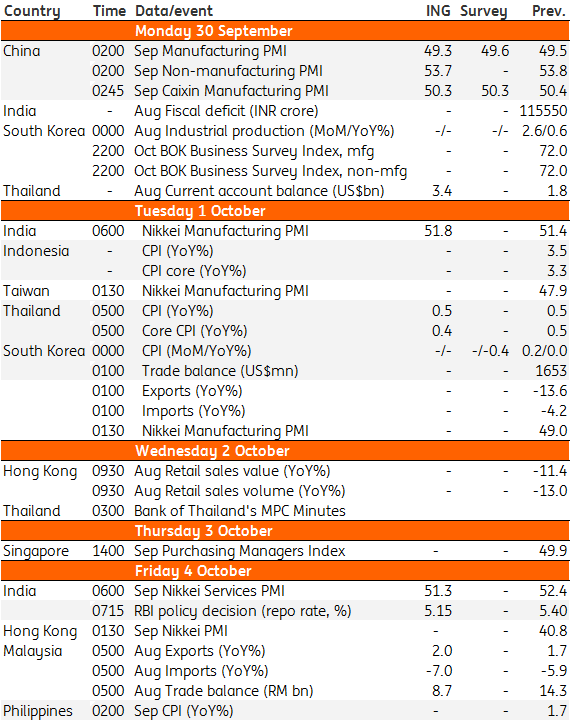
Source: ING, Bloomberg, *GMT



Comments
Log in or sign up to join the conversation.