

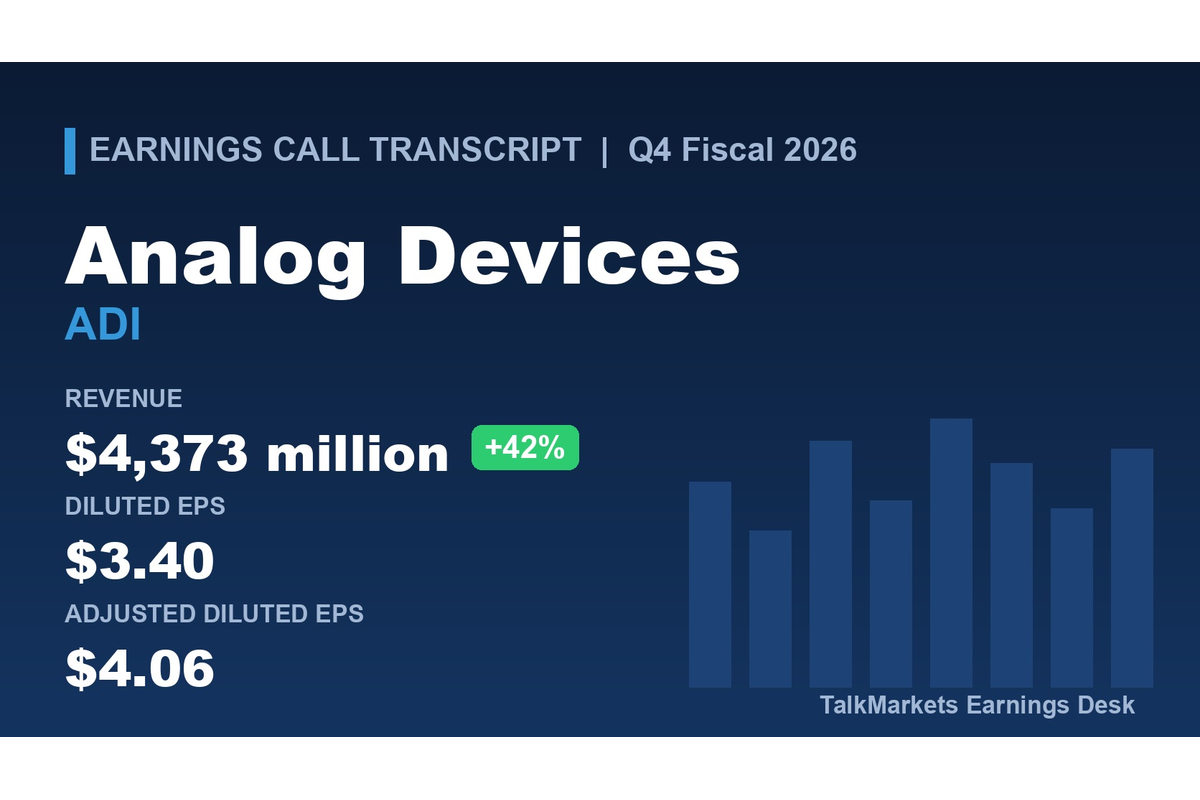
Analog Devices' fiscal Q4 2026 revenue rose 42% to $4.37 billion, led by Data Center and Industrial. Diluted EPS rose to $3.40 from $1.60, adjusted EPS to $4.06 from $2.26, and it declared a $1.10 dividend.
Ticker: ADI
Analog Devices, Inc. (ADI) reported results on 24 November 2026 for the fourth quarter of fiscal 2026, the three months ended 31 October 2026. The semiconductor company posted record fiscal year results, with sharply higher revenue, margins and earnings in the quarter. The company said AI infrastructure investment drove growth in its data center and automatic test equipment businesses.
The key numbers (three months ended 31 October 2026)
Metric | This year | Last year | Change |
|---|---|---|---|
Revenue | $4,373 million | $3,076 million | +42% |
Gross margin | $3,033 million | $1,942 million | |
Operating income | $1,869 million | $945 million | |
Diluted EPS | $3.40 | $1.60 | |
Adjusted operating income | $2,287 million | $1,338 million | |
Adjusted diluted EPS | $4.06 | $2.26 |
Gross margin percentage rose 620 basis points and operating margin rose 1,200 basis points. Adjusted operating margin rose 880 basis points. Operating cash flow was $2,341 million and free cash flow was $2,001 million, or 46% of revenue.
Revenue by end market
Industrial: 50% of revenue, up 55%.
Automotive: 24% of revenue, up 21%.
Communications: 16% of revenue, up 81%.
Consumer: 10% of revenue, up 7%.
Dividend and buybacks
ADI returned $1,410 million to shareholders in the quarter, through dividends of $532 million and stock repurchases of $878 million. The Board declared a quarterly cash dividend of $1.10 per share, payable on 21 December 2026 to shareholders of record on 7 December 2026.
CEO and Chair Vincent Roche said: "While AI infrastructure investments are driving tremendous growth across our data center and ATE businesses, more than two-thirds of our growth in fiscal 2026 came from non-AI-centric market opportunities."
Full year
For fiscal 2026, revenue rose 38% to $15,179 million from $11,020 million. Operating income was $5,858 million against $2,932 million, diluted EPS was $10.21 against $4.56 and adjusted diluted EPS was $13.05 against $7.79. Free cash flow was $5,453 million, and ADI returned $5,413 million to shareholders.
Source: SEC Form 8-K Exhibit 99.1
Full call transcript
Operator:
Good morning, and welcome to the Analog Devices fourth quarter fiscal year 2026 earnings conference call, which is being audio webcast via telephone and over the web. I'd now like to introduce your host for today's call, Mr. Jeff Ambrosi, head of investor relations. Sir, the floor is yours.
Jeff Ambrosi (Head of Investor Relations):
Thank you, Danny. Good morning, everybody. Thank you for joining our fourth quarter fiscal 2026 conference call. Joining me today is ADI CEO and Chair, Vincent Roche, and ADI CFO, Richard Puccio. Before we begin, I'd like to highlight an upcoming change to how we present revenue by end market.
Beginning in the first quarter of fiscal 2027, data center will be reported as a standalone end market, and our revenue from our wireless business will be reported within industrial, which also includes revenue from aerospace and defense, automation, test and measurement, health care, and energy applications. Automotive and consumer will be unchanged. This change only affects how we present revenue by end market and does not change our segment reporting for total reported revenue.
In connection with our first quarter fiscal 2027 results in February, we will publish three years of recast quarterly revenue by end market on our investor relations website. Now, for anyone who missed earnings release, you can find it at investor.analog.com, along with related financial schedules. The information we're about to discuss includes forward-looking statements, which are subject to certain risks and uncertainties as further described in earnings release, periodic reports, and other materials filed with the SEC.
Actual results could differ materially from the forward-looking information as these statements reflect our expectations only as of the date of this call. We undertake no obligation to update these statements, except as required by law. References to gross margin, operating and non-operating expenses, operating margin, tax rate, earnings per share, and free cash flow in our comments today will be on a non-GAAP basis, which excludes special items. When comparing our results to our historical performance, special items are also excluded from prior periods.
Reconciliation of these non-GAAP measures to their most directly comparable GAAP measures and additional information about our non-GAAP measures are included in today's earnings release. References to earnings per share are on a fully diluted basis. And with that, I will turn the call over to ADI CEO and Chair Vincent Roche.
Vincent Roche (CEO and Chair):
Thank you, Jeff, and a very good morning to each and every one of you. Capping off a record year for ADI, four-quarter revenue, margin, and earnings all came in above the midpoint of our guidance. For the full year, our revenue increased nearly 40% to more than $15 billion, with robust double-digit growth across all of our end markets. AI infrastructure-driven investments drove significant growth for both our ATE and data center businesses.
That said, more than two-thirds of our total growth was driven by non-AI-centric markets, highlighting the diversity of our customer base and our ability to capitalize on numerous secular tailwinds, as well as the broader cyclical recovery. Our fiscal '26 top-line growth was paired with significant margin expansion, which enabled us to deliver record-free cash flow of $5.5 billion. We attribute these results to the optionality and resiliency of our business model, long-term commitment to innovation and customer success, and strong operational execution right across the company.
And as our customers tackle ever more difficult challenges at the boundary between the physical and digital worlds, we believe we're well-positioned to deliver and capture even greater value in the future. As we've long said, R&D is our first call on capital because innovation is the wellspring of ADI's value creation. Our R&D investments in fiscal '26 were the largest in our history, spanning analog, digital software, and AI. We also continued ramping investments to enhance our customers' end-to-end experience of ADI, from ideation to realization.
And on the M&A side, our acquisition of Alif added AI-native microcontrollers and fusion processors to our AI toolbox. In addition, our acquisition of Empower strengthens our ability to grow the core power market, which we view as one of the largest SAM opportunities within AI infrastructure. Taken together, these investments significantly expanded our ability to solve increasingly complex challenges for our customers, delivering more complete solutions, combining cutting-edge sensing, signal processing, connectivity, and power.
We credit this overall investment strategy for our record design and pipeline growth of 40% this past year, eclipsing our FY '25 record with contributions across all end markets and regions. Our robust customer pipeline is more than a leading indicator of future revenue, however. We believe it reflects the growing criticality of our solutions in the AI era, as rapid technological evolution creates ever more complex challenges across numerous and different markets.
Customers are increasingly turning to ADI's higher-value offerings to help lower their total cost of ownership, accelerate their time-to-market, and, of course, enhance system performance. Our differentiated values reflected in ADI's average selling prices, which are more than 4x the industry average, and the ASPs of our newer products are notably higher, reflecting the increasing value of our solutions that we're delivering to our customers.
I'd like to spend the remainder of my planned remarks sharing how we are translating innovation into growth for ADI across the various market sectors, beginning with our industrial business, which comprises test and measurement automation, aerospace and defence, healthcare, and energy. Starting first, test and measurement. We're benefiting from the intensely demanding test requirements of modern AI compute, memory, networking and power systems, where complexity is increasing at an extraordinary rate. This plays directly to ADI's leadership and high-performance signal intelligence that transforms raw physics into insight and response.
The greater accuracy, bandwidth and measurement precision enabled by our technology helps customers test next-generation devices more rapidly, more efficiently, and with greater confidence. This resulted in record ATE and ETM revenue this year, and record design-ins that we believe position us for continued growth through fiscal '27 and beyond. In industrial automation, customers continue to digitalise, automate and deploy robots across semiconductor fabs, biopharma, data centres, and other manufacturing environments to accelerate productivity and address evolving geopolitical and labour dynamics.
As a result, our automation revenue and design-ins across industrial control, connectivity and robotic segments accelerated significantly in fiscal '26, with the fastest growth coming from robotics. We expect the next evolution of robotics from automation to autonomy will unlock tasks that historically required human intervention and create opportunity for higher-value ADI content and subsystems that can reduce latency and increase system accuracy. Autonomous robotic modalities, including humanoids, which can require up to 10x more ADI content compared to traditional robots, will steadily increase our opportunity over time.
In aerospace and defence, systems are evolving rapidly to sense threats earlier, communicate securely in contested environments, and make mission-critical decisions much, much faster. These requirements are driving increasingly complex radar, communications, and autonomous machines, where ADI's ability to combine RF, signal processing, IMUs, and power management into higher-value solutions is differentiated. In this sector, we almost doubled growth in our design pipeline this past year across both established and emerging defence customers, which we believe positions us for continued growth in '27 and beyond.
In healthcare, our revenue growth accelerated in '26 as innovation across the industry increasingly converged around continuous glucose monitoring, AI-assisted imaging, and surgical robotics. Our precision sensing, signal processing, algorithms, and ultra-low-power technologies are helping customers to deliver innovative solutions designed to better manage chronic disease, help clinicians detect and diagnose conditions earlier, and make complex procedures more precise and less invasive. Our growing design and pipeline across myriad applications there positions ADI for continued growth in '27 and reinforces the potential of our longer-term opportunity.
In energy, rapidly rising electricity demand is magnifying one of the world's most fundamental engineering challenges, how to generate, manage, store, and deliver significantly more power while improving efficiency and reliability, and ADI sits at several key points across that system. For example, our precision sensing enables greater visibility and control of the grid, while our battery management technologies enable more efficient storage and local distribution. Energy was one of our strongest areas of pipeline growth through fiscal '26, reinforcing our long-term outlook for this business.
Turning now to automotive, we delivered a second consecutive year of record revenue, despite lower vehicle production, due to our strong and expanding position in next-generation ADAS and infotainment systems. As vehicles move toward greater autonomy, they must process dramatically more sensor information, move more data, and reliably power many interconnected subsystems, all the while meeting demanding requirements for signal integrity, energy efficiency, and safety. These challenges play to ADI strengths in high-speed connectivity and power solutions designed to support functional safety requirements.
L2+ autonomous driving systems remain relatively early in their global adoption, and as the industry progresses toward higher levels of autonomy, we expect content opportunities for ADI to continue to increase. In the past year, design and growth across our GMSL, A to B, and functionally safe power solutions underscores our substantial role in enabling the vehicle of tomorrow. In addition, we saw a strong increase in designs for battery management solutions, which we expect to grow in the coming year and beyond as EV adoption increases.
Not surprisingly, our data center business was our fastest growing market in fiscal '26, both from a revenue and design and perspective. Robust investments in AI infrastructure are creating enormous challenges, around two of the physical bottlenecks to scaling AI, moving exponentially more data and efficiently delivering unprecedented power loads, and ADI is well positioned to address both. In the networking domain, our optical control technology keeps electro-optical systems precisely tuned across everything from pluggables to OCS so that every packet of light is accurate, stable, and efficient.
And as you know, data center power has become one of the most significant constraints to AI advancement, as increasing rack and processor densities are fundamentally changing how power is converted, controlled, protected, and delivered. And customers are choosing ADI to help ensure that every watt used in the data center is available for computation and maximum impact. And as the resulting thermodynamic challenges grow with increasing power density, liquid cooling is shifting from an option to a requirement.
Customers are turning to ADI to translate physical signals, such as temperature, flow, leakage, and coolant health into actionable intelligence, which is creating a new differentiated content opportunity. So overall, we believe our data center revenues will continue to be one of the faster growing businesses in '27 and beyond.
Finally, continued demand at the premium end of the consumer market overcame memory headwinds to drive double digit growth in revenue and design activity across premium handsets, wearables, hearables, and gaming segments, which positions ADI for continued diversified growth in this sector in '27 and beyond. So in closing, FY26 demonstrated what makes ADI different. We are built to define and capture new waves of opportunity as we compound the businesses underpinning our resilience through cycles.
We leverage a six decade culture of curiosity and cutting edge innovation to continuously advance the state of the art at the electrophysical interface, a boundary that is increasingly central to the advance of technology's most valuable applications. And our customers increasingly choose ADI as a strategic partner for applications, domain expertise, scope of high performance analog software and AI capabilities, and differentiated hybrid manufacturing strategy.
And as we enter '27, we continue to invest with discipline to further enhance and extend the value we can deliver to our customers and shareholders alike in the years ahead. And with that, I'll turn it over to Rich.
Richard Puccio (CFO):
Thank you, Vince, and let me add my welcome to our fourth quarter earnings call. I'll start with a brief overview of our full year fiscal '26 financial performance. Revenue for the year came in at 15.2 billion, up 38% from fiscal 2025, reflecting broad base strength across the business. Gross margin finished at 72.9% up 360 basis points, driven by mix utilization and higher revenue. Operating margin finished at 49.5% up 760 basis points, reflecting gross margin fall through and strong operating leverage.
Earnings for share increased 68% to $13.05. Turning to the fourth quarter, revenue came in toward the high end of our outlook at 4.37 billion, growing 9% sequentially and 42% year over year. Industrial represented 50% of our fourth quarter revenue, finishing up 11% sequentially and 55% year over year. Ongoing cyclical momentum, along with secular demand in the AI infrastructure and defense markets, resulted in broad base growth, including record results in aerospace and defense, ATE, and electronic test and measurement.
For the full year, industrial grew 51%, reflecting the depth and breadth of our business with all of our industrial sectors seeing accelerating double digit growth. Aerospace and defense, ATE, and electronic test and measurement reached new highs for the year. Automotive represented 24% of quarterly revenue, finishing up 5% sequentially and 21% year over year. We saw continued growth for our leading connectivity, audio processing, and power solutions, as well as a notable pickup in demand for our battery management systems.
For the full year, automotive increased by 12%, driven by continued content and share gains in next generation ADAS and infotainment systems, despite the backdrop of lower vehicle sales. Additionally, BMS revenue returned to full year growth after two years of decline. Communications represented 16% of quarterly revenue, finishing up 8% sequentially and 81% year over year. The data center business now represents 83% of comms or 13% of total sales, growing more than 100% year on year for the second consecutive quarter, fueled by AI driven demand.
Wireless revenue was up double digits year over year for the fifth straight quarter. For the full year, communications increased 74% and was our fastest growing market for a second consecutive year, reflecting our growing presence in AI infrastructure and a cyclical recovery in wireless. Consumer represented 10% of quarterly revenue, finishing up 7% sequentially and year over year, remaining resilient in the face of memory related headwinds.
For the full year, consumer increased 15% with all applications growing double digits, driven by our exposure to high end handsets, secularly growing wearables and hearables, and a notable acceleration in our prosumer business. Now on to the rest of the P&L. Fourth quarter gross margin was 74.5% up 200 basis points sequentially and 470 basis points year over year, driven predominantly by favorable mix and higher revenue.
OpEx in the quarter was 972 million, resulting in an operating margin of 52.3% up 230 basis points sequentially and 880 basis points year over year. Non operating expenses finished at 37 million, lower than expected due to market to market gains from strategic balance sheet investments. The tax rate for the quarter was 12.3%. EPS was $4.06, up 18% sequentially and 80% year over year. Now I'd like to highlight a few items from our balance sheet and cash flow statements.
Cash and short term investments finished the quarter at 5.2 billion, and our net leverage ratio decreased slightly to 0.8. For land, we built strategic die bank and finished goods buffers throughout the quarter. Inventory increased $152 million sequentially with days of inventory increasing to 165. Channel inventory also increased as we are now back within our six to seven week model.
The investments we have made in inventory over the past two years have helped drive sustained above seasonal growth and mitigate lead time expansion, especially for certain products where demand is exceeding supply. Fiscal 26 operating cash flow was 6.2 billion and CAPEX was 0.7 billion, resulting in free cash flow of 5.5 billion or 36% of revenue. Over the same period, we returned $5.4 billion to shareholders via dividends and share repurchase in line with our commitment to return 100% of free cash flow over the long term.
Now moving on to our first quarter 2027 outlook. Revenue is expected to be 4.4 billion plus or minus 150 million. Operating margin at the midpoint is expected to be 50.5% plus or minus 100 basis points. Non-operating expense is expected to be roughly 90 million. Our tax rate is expected to be 12% to 14% and based on these inputs, adjusted EPS is expected to be $3.82 plus or minus 20 cents.
Turning to capital investment, we have executed well against our manufacturing expansion plans laid out at our investor day in 2022, building the capacity to support the high end of our 7 to 10% long term growth model. We are also well positioned from a capacity standpoint to support sustained above seasonal growth through fiscal 2027. Looking past 2027, while considering our momentum and the strong pipeline execution Vince referenced earlier, our confidence in future growth has risen.
In order to capitalize on our potential, we are expanding our capacity further and currently expect fiscal 2027 CAPEX to be approximately $1.6 to $1.9 billion. Even with this higher investment, we expect fiscal 2027 free cash flow to increase meaningfully and our commitment to return 100% of free cash flow over the long term is unchanged. In closing, fiscal 2026 caps one of the strongest growth years in ADI's history. We achieved record revenue, profitability and earnings per share while generating more than $5 billion of free cash flow.
We achieved these results while continuing to invest in the businesses and the innovation that we believe will fuel our future success. As we look ahead, we believe we are well positioned to build on this momentum, supported by the strength of our business model and our track record of disciplined operational execution. With that, I'll give it back to Jeff for Q&A.
Jeff Ambrosi (Head of Investor Relations):
Thank you, Rich. Now let's get to our Q&A session. We ask that you limit yourself to one question in order to allow for additional participants on the call this morning. If you have a follow up, please recue and we'll take your question if time allows. With that, operator, can we have our first question, please?
Operator:
For those participating by telephone dial in, if you have a question, please press star 11 on your phone to enter the queue. If your question has been answered and you wish to be removed from the queue, please press star 11 again. If you're listening on a speaker phone, please pick up the handset when asking your question. In the interest of time, we ask that you please limit yourself to one question. We'll pause for just a moment to compile the Q&A roster.
Our first question comes from Tori Sponberg with Stifel. Your line is open.
Analyst (Stifel):
Yes, thank you, and congratulations on the strong results. So, you know, there's a lot of sort of macro issues and concerns out there. You know, you sound very confident. You know, Rich just talked about, you know, increasing CAPEX next year. I think he also said you expect to grow above seasonal, you know, throughout fiscal 27. So help us, you know, sort of level set what's going on here, you know, between some of the perhaps noise at the macro level and what you're seeing.
Because it does feel like, you know, you're actually seeing continuous growth above your long term target, you know, certainly fiscal 27, maybe even 28 as well.
Company Executive:
Thanks, Tori. So, yeah, I think, you know, at a high level, the opportunity that ADI is addressing has been growing in leaps and bounds. As you know, we address many, many different applications. Our span is very, very strong actually across all the regions of the world. We've got, I would say, at this point in time, a broader set of some very significant secular drivers. And we're not dependent on just a very concentrated infrastructure data center build out.
So, you know, generally as well, if I look at the ASP structures of the company right now, you know, they reflect our ability to generate value beyond what our competitors can do and capture that value. But also, if I look at the new products in our pipeline, the products that we're bringing to market now, some of these products have very, very significant multiples over the older generation products.
So I think in terms of the intersection of many markets in which we have increasing strength, our ability to support the old legacy products with increasing ASPs, newer products with much higher ASPs. And what we pay a lot of attention to, Tori, is the pipeline. I mean, what did the order books tell us? Well, the order books tell us right now that POS bookings are significantly higher than POS billings.
And our customer wins in terms of our design and pipeline right across all the sectors, and I mentioned many of them in the earnings script here, at a record level. In fact, our 26 pipeline has compounded significantly beyond an already strong 25 pipeline, which grew significantly beyond 24. So you put all those things together. You know, I see, for example, also in the world of AI, we're at the beginning of the build out of a very, very significant meta technology that will change all other technologies.
So we'll continue to unpack that story for you as time progresses. But I'd say in the, you know, we've got a lot of idiosyncratic, secular tailwinds and cyclical, particularly in the industrial market.
Analyst (Stifel):
Thank you.
Company Executive:
Thank you, Tori. Just to clarify, Rich's comment on, it was a capacity statement on being able to support above seasonal growth. It wasn't guidance for the year for fiscal 27. We'll take our next caller, please.
Operator:
Thank you. Our next question comes from Vivek Auria with Bank of America Securities. Your line is open.
Analyst (Bank of America Securities):
Thanks for taking my question. Actually, both related to just the near term outlook. So you're guiding the current quarter sort of flattish. It seems a little conservative relative, I think, you know, wins to several quarters of above seasonal growth. So I'm just curious, you know, what you call this kind of seasonal below seasonal, just what you're seeing from a sequential segment perspective. And then one for kind of related for rich on operating margins. I think you're guiding down 200 basis points almost sequentially.
Just what are the puts and takes of gross margin and Opex and and is there, you know, some indication there of how we should think about those metrics running into 2027. That would be incredibly helpful. Thank you.
Company Executive:
You're rich.
Richard Puccio (CFO):
Thanks, Vivek. I'll start with your first question around the seasonality. But first, just as a backdrop, you know, the upside to our Q4 midpoint was, you know, driven heavily by the industrial and automotive. You know, while comms was a little bit weaker driven by some sequential softness in the wireless piece data center, however, was as expected and was up double digits sequentially and consumer was as expected.
Now, if we if we look out at the Q1 market outlook, we are, as we've guided, we're expecting it to grow modestly quarter over quarter, which actually is well above our Q1 seasonality. Typically, our Q1 would be down mid single digits. So I do think that we are we are guiding a strong above seasonal first quarter. And, you know, from an end market perspective, you know, we expect communications to be up mid single digits, obviously being led by the data center growth.
Industrial expected to be up low mid single digits. Auto expected to be down low single digits and consumer down 10 to 15 percent. The other thing I would tell you is we would we would expect the channel inventory to stay flattish with weeks likely to fall. So that's that's how I feel about our our guide from a revenue perspective, you know, on the on the gross margin side. Obviously, we came in better than expected driven by higher revenue and favorable mix.
But as I mentioned, I think I talked about this in last quarter's call. We shut down our fabs around the holidays with holidays, excuse me, which we will do again this year. And as a result, we see gross margin and Q1 moderating down to approximately 74 percent. If we flip forward as we work our way down to the margin piece, you know, you know, obviously we delivered a significant amount of leverage in fiscal 2026.
Before operating margin was about 30 bits above midpoint of our guidance, almost entirely driven by gross margin favorability as expenses were a bit higher than planned driven by sales commissions. And we're also leaning in as we've talked about into AI and driving a little bit higher token and cloud costs in that period. When we look at Q1 we are anticipating OpEx to grow in the mid single digits sequentially driven by our continued growth in our investments.
And we will also have a full year, full year, sorry, a full quarter of all of in our expenses, which obviously puts them upward pressure on the expense. However, and I think this is an important point for the year, we continue to target OpEx growth at roughly half of the rate of revenue growth and we do see continued operating leverage for the full year.
Company Executive:
Thank you, Vivek. Take our next caller, please.
Operator:
Thank you. Our next question comes from Jim Schneider with Goldman Sachs. Your line is open.
Analyst (Goldman Sachs):
Good morning. Thanks for taking my question. With respect to the OpEx investments you're making to expand capacity, can you maybe give us a sense, one of those investments have been made this year, what revenue level you can support with the new capacity, and then maybe separately speak to any kind of constraints or bottlenecks you're seeing on the foundry side for those that sort of made external ABI. Thank you.
Company Executive:
Thanks, Jim. So, first, a couple of starter points. The billion dollar step up essentially that I talked about in 27 verse 26. One important point is a lot of a chunk of that will be eligible for meaningful tax credits under the chips act. So we will get some offsets in our depreciation going forward and also get some offset in the amount of cash flow net that goes out the door. The way to think about the investment we're making.
Big piece of it is going to go towards clean room expansion at our European and US sites. These are places where we already have available space within existing fabs. And we're also investing in backend tests and assembly capacity. I do expect capex for these projects will decline as we move into 28. And that will put us back down into our long term capex model of, of 4 to 6% of revenue.
And I do expect that we'll start to see some of the new capacity come online in stages, starting as early as for us q 128, which gives us significantly more supply for our highest demand nodes and products. Obviously really important positioning us for sustained future growth. And I would say from a constraints perspective. Frankly, I think it's tight everywhere. It's tight in internal fabs backend OSAT foundry.
Right now it's an industry right wide dynamic, I wouldn't say for us we're working really hard to sort of D bottleneck and unlock incremental supply everywhere we can. I think I've talked in prior quarters that essentially on a weekly basis we're adding incremental capability and capacity as tools are coming online for purchases we started making, you know, upwards of nine months ago, just to give, just to give some perspective on how long the team has been working on building up supply.
And obviously we've been out of that to demonstrate what we've been doing there with our ability to supply, you know, above seasonal demand throughout this past year, and we expect we can continue to do the same into 2027. Yeah, just a couple of additional pieces of color I think, certainly over the past six months or so, I would say, packaging assembly has been the primary choke point.
Solving that problem obviously is much easier than solving, you know, a fab problem just in terms of the timescales it takes to bring equipment into the manufacturing process but we see that improving with each passing month. The other thing I just want to talk about to add a little color to what Richard said about capex. We've always been very disciplined and how we spend our capex. We have, obviously, many, many times we've talked about our hybrid manufacturing model.
So, most of the silicon we procure is from external partners that will remain the case in the years ahead. But we're adding capacity on very, very specific processes inside the company, where we need to build more resiliency extend our footprint for a core many, many of our core markets. And, you know, those of you who know us for a long time, know that our behavior is to invest in stages in line with demand. So that's what I think you can expect in the years ahead.
And what I believe is, is a growth inflection for the industry and for ADI. Thank you, Jim. We'll take our next question please.
Operator:
Thank you. Our next question comes from Harlan Sir with JPMorgan. Your line is open.
Analyst (JPMorgan):
Good morning. Thanks for taking my question. Give us a great summary of the industrial segment drivers going forward. And I know the team has always talked about the potential for more incremental goes margin upside as your higher margin broad market industrial business drives back to sort of historical consumption levels. You seem to recall that last quarter, but market industrial was still sort of double digits percentage below historical consumption level. So, where are your broad market shipments currently trending as the cyclical dynamics of continue to improve.
And as that continues to move higher, can that drive another let's say 100 basis points plus of gross margin upside from a 74% level over the next few quarters.
Company Executive:
I'll take that one and then I'll add some color as necessary. Sure. So, I'm going to try to unpack that a little bit Harlan first talking about this notion of where we are relative to consumption. And I think it is, you know, and obviously this consumption we're talking about as the sort of longer term growth trend line. And clearly if you look at our overall numbers, you know, revenue finished well above that trend line. For 26 having after having been well under in 24 and 25.
And I'll break it down because I do think this is important as we think about where we are in the cycle. Thriving the above consumption trend line in 26 was our aerospace and defense business, our AT business and our data center businesses, which are continuing to achieve significant new highs with continued momentum, right. That's about 30% of our revenue, and we believe the strength in these markets are driven by better and demand, not inventory restocking.
As for the rest of our businesses, we believe we are shipping either to or below consumption today. So if you, you know, essentially outside of those that 30% chunk of our business, we are still below the long term trend line. So overall, we feel good about where we are from a shipment level relative to trend. The other thing is we don't see any evidence yet of any material restocking across our customer portfolio.
Yeah, so I think your assertion Harlan that, you know, with the continued improvement in kind of the broad fragmented market, we will see margin improvement. I can't give you a number, but we know that will be directionally true. Yeah. And, and, and following on to that, you know, you, you, you can see in our, in our numbers, you know, we've, we finished with a, you know, a 50% of our business in industrial and I've been talking about this track for a while.
Every percentage point we grow industrial as a share gives us some opportunity for some gross margin appreciation. Because as a reminder, we've talked about this now for a couple quarters, given where we're running and the supply constraints that we've talked about utilization is not going to be a driver for us over the near to medium term for improved gross margin. It'll continue to be revenue acceleration and mix and mix within the mix, obviously. So continued growth. You're right.
The continued growth in industrial and gaining share of our overall revenue will give us opportunity for appreciation. Thank you, Harlan. Thank you. Thanks, Harlan. Take a next question, please.
Operator:
Thank you. Our next question comes from Joshua Buckalter with TD Cowen. Your line is open.
Analyst (TD Cowen):
Hey, guys. Thank you for taking my question and congrats on the very strong year. I wanted to ask about the, the column segment specifically and double click a bit there. I can totally realize the year over year growth is, is, you know, fantastic.
But can you maybe walk us through again the drivers of what the sequential deceleration I know you called out wireless being weaker, but I think that was only supposed to be around, you know, less than 20% of revenue now with data center 80% plus. Any metrics you can give us on sort of the underlying business underneath within comms, whether across power or optical and data center. Thank you.
Company Executive:
Yeah, thanks, Josh. And you're right. I think what I said was that the data center part of comms was, was up to, you know, to 87% and only 33 80 sorry 83% and the rest is in the wireless so I'll give you the breakdown and I'll talk about the split which is I think what you want to hear. So data center obviously continues to hit new highs up more than 100% year over year again and pew four remains our strongest business from a growth perspective.
Book to bill continue to be nice will be a nicely above one and signals from our pipeline indicate a strong long term trajectory as Vince mentioned, design in and design when results in data center have been very strong. So if you look for the year data center was up more than 90% optical did grow a bit faster than power, which is a little bit of a shift.
We had been talking about power and optical growing about the same, but we did see a little bit faster growth in optical, you know, for fiscal 27 you know we only guide one quarter, but I do feel confident that data center both power and optical will have significant growth for us in fiscal 2027. And then the other piece just quickly on wireless as we're talking about comms in a current construct. You know, we've mentioned it'll roll up into industrial next quarter.
We continue to benefit from the cyclical recovery. And while we saw some moderation in q four, it has continued to grow double digits year over year for five quarters. Thank you, Josh. Just add a quick about data center. I mean, last quarter, I think we talked about it being up 10% sequentially. It was a bit better than that sequentially. So I don't know if there was any moderation, so to speak, in our data center momentum. Move on to the next call. Next caller, please.
Operator:
Thank you. Our next question comes from Stacy rask on with Bernstein research. Your line is open.
Analyst (Bernstein Research):
Hi, guys, thanks for taking my question. Um, it seems to me the data center is still likely to be your largest driver of growth next year. I guess in that context, I'm wondering, what is the structure of data center look like relative to corporate average and I guess relative to industrial.
Is it a creative or diluted to those margins because I mean if it grew 90% this year probably seems like it's still going to grow similar next year and even more than some of the other ones. How do I think about the margin structure relative to everything else for that segment.
Company Executive:
Yeah, so, Stacy. Thanks for the question. Overall, the data center portfolio is an above corporate average gross margin business obviously is that business grows and scales, and we move into newer areas.
You know, we will continue to fight for our share and for our price, but for, for now this is an above and above corporate average margin business, I would say overall it is probably slightly below where we sit with the industrial given the presence of the broad market, which is a much bigger part in industrial, and that is where actually our highest margins are we've talked about that in the past, Stacy, the way to think about the data center business.
It behaves a lot like a B2B business. It is driven by performance. It is diversified the number of products, the number of skews me so across the various parts of the, of the data center and cloud business is quite diverse so it behaves a lot like a B2B sec. Thank you and operator will take our last last question please.
Operator:
Thank you. Our final question comes from Matthew Prisco with Cantor, your line is open.
Analyst (Cantor Fitzgerald):
Thank you for taking the question. Maybe you can walk us through the cyclical backdrop a little bit more as you see it today linear linearity of orders to the quarter escalation trends backlog lead times visibility kind of all that good stuff, and then pricing as well and how you think about that dynamic impact and growth and in 27. Thank you.
Company Executive:
Yeah, I'll take that. Yeah. Okay, so I'll start with the cycle sort of that our thoughts on, you know, when, when does it end and where are we now, right. So, we talked about our growth is a strong growth has been a function of secular idiosyncratic and cyclical, which we believe are all still with us. We see that in our order book, and our pipeline and our overall overall assessment of our inventories.
You know, obviously that we've been big beneficiaries of the AI and defense super cycles, which shows up in our ADAF, ATE and data center businesses which are about 30% of ADI. Also, we've talked a lot about the auto share gains where we've been very successful in the next gen ADAF and infotainment, particularly in the fastest growing car market China, China EVs. We continue to get content and share gains and consumer.
Another important point here as we work our way through the cycle is the benefit we're getting out of our maximum revenue synergies. I think I had mentioned in the last quarter that we thought we'd get $700 million of synergies in 26. In fact, we got closer to $900 million in synergies in 26. And we expect we will exceed our billion dollar target easily in 27.
Now, if you look at our what we're seeing from a bookings perspective and a book to bill as we talked about before momentum here is ongoing, we can see it in the breadth and strength of the demand book to bills above one in, in, in almost, in almost all of our end markets.
The other piece I would say from us, two things from a cyclical perspective we're still seeing we've talked about one of the really important things that we watch is how the mass market sort of broad market part of our businesses doing, and we continue to see growth and volumes and orders across the broad market. And then I would also say we've continued to pretty tightly manage inventory.
You know, we've, we've built, as I said, where we've got high running products we've been building more dive bank and buffers. In the, the, on the indirect side channel, as we mentioned we've been working hard to get more inventory into the channel had fallen below the six week mark, and have now gotten ourselves back up into the six to seven week target. So we feel like we're still pretty lean from an inventory perspective in the channel demand is still strong cancellation activities are pretty normal.
So we, you know, we feel like we're still in the middle of this cycle. Thank you. Okay everyone thanks for joining us today, copy of the transcript will be available on our website, and all available reconciliations and additional information can also be found in the quarterly results section of our investor relations website, investor.analog.com and thank you for your continued interest in analog devices.
Operator:
This concludes today's analog devices conference call, you may now disconnect.
Comments
Log in or sign up to join the conversation.