

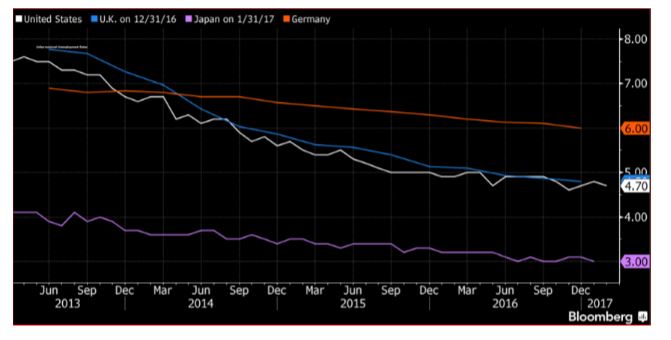
The February jobs report gives us another snapshot of how the income for American worker is undergoing change. Continuing a recent trend, average hourly earnings rose a modest 0.2 per cent and weekly hours worked remained unchanged for last month.The modest increase in wage income, at a time when the country is very close to or at full employment, is a major cause for concern (see Figure 1). If an accommodating monetary policy that generates full employment will not boost wages, then what will?
This sense of wage frustration is widely shared in the advanced economies. In the United Kingdom wage growth has slowed at a time when a devaluing pound is reducing real wage income. The ECB President Mario Draghi calls wage growth ''the linchpin of a self-sustained increase in inflation'' and he is totally focussed on that variable in setting monetary policy. Japan, while experiencing the lowest unemployment rate of any advanced nation (3 per cent), has experienced no wage pressures for many years.As a recent Bloomberg article put it, ''it is a good time to find a job in these countries, but do not expect a big raise''[1]
Figure 1 Unemployment Rates in U.S., U.K., Japan and Germany
Relative Income Shares
Any student studying relative income shares during the latter part of the 20th century has accepted as gospel that the share of national output accruing to workers as compensation was relatively constant. The idea had become so engrained that it was accepted wisdom in the economic profession. However, its decline during the early years in the 21st century has drawn a lot of attention for both economic and political reasons. Something fundamentally has changed for the American worker, not necessarily for the better.
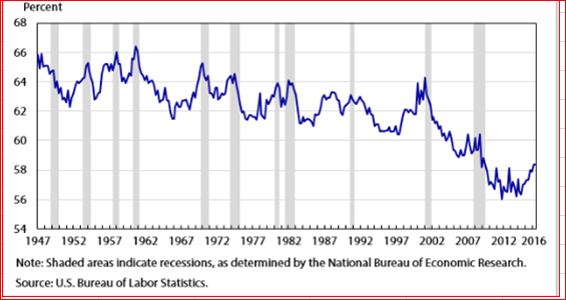
A recent study by the U.S. Bureau of Statistics (BLS) examines this question in considerable detail.[2] The study documents 1)labor share of national income and 2) labor share vis a vis profits within different industries. Figure 2 shows that the labor share had a steady decline from a ratio of 65 per cent in 2002 to 58 per cent in 2016. Not only was the decline dramatic, but it was particularly swift in the past decade.
Figure 2 Labor Share of Output
The BLS accounts for this decline by citing :
“the considerable changes to the U.S. and world economy over the early 20th century—including phenomenal changes in the techniques of production, in the accumulation of capital relative to labor and in real income per head.”
The study notes that investment, especially in computerized goods, has played a large part in the observed decline in labor share.And, the use of robots will only accentuate this decline in the future. This evidence contradicts those who claim that shift towards more offshore production is behind the loss of labor share. In truth, the loss has more to do with technological changes than where plants are physically located.
Another interesting finding concerns worker compensation and labor productivity. The study revealed that over the last 15 years, labor productivity has increased faster than hourly compensation (discounted for inflation). This is another way in which to view the decline in labor share of national income. Workers have been restrained in income growth and have ceded some of the rewards from greater productivity to their employers, allowing the corporations to keep a lid on price increases while still maintaining healthy profits.
In addition, there is considerable variation in the labor share across different industries ( Figure 3).
Figure 3 Labor Share of Non-Farm Income by Industry Sector
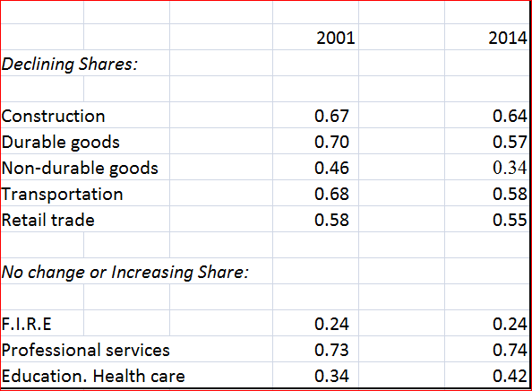
The labor share in major industries like durable and non- durable goods has contributed to the overall decline in national income shares. Labor has picked up gains in the professional, education and health care sectors. This seems consistent with the overall shift away from producing goods in favor of delivering services that has taken place over several decades. Yet, the shift seems more pronounced in the past decade and half.
The weakness in wage growth everywhere is not lost on central bankers. As long as wage growth is moderate, we can expect low inflation at a time when employment growth is relatively healthy. The more vexing question concerns how to spur wage growth and help workers regain some of their loss-share of national income.
Sources:
[1] It's a Good Time to Find a Job in These Countries, But Don't Expect a Big Raise



Comments
Log in or sign up to join the conversation.