

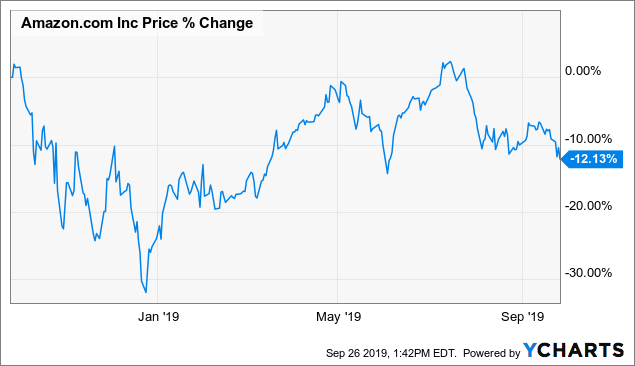
Amazon (AMZN) is a widely discussed stock, with both the Amazon bulls and bears usually taking sanguine positions. Besides, the company is at the center of political discussions recently. Add some general market weakness to the mix, and the stock has produced negative returns of -12% in the past year.
(Click on image to enlarge)
Data by YCharts
Many investors seem to be missing the forest for the trees when it comes to Amazon, putting too much attention to the short-term uncertainty drivers and missing the long-term opportunity in the stock.
Solid Fundamentals
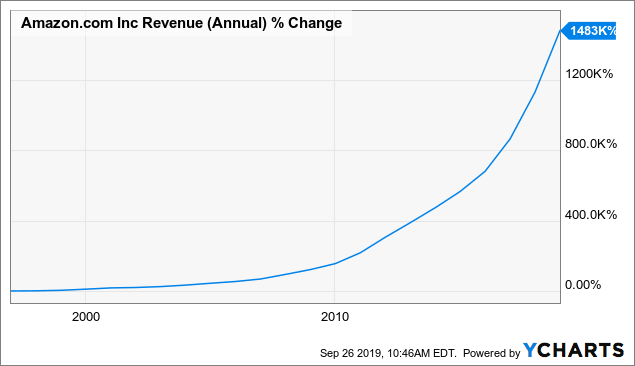
It's hard to argue against the fact that Amazon has been one of the most successful companies in the consumer space over the past decades. Revenue growth has been nothing short of spectacular.
(Click on image to enlarge)
Data by YCharts
Growth tends to naturally slow down as a company gains size over the years, but Amazon keeps firing on all cylinders as of the most recent earnings report. Total revenue increased 20% in US dollars and 21% in constant currencies, while Amazon Web Services (AWS) delivered a growth rate of 37% in revenue.
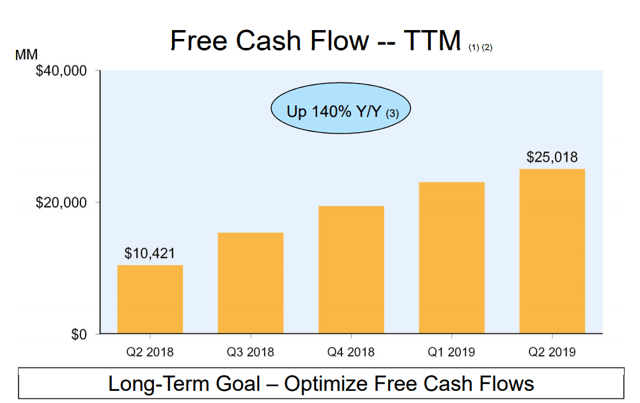
Amazon is all about competitive prices and low-profit margins, and the company reinvests aggressively for growth. This makes profit margins small and hard to predict. Nevertheless, free cash flows are consistently moving in the right direction.
(Click on image to enlarge)
Source: Amazon
Long-Term Growth Potential
The big question when it comes to investors in a high growth business such as Amazon is what kind of performance the company can sustain going forward. This depends on two main variables: Competitive strengths, meaning the factors that allow the company to keep the competition at bay and protect its business, and how much room for growth the company's different markets are offering.
Brand value is a key source of competitive differentiation for Amazon. According to Brand Finance, Amazon is the most valuable brand in the world, with an estimated brand value of $187.9 billion.
Vertical integration provides an additional layer of strength to Amazon's armor, and the company's gargantuan logistics network would be prohibitively expensive to replicate by the competition. Besides, the company leverages its massive size to obtain economies of scale and competitive pricing in cloud computing infrastructure.
The network effect is also at play. Buyers and sellers attract each other the largest platforms in online commerce, creating a virtuous cycle of sustained growth and increased competitive strength over time.
In a nutshell, Amazon has gained a lot of ground in different businesses over the years due to the company's massive competitive advantages sustained by brand value, scale advantages, and the network effect.
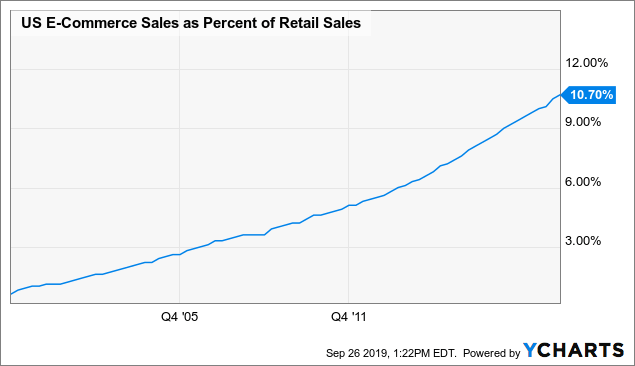
Online retail is rapidly gaining share as a percentage of retail sales, but online still represents a modest 10.7% of all retail transactions. In international markets, this trend is even much younger than in the U.S.
In all probability, online retail will keep gaining share versus brick-and-mortar over the years ahead, and Amazon comes second to none in its ability to profit from such a massive secular trend.
(Click on image to enlarge)
Data by YCharts
To put some numbers in perspective, Amazon is expected to make $279 billion in revenue this year, while Walmart (NYSE: WMT) is expected to make $525.9 billion in revenue. Amazon still has substantial room for expansion in the retail business, and that does not even consider the company's potential in cloud computing, digital content, online advertising, and hardware.
Priced For Growth, But Not Overvalued
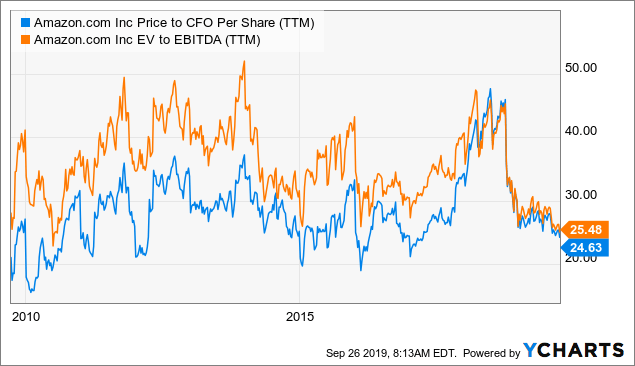
Amazon reinvests most of its profits and cash flows for further growth, so traditional valuation metrics such as price to earnings don't really work very well in this case. Looking at indicators such as price to operating cash flow and enterprise value to EBITDA, Amazon stock is trading at ratios around 25.
This is not cheap at all but not excessive either for such a powerful growth business. These valuation metrics are in line with historical standards for Amazon over the past decade, and both ratios are even approaching the low end of the historical valuation range.
(Click on image to enlarge)
Data by YCharts
It is important to keep in mind that valuation is always a dynamic as opposed to a static concept. The current stock price is reflecting a particular set of expectations about the company in the future. When the company outperforms those expectations, this has a positive impact on the stock price since the price needs to increase in order for the valuation to remain constant.
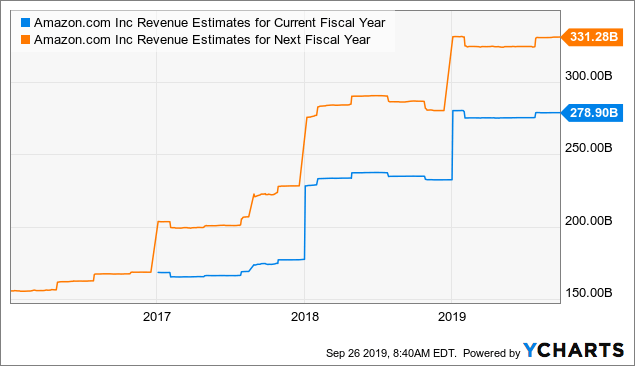
One of the main reasons why Amazon stock has performed so well in the long term is that the company has managed to sustain rapid growth rates for longer than expected, and revenue expectations have consistently increased over time. The chart below shows how revenue estimates for Amazon in both the current year and the next fiscal year have significantly increased over the past several years.
(Click on image to enlarge)
Data by YCharts
The fact that Amazon has exceeded growth expectations in the past does not guarantee that the company will keep doing so in the future too. However, there are fundamental reasons why Amazon has grown at a rapid speed over the years: brand recognition, scale, technological prowess, and innovative drive are key growth drivers for the business, and those drivers remain well in place as of the time of this writing.
Valuation needs to be analyzed in the context of other return drivers. A company producing strong growth and consistently delivering earnings above expectations deserve a higher valuation than a business producing mediocre financial performance and underperforming expectations.
But sometimes, it can be challenging to incorporate the multiple factors into the analysis in order to see the complete picture from a quantitative perspective. The PowerFactors system is a quantitative system that ranks companies in a particular universe according to a combination of factors, such as financial quality, valuation, fundamental momentum, and relative strength.
Here is a quick explanation of the factors considered in the algorithm:
- Financial quality includes profitability metrics such as revenue growth, return on investment, and free cash flow margin.
- Valuation covers typical valuation ratios such as price to earnings, price to earnings growth, and price to free cash flow.
- Fundamental Momentum: This factor looks for companies that are performing better than expected and producing rising expectations, so it measures the change in earnings and sales forecasts.
- Relative Strength: Winners tend to keep on winning. When a stock is outperforming the market, it tends to continue doing so more often than not. For this reason, the PowerFactors system looks for stocks delivering above-average returns over different time frames.
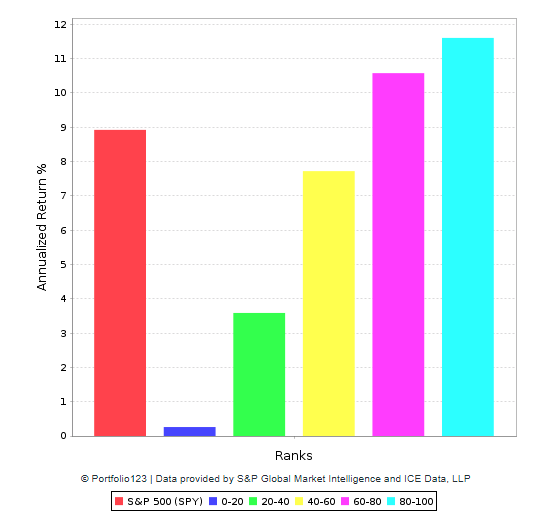
The backtested performance numbers show that companies with high PowerFactors rankings tend to deliver superior returns in the long term. The higher the PowerFactors ranking, the higher the expected returns, indicating that the system is consistent and robust.
(Click on image to enlarge)
Data from S&P Global via Portfolio123
Amazon has a PowerFactors ranking of 87 as of the time of this writing, meaning that the stock is well into the top quintile of companies in the US stock market based on this algorithm. From that perspective, the stock is not overvalued at all when valuation is assessed in the context of other return drivers.
Risk And Reward Going Forward
Amazon is truly a growth company, meaning that management is willing to make big investments and take considerable risks in order to capitalize on long-term growth opportunities. There is no guarantee that the company will succeed in any of these ventures, and Amazon has, in fact, launched several failed products in the past.
The way I see it, this innovative drive is a key source of strength for the business. In the words of Jeff Bezos:
"You need to be making big, noticeable failures...The great thing is that, when you take this approach, a small number of winners pay for dozens, hundreds of failures, and so every single important thing we've done has taken a lot of risk, risk-taking, perseverance, guts, and some have worked out. Most of them have not. That has to happen at every scale level all the way down."
This risk-taking philosophy is what makes Amazon so unique, and one of the main reasons why the company has been able to grow at such an impressive speed over the long term. However, it is also a risk factor, and it makes financial performance harder to predict and profit margins more volatile.
International expansion is also a huge opportunity for Amazon over the years ahead, but international growth is both expensive and risky.
The biggest risk currently affecting Amazon stock is the growing public discussion about breaking out large technology companies. Chances are that this won't happen any time soon, and it's important to acknowledge that Amazon could even be worth more for shareholders if the company spins-off its Amazon Web Services business.
According to research data from Cowen, AWS revenues could reach $36.1 billion this year, growing by 31% annually and reaching $140 billion in 2024. Under these assumptions, AWS alone would be worth $506 billion. Offering a similar perspective, the analysts at Morningstar calculate that AWS is worth $550 billion as a standalone business.
Amazon as a whole has a market capitalization value of $874 billion, if AWS alone is worth $500 to $550 billion, investors are currently paying $324-374 billion for the rest of the business.
This includes Amazon's retail segment (first-party product and service sales, as well as Prime membership and other subscription fees, and third-party sales). Adding the advertising business and the physical stores into the mix, this valuation looks too cheap.
In a nutshell, it seems highly unlikely that Amazon will be split into different companies any time soon. Even if this does happen eventually, investors could actually benefit from it financially. In fact, I would not be surprised at all to see Amazon spinning off AWS by its own decision to fully realize the market value of such a business in the future.
An old saying in the market is that "bull markets climb a wall of worry." The time to buy Amazon is when investors have plenty of doubts about the company, and regulatory risk could be creating this proverbial wall of worry right now.
You don't generally get an opportunity to buy a high-quality business for an attractive valuation. When you do, this is generally because there are some uncertainty drivers weighing on the stock price. For investors who can focus on the long term opportunity and tolerate the short-term uncertainty, this could be creating an attractive opportunity.



Comments
Log in or sign up to join the conversation.