


Short‑term rentals via platforms such as Airbnb (ABNB) reduce available housing supply in Belgium, adding pressure to an already tight housing market – but this is only part of the story
Short-term rentals: a small but meaningful share of housing supply
Online booking platforms have surged in popularity among both travellers and hosts in recent years.
In 2024, around 1.23 million stays were booked via these platforms in Belgium, accounting for 12.3 million overnight stays. In 2025, the 10 million overnight stay threshold had already been surpassed in the first three quarters of the year.
While this strong growth highlights the increasing importance of short-term rentals, it also has implications for the housing market, particularly in high-demand urban and tourist areas. At the same time, structurally higher interest rates and rising house prices have reduced housing affordability. The homeownership rate declined from 72.4% in 2022 to 70.9% in 2025, accompanied by a growing number of renters, further increasing pressure on rental markets.
Against this backdrop, we estimate the impact of short-term rentals via sites like Airbnb in regions where data on entire homes is available, namely the Brussels-Capital Region, Antwerp and Ghent. These areas are characterised by persistently tight housing markets and rank among the most expensive rental markets in Belgium.
Our estimates suggest that Airbnb removes around 3,000 homes from the regular housing supply in Brussels alone, with a further nearly 2,000 homes in Antwerp and Ghent combined. In total, this corresponds to roughly 0.8% of the rental housing stock being unavailable for permanent occupancy due to short-term rentals. This share is likely higher when accounting for other platforms such as Booking.com and Expedia (EXPE).
While this confirms that short-term rentals contribute to housing market pressures, they remain only one part of the story and are not the main driver of housing affordability challenges in Belgium.
Airbnb is estimated to have removed nearly 5,000 homes from the regular housing market
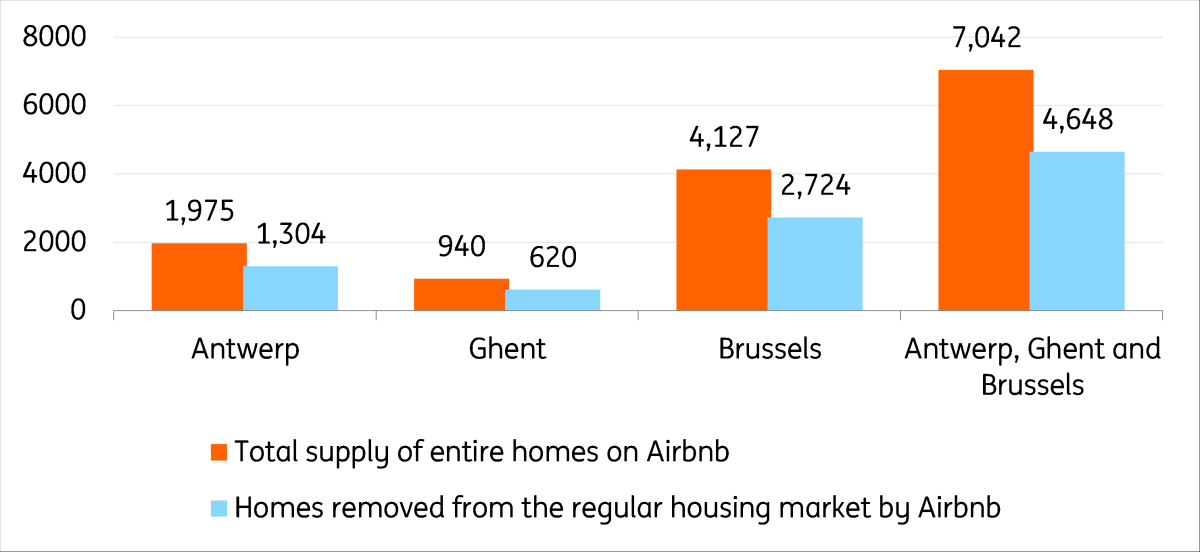
Source: Inside Airbnb, BISA, own calculations ING
Structural bottlenecks lie at the heart of housing affordability challenges
While a legislative framework to regulate short-term rentals has been in place for some time in Belgium, its impact has been limited due to low compliance. The new European regulation that entered into force in May aims to address this by requiring platforms to share data. A key next step is the creation of a national registration system, which could bring an estimated 1,800 out of 4,650 homes back to the regular housing market.
However, this alone will not be sufficient to ease pressures on the Belgian rental market. Structural bottlenecks remain the main constraint:
Low construction activity: Despite a slight uptick in early 2026, building permits remain at historically low levels.
Mismatch between supply and demand: New construction is increasingly misaligned with demand. Apartment permits are declining (‑8% YoY) despite rising demand for smaller units, while permits for single-family homes are increasing (+17% YoY), potentially widening the mismatch.
Rising construction and financing costs: Higher energy prices, more expensive building materials, and elevated long-term interest rates are increasing costs for both developers and buyers, weighing on new construction. At the same time, construction sector bankruptcies rose again in early 2026 (+3.3% YoY), further slowing supply.
Regulatory framework and supply effects: Housing regulation has tightened significantly in recent years. While stricter rules pursue legitimate objectives, they may have unintended consequences. Evidence shows that measures such as rent caps can reduce rental supply, dampen construction, and lower market turnover.
Addressing short-term rentals can therefore help alleviate part of the pressure, but its impact on overall housing affordability will remain limited. Improving affordability requires tackling these structural constraints. This involves, above all, ensuring that housing supply better reflects changing demand, including by encouraging the development of smaller units.
At the same time, a stable investment climate is needed to support construction and renovation, while new regulations on housing quality and energy performance should be designed to avoid further constraining supply.



Comments
Log in or sign up to join the conversation.